eBook - ePub
Biomass, Biofuels, Biochemicals
Recent Advances in Development of Platform Chemicals
- 508 pages
- English
- ePUB (mobile friendly)
- Available on iOS & Android
eBook - ePub
Biomass, Biofuels, Biochemicals
Recent Advances in Development of Platform Chemicals
About this book
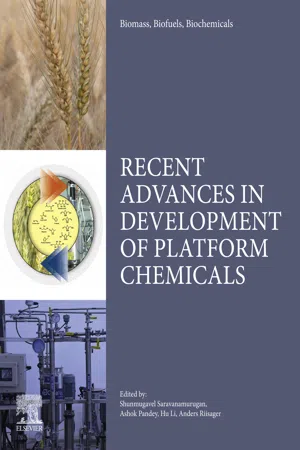
Biomass, Biofuels, Biochemicals: Recent Advances in Development of Platform Chemicals provides a detailed overview on the experimentally developed methods that facilitate platform chemicals derivation from biomass-based substrates with robust catalyst systems. In addition, the book highlights the green chemistry approach towards platform chemical production. Chapters discuss platform chemicals and global market volumes, the optimization of process schemes and reaction parameters with respect to achieving a high yield of targeted platform chemicals, such as sugars and furonic compounds by modifying the respective catalytic system, the influence of solvents on reaction selectivity and product distribution, and the long-term stability of employed catalysts.
Overall, the objectives of the book are to provide the reader with an understanding of the societal importance of platform chemicals, an assessment of the techno-economic viability of biomass valorization processes, catalyst design for a specific reaction, and the design of a catalytic system.
- Covers recent developments on platform chemicals
- Provides comprehensive technological developments on specific platform chemicals
- Covers organic transformations, catalytic synthesis, thermal stability, reaction parameters and solvent effect
- Includes case studies on the production of a number of chemicals, such as Levulinic acid, glycerol, phenol derivatives, and more
Trusted by 375,005 students
Access to over 1.5 million titles for a fair monthly price.
Study more efficiently using our study tools.
Information
Chapter 1
Lignocellulose-derived platform molecules
An introduction
Suhas H. Shinde, Amol Hengne, and Chandrashekhar V. Rode Chemical Engineering and Process Development Division, CSIR-National Chemical Laboratory, Pune, India
Abstract
Fossil feedstocks such as crude oil, natural gas, and coal are formed by natural anaerobic decomposition of buried organisms for a period of more than 650 million years. On the other hand, agrobiomass is quick to grow and becomes a renewable source of chemical and fuel production through processing in a biorefinery.
Keywords
Biomass; Biorefinery; Cellulose; Lignocellulose; Petrofinery; Platform molecules
1. Introduction
Fossil feedstocks such as crude oil, natural gas, and coal are formed by natural anaerobic decomposition of buried organisms for a period of more than 650 million years [1]. On the other hand, agrobiomass is quick to grow and becomes a renewable source of chemical and fuel production through processing in a biorefinery (Fig. 1.1).
In the petrochemical industry, organic chemicals such as methanol, olefins (e.g., ethylene, propylene, and butadiene) and aromatics (e.g., benzene, toluene, and xylenes) are produced in large volumes (Fig. 1.2) and they are generally referred to as primary petrochemicals or base chemicals. These base chemicals can be converted into a variety of consumer and industrial products via chemical modifications.


Presently, the global requirement for energy and chemicals relies entirely on fossil resources; however, these are depleting much faster due to their exponential increase in usage in the transportation and industrial sectors. This eventually translates into serious environmental problems. Fossil fuels are continually being formed via natural processes, but they are not considered as renewable resources because their formation takes place over millions of years [2,3]. Around 21.3 billion tons of carbon dioxide (CO2) per year is expelled into the environment by the burning of fossil fuels. It is estimated that only about half of that amount is being absorbed by natural processes [4]. Carbon dioxide is a greenhouse gas that contributes to global warming. The use of nondegradable materials and hazardous, toxic, and polluting chemicals is also on the rise because of developments in industrial processes worldwide. This has surely imposed far-reaching, severe health hazards to human beings and also a threat to the environment. Therefore the primary challenges for scientists and technologists are to look for alternative viable options for fuels, chemicals, and materials. Until now, there has been no single technology that can replace fossil fuels entirely. Therefore attempts are being made to exploit alternate resources to gradually reduce the dependence on fossil resources. Biomass is one of the sustainable alternatives because it is a renewable source of organic carbon and available in high abundance on earth. Biomass comes mainly from dead plants, algae, crops, trees, and marine organisms, and biological waste from households, animals, and food production. Although biomass is available in many forms not all of them are suitable as feedstock for biorefinery. Therefore the biomass being utilized for biorefinery as a feedstock must be cheap, abundantly available, and likely to undergo chemical conversion. Among the several available biomass feedstocks, lignocellulose, chitin, and microalgae are the most accessible for downstream processing.
2. Integrated biorefinery
The term “biorefinery” is primarily defined as complex (fully integrated) systems of sustainable, environmentally and resource-friendly technologies for the comprehensive materials and energy production [5,6]. However, according to the US Department of Energy (DOE), biorefinery is an overall concept of processing plants where biomass feedstock is converted into a wide spectrum of valuable products that are produced from petrochemical refinery [7,8]. The American National Renewable Energy Laboratory (NREL) defines biorefinery as a facility that integrates biomass conversion processes and equipment to produce fuels, power, and chemicals [9]. The biorefinery, which produces a multitude of fuels and chemical products that are analogous to today's petroleum refinery, is shown in Fig. 1.3. Biorefineries have been identified as the most promising route to the creation of a new domestic biobased industry [10,11].
From the start of the biorefinery concept, several technological advances have been made. Biorefineries are known as generation-I, -II, and -III.
- 1. Generation-I biorefinery: This involves the dry milling of edible grains for ethanol production, which ultimately competes seriously with the food chain. It has a fixed processing capability to produce a certain amount of ethanol and because of that, this technology can be used for restricted purposes only [6].
- 2. Generation-II biorefinery: This is a wet-milling technology using grain feedstock, but it has the capability to produce a variety of end products such...
Table of contents
- Cover image
- Title page
- Table of Contents
- Series: Biomass, Biofuels, Biochemicals
- Copyright
- Contributors
- Preface
- Chapter 1. Lignocellulose-derived platform molecules: An introduction
- Chapter 2. Glucose oxidation to carboxylic products with chemocatalysts
- Chapter 3. 5-Hydroxymethylfurfural—a C6 precursor for fuels and chemicals
- Chapter 4. 2,5-Diformylfuran—an oxidation product of 5-hydroxymethylfurfural
- Chapter 5. Advances in the synthesis and application of 2,5-furandicarboxylic acid
- Chapter 6. Levulinic acid—a potential keto acid for producing biofuels and chemicals
- Chapter 7. γ-Valerolactone—an excellent solvent and a promising building block
- Chapter 8. Lactic acid/lactates production from biomass over chemocatalytic strategies
- Chapter 9. Sustainable production of sorbitol—a potential hexitol
- Chapter 10. Furfural as a platform chemical: From production to applications
- Chapter 11. Furfural as a renewable chemical platform for furfuryl alcohol production
- Chapter 12. Furfuryl alcohol—a promising platform chemical
- Chapter 13. 5-Ethoxymethylfurfural—a remarkable biofuel candidate
- Chapter 14. Chemocatalytic pathways for high-efficiency production of 2,5-dimethylfuran from biomass-derived 5-hydroxymethylfurfural
- Chapter 15. Catalytic upgrading of glycerol, a promising biodiesel coproduct
- Chapter 16. Sustainable production of biodiesel over heterogeneous acid catalysts
- Chapter 17. Cellulose valorization to potential platform chemicals
- Chapter 18. Phenol derivatives of lignin monomers for aromatic compounds and cycloalkane fuels
- Index
Frequently asked questions
Yes, you can cancel anytime from the Subscription tab in your account settings on the Perlego website. Your subscription will stay active until the end of your current billing period. Learn how to cancel your subscription
No, books cannot be downloaded as external files, such as PDFs, for use outside of Perlego. However, you can download books within the Perlego app for offline reading on mobile or tablet. Learn how to download books offline
Perlego offers two plans: Essential and Complete
- Essential is ideal for learners and professionals who enjoy exploring a wide range of subjects. Access the Essential Library with 800,000+ trusted titles and best-sellers across business, personal growth, and the humanities. Includes unlimited reading time and Standard Read Aloud voice.
- Complete: Perfect for advanced learners and researchers needing full, unrestricted access. Unlock 1.5M+ books across hundreds of subjects, including academic and specialized titles. The Complete Plan also includes advanced features like Premium Read Aloud and Research Assistant.
We are an online textbook subscription service, where you can get access to an entire online library for less than the price of a single book per month. With over 1.5 million books across 990+ topics, we’ve got you covered! Learn about our mission
Look out for the read-aloud symbol on your next book to see if you can listen to it. The read-aloud tool reads text aloud for you, highlighting the text as it is being read. You can pause it, speed it up and slow it down. Learn more about Read Aloud
Yes! You can use the Perlego app on both iOS and Android devices to read anytime, anywhere — even offline. Perfect for commutes or when you’re on the go.
Please note we cannot support devices running on iOS 13 and Android 7 or earlier. Learn more about using the app
Please note we cannot support devices running on iOS 13 and Android 7 or earlier. Learn more about using the app
Yes, you can access Biomass, Biofuels, Biochemicals by S. Saravanamurugan,Hu Li,Anders Riisager,Ashok Pandey in PDF and/or ePUB format, as well as other popular books in Technology & Engineering & Chemical & Biochemical Engineering. We have over 1.5 million books available in our catalogue for you to explore.