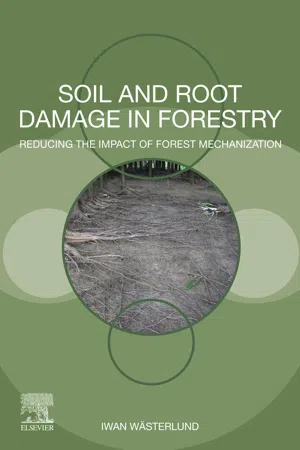
eBook - ePub
Soil and Root Damage in Forestry
Reducing the Impact of Forest Mechanization
- 200 pages
- English
- ePUB (mobile friendly)
- Available on iOS & Android
eBook - ePub
About this book
Agroforestry has significantly impacted our forests, but an often-overlooked issue is the effect of harvesting on soils and root systems. Soil and Root Damage in Forestry explains how soil and roots might be damaged through logging activities or silvicultural activities, how resulting root diseases impact the root and soil systems, and the impacts of chemical applications on the soil and root system. This book goes beyond the 'why' to also provide methods to reduce the impacts of machines on soils and offers solutions to minimize the impacts of machines on soils. Soil and Root Damage in Forestry serves as a valuable resource not only for those already working in soil science and forest ecology, but also provides insights for advanced students seeking an entrance to the "hidden half" of the planet.
- Combines damages to soil and roots in one volume for the first time
- Includes calculations related to soil strength providing soil scientists and ecologists with methods to estimate root damage
- Provides suggestions on how to reduce the impact of harvesting on soil and root systems
Trusted by 375,005 students
Access to over 1.5 million titles for a fair monthly price.
Study more efficiently using our study tools.
Information
Topic
Ciencias biológicasSubtopic
EcologíaChapter 1: Forest responses to soil disturbance due to machine traffic
Abstract
The review concerns the measured growth effects due to soil disturbance, and soil compaction at clearfelling operations, mechanized commercial thinning, and precommercial thinning (cleaning). The impact on growth depends very much on rate of recovery in the soil, the logging methods and machinery used, and the soil moisture at operation. In general, the measured growth reductions from poor operations justify improvements in ground-based logging methods, machinery, planning, and education though not skyline operations if this is not justified by the terrain characteristics.
Kewwords
Edge tree growth; Persistence; Schedule to judge damage; Spacing; Thinning operations; Tree growth; Wounding
Introduction
In the ISTVS glossary (Anon, 1968), the terrain trafficability is defined as “the ability of terrain to support the passage of vehicles.” The idea behind that definition is that a vehicle should be able to pass the terrain with only an acceptable degree of soil disturbance. A such statement will immediately raise the question: What is an acceptable degree of soil disturbance? To say that there should be no disturbance at all is to overdo it. In that case the one who is proposing this must realize that no man or animal should be allowed to walk on the ground (cf. Fig. 1.1)!
From another point of view, we could try to interpret acceptable disturbance as the forest should have a sustainable growth. Sustainability is a very fashionable word, and it is defined by the Brundtland commission as a development that “meets the needs of the present without compromising the ability of future generations to meet their own needs” (WCED, 1987). The question is what does it mean? If the regeneration in terms of species mix, soil conditions, and so on matches the harvested forest area, it is, theoretically, sustainable utilization (Freezailah, 1994). Should the forest look like and grow like it was doing yesterday or 500 years ago? How should we regard a natural development of a forest with time, is that acceptable? Now, with all these questions in mind, we realize that we are back on the starting point. The only useable definition on an acceptable degree of soil disturbance so far is if the site productivity (growth of the stand) is equal after the soil disturbance from machine traffic as it was before. If this definition can be agreed upon, then we have a measure of the soil disturbance that can be relatively easily measured and defined, as well as quantified in terms of volume and money. The presentation below takes that approach as a basis and if the reader comes up with better frames to judge from, the reader is welcome to present it. However, as discussed in the section below, there are many other aspects of soil disturbance but they are at the present state of knowledge quite difficult to quantify and may therefore not be a proper justification of measures to minimize soil disturbance at forest operations.

After Adams, P.W., Froehlich, H.A., 1981. Compaction of Forest Soils. Oregon State University, Extension Service, PNW-217.
Clearfelling operations
Trafficated area
At clearfellings of forest areas with the tree-length method, the skid trails are reported to take up 15%–35% of the site area but the total area influenced may run as high as 80% (Lull, 1959; Froehlich, 1978; Martin, 1988; Reisinger et al., 1988; Davis, 1992). More than half of the skid trail area (50%–75%) has been classified as disturbed and compacted. By using designated skid trails and increased spacings to 125 ft (37 m), the disturbed area could be limited from 15%–20% to 8% according to Stewart et al. (1988). In that case, a grapple skidder cannot be used. In a controlled logging operation in Malaysia, trails after skidders covered 24% of the area, whereas trails after manual extraction covered only 4% (Malmer and Grip, 1990). One interesting thing is that very few seem to bother about the feller-bunchers or harvesters. However, in a study by Lee et al. (1990), it was found that a frame-mounted feller-buncher caused more soil disturbance and compaction than a boom-mounted because the first machine type has to travel to each tree. Martin (1988) recommends the use of forwarders rather than dragging the whole tree to reduce exposure of mineral soil. He also recommends delimbing of conifers on the site and placing the slash in the trails to reduce compaction.
In Europe, the traffic during clearfelling appears to be a forgotten topic. Roughly estimated, about 30% of the area is used for forwarding or skidding of the timber. With use of a feller-buncher or a harvester the influenced area could be much higher especially if the machines are traveling different routes.
Generally, the clearfelling is followed by some kind of site preparation before planting which may further increase the traffic on the site. The site preparation for the next tree generation could imply slash removal, soil scarification, etc. A heavy work well suited for mechanization which means machines traveling back and forth over the area. Slash piling is often included in the total effects of the logging operation, but Davis (1992) argues that alternatives to tractor slash piling should be considered to reduce the trafficated area. Gent and Morris (1986) concluded that windrowing and chopping of slash added only little added effect to the total soil bulk density partly because of all traffic before that treatment. The organic matter content after slashing may be in the same (low) level as in the skid trails (Snider and Miller, 1985).
However, if the soil preparation is done with, for example, a power...
Table of contents
- Cover image
- Title page
- Table of Contents
- Copyright
- Dedication
- Preface
- Chapter 1. Forest responses to soil disturbance due to machine traffic
- Chapter 2. Impacts of soil disturbance on forest and forest soils
- Chapter 3. Impeded root growth in compacted till soils
- Chapter 4. Soil and root strength
- Chapter 5. Rutting on peaty soil
- Chapter 6. Soil mechanics for forestry ground and measurements
- Chapter 7. Alpine routes reinforced with geonet for ATV
- Chapter 8. Logging residues as soil–root protection
- Index
Frequently asked questions
Yes, you can cancel anytime from the Subscription tab in your account settings on the Perlego website. Your subscription will stay active until the end of your current billing period. Learn how to cancel your subscription
No, books cannot be downloaded as external files, such as PDFs, for use outside of Perlego. However, you can download books within the Perlego app for offline reading on mobile or tablet. Learn how to download books offline
Perlego offers two plans: Essential and Complete
- Essential is ideal for learners and professionals who enjoy exploring a wide range of subjects. Access the Essential Library with 800,000+ trusted titles and best-sellers across business, personal growth, and the humanities. Includes unlimited reading time and Standard Read Aloud voice.
- Complete: Perfect for advanced learners and researchers needing full, unrestricted access. Unlock 1.5M+ books across hundreds of subjects, including academic and specialized titles. The Complete Plan also includes advanced features like Premium Read Aloud and Research Assistant.
We are an online textbook subscription service, where you can get access to an entire online library for less than the price of a single book per month. With over 1.5 million books across 990+ topics, we’ve got you covered! Learn about our mission
Look out for the read-aloud symbol on your next book to see if you can listen to it. The read-aloud tool reads text aloud for you, highlighting the text as it is being read. You can pause it, speed it up and slow it down. Learn more about Read Aloud
Yes! You can use the Perlego app on both iOS and Android devices to read anytime, anywhere — even offline. Perfect for commutes or when you’re on the go.
Please note we cannot support devices running on iOS 13 and Android 7 or earlier. Learn more about using the app
Please note we cannot support devices running on iOS 13 and Android 7 or earlier. Learn more about using the app
Yes, you can access Soil and Root Damage in Forestry by Iwan Wasterlund in PDF and/or ePUB format, as well as other popular books in Ciencias biológicas & Ecología. We have over 1.5 million books available in our catalogue for you to explore.