- 306 pages
- English
- ePUB (mobile friendly)
- Available on iOS & Android
eBook - ePub
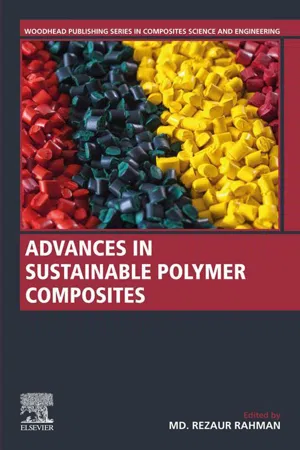
Advances in Sustainable Polymer Composites
About this book
Advances in Sustainable Polymer Composites reviews recent scientific findings on the production and use of sustainable polymers and composites as innovative new materials. The book discusses the importance of sustainable polymers in terms of current practices and how to address environmental and economic issues. Attention is focused on the physical, chemical and electrical properties of these composites. The book also looks at the lifecycle of both single and hybrid polymers and nanocomposites, with chapters covering the latest research findings on sustainable polymer composites with various filler loadings and their improvement on compatibility.
From the viewpoint of polymer composites, this book covers not only well-known sustainable future trends in sustainable polymers and composites, but also advanced materials produced from micro, nano and pico-scale fillers that achieve better physical and mechanical results.
- Features advanced materials produced from micro, nano and pico-scale fillers
- Emphasizes the modeling and prediction of thermal, rheological and mechanical behavior
- Covers various types of fillers and different reinforcement agents
- Focuses on all aspects of fabrication, characterization and applications
- Addresses sustainability approaches and solutions
Trusted by 375,005 students
Access to over 1.5 million titles for a fair monthly price.
Study more efficiently using our study tools.
Information
1
Importance of sustainable polymers for modern society and development
Md. Rezaur Rahman, Nur-Azzah Afifah Binti Taib, Muhammad Khusairy Bin Bakri and Siti Noor Linda Taib, Faculty of Engineering, Universiti Malaysia Sarawak, Jalan Datuk Mohammad Musa, Kota Samarahan, Malaysia
Abstract
Polymers are one of the most important and enormously used materials in the modern society. Scientists and researchers keep on improving this material via their studies and research, in order to come up with sustainable properties with the finest products. In this study the significance of sustainable polymers for modern society and development had been expanded. In addition, the current applications of synthetic and biodegradable polymers and its positive and negative impacts on the environment are also stated. The polymeric materials waste management and the sustainability of biodegradable polymers are specified.
Keywords
Sustainable; synthetic; biodegradable; waste management
1.1 Introduction
1.1.1 Polymer
Polymers are an essential material that is widely used in a lot of daily life’s products and good, and it is unimaginable to live without it. Polymers were formed when many small molecules named monomers were linked together to form long chains. People have been using polymers for many years in their lives, but they did not know it well until the Second World War. This is due to relatively few materials that were available for people for a civilized life. Materials such as steel, glass, wood, and brick were used for construction, while agricultural products such as cotton and jute were used for clothing or fabric manufacture. The introduction of this new material, that is, polymers, was due to the rapid increase in demand for manufactured products. It is safe to say that polymer-based products are all around us, from the synthetic fibers that make our clothes to Teflon-coated cookware. The lists are nearly endless (Namazi, 2017).
Derived from classical Greek words “poly” (means “many”) and “meres” (means “parts”) makes up the word “polymer” or sometimes “macromolecule,” and this modern view of polymers was introduced in the 1920s by the German chemist, Hermann Staudinger (Namazi, 2017; Rasmussen, 2018). Typically, the molecular weight of the polymer molecule is high, which is between 10,000 and 1,000,000 g/mol and consisted of several structural units that are bound together by covalent bonds. Next, via chemical reaction of monomers, the polymers would be obtained. This is because in suitable condition, the formation of polymer chain can be obtained as the monomers can react with another molecule, either from the same or different type. The formation of natural polymers occurred when this reaction process happened naturally, while the synthetic polymers are when it was man-made (Namazi, 2017). At an early date, natural polymers were chemically modified in an empirical manner. It was then followed by the production of completely synthetic substances that we now understand to be polymers in the 19th century. The polymers produced include polyaniline (PANI), polystyrene, poly(vinyl chloride), cuprene, polyisobutylene, and polyisoprene (Rasmussen, 2018). Both types of polymers are extensively used in many applications such as medication, transportation, clothing, and communication. Undoubtedly, human society without synthetic and natural polymers is difficult to imagine. Now, rapid development had been seen in the polymer industry, and as for now, it is larger than copper, steel, aluminum, and some other combined industries (Namazi, 2017).
1.1.2 Biopolymer
In the 1850s, cellulose-based plastics were created by a British chemist, which indicates that this matter is not a newly found alternative to conventional plastics (Reddy et al., 2013). However, only in the 1980s, ICI (Great Britain) had introduced the first bio-based products to the markets, which is polyhydroxyalkanoates (PHAs) (Storz and Vorlop, 2013). According to Pan et al. (2016), properties of biodegradable plastics are similar to the conventional one, except that the biodegradable plastics decompose naturally due to the activities of microorganisms, producing carbon dioxide (CO2) and water (H2O) as byproducts. In addition to CO2 and H2O the degradation gives rise to natural substances such as methane, biomass, and humic matter, which are readily eliminated with no harmful effect on the environment (Azios, 2007; Gill, 2014). The rate of the degradation process is determined by the natural environments of the products, which contains chemical, biological, and physical forces. Moreover, factors such as temperature, presence of oxygen, humidity, and pH are also involved in the degradation process (Zee, 2005; Jamshidian et al., 2010).
Not all bioplastics are biodegradable, as biodegradation properties are linked to the biopolymer’s chemical structure and the constitution of the final product, not the resources of the polymer based. Thus this means that 100% of fossil-based plastic may be considered biodegradable, and 100% of bio-based plastic may be nonbiodegradable (Gilbert et al., 2015; Nampoothiri et al., 2010). Fig. 1.1 shows the material-coordinated system of the bioplastic. There are many sources and materials that are used as the biopolymers or bioplastic’s base, such as cellulose, starch, poly(lactic acid) (PLA), and poly-3-hydroxybutyrate (PHB) (Reddy et al., 2013). Due to the significant progress that had been made in developing these bioplastics, it has been used in a variety of fields ranging from the low-end raw material production such as the agricultural industry to high-end industries involving packaging, textiles, pharmaceutical, and biomedical applications (Widdecke et al., 2008; Gironi and Piemonte, 2011). There are several potential benefits and expansion usage of bio-based materials to be used as energy and environment sector, such as greenhouse gas (GHG) balance and codependency on the use of renewable resources rather than sole dependence with the finite resources (Song et al., 2009).

1.2 Current application of polymers
Polymer chemistry, perhaps more than any other field of research, crosses and cuts across the traditional lines of all branches of chemistry, biology, physics, materials, engineering, pharmacy, and even medicine (Namazi, 2017). Thus the polymeric materials can be applied in many fields or industries such as biomedical or medicine, packaging, automotive, energy generation, and storage.
1.2.1 Biomedicine/medicine
Nowadays, one of the booming areas of usage of polymeric materials is the biomedical or medical field. Polymers in this field are nontoxic, biodegr...
Table of contents
- Cover image
- Title page
- Table of Contents
- Copyright
- List of Contributors
- 1. Importance of sustainable polymers for modern society and development
- 2. Physical and chemical properties of sustainable polymers and their blends
- 3. Sustainable reinforcers for polymer composites
- 4. Sustainable resin systems for polymer composites
- 5. Use of sustainable polymers to make green composites
- 6. Electrical properties in reinforced polymer composites
- 7. Rheological behavior and transport of molten polymers and gas–non-Newtonian fluids
- 8. Applications of sustainable polymer composites in automobile and aerospace industry
- 9. Hybrid sustainable polymer composites
- 10. Nano-reinforcement in sustainable polymer composites
- 11. Life cycle assessment of sustainable composites
- 12. Recycling of sustainable polymers and composites
- Index
Frequently asked questions
Yes, you can cancel anytime from the Subscription tab in your account settings on the Perlego website. Your subscription will stay active until the end of your current billing period. Learn how to cancel your subscription
No, books cannot be downloaded as external files, such as PDFs, for use outside of Perlego. However, you can download books within the Perlego app for offline reading on mobile or tablet. Learn how to download books offline
Perlego offers two plans: Essential and Complete
- Essential is ideal for learners and professionals who enjoy exploring a wide range of subjects. Access the Essential Library with 800,000+ trusted titles and best-sellers across business, personal growth, and the humanities. Includes unlimited reading time and Standard Read Aloud voice.
- Complete: Perfect for advanced learners and researchers needing full, unrestricted access. Unlock 1.5M+ books across hundreds of subjects, including academic and specialized titles. The Complete Plan also includes advanced features like Premium Read Aloud and Research Assistant.
We are an online textbook subscription service, where you can get access to an entire online library for less than the price of a single book per month. With over 1.5 million books across 990+ topics, we’ve got you covered! Learn about our mission
Look out for the read-aloud symbol on your next book to see if you can listen to it. The read-aloud tool reads text aloud for you, highlighting the text as it is being read. You can pause it, speed it up and slow it down. Learn more about Read Aloud
Yes! You can use the Perlego app on both iOS and Android devices to read anytime, anywhere — even offline. Perfect for commutes or when you’re on the go.
Please note we cannot support devices running on iOS 13 and Android 7 or earlier. Learn more about using the app
Please note we cannot support devices running on iOS 13 and Android 7 or earlier. Learn more about using the app
Yes, you can access Advances in Sustainable Polymer Composites by Md Rezaur Rahman in PDF and/or ePUB format, as well as other popular books in Technology & Engineering & Materials Science. We have over 1.5 million books available in our catalogue for you to explore.