eBook - ePub
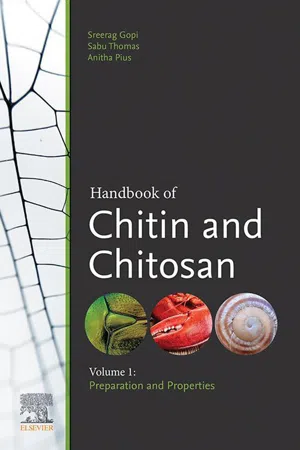
Handbook of Chitin and Chitosan
Volume 1: Preparation and Properties
- 506 pages
- English
- ePUB (mobile friendly)
- Available on iOS & Android
eBook - ePub
Handbook of Chitin and Chitosan
Volume 1: Preparation and Properties
About this book
The Handbook of Chitin and Chitosan: Preparation and Properties, Volume One, is a must-read for polymer chemists, physicists and engineers interested in the development of ecofriendly micro and nanostructured functional materials based on chitin and their various applications. The book addresses the entirety of working with these materials, from their isolation, preparation and properties, through composites, nanomaterials, manufacturing and characterizations. This is the first of three volumes in a series that contains the latest on the major applications of chitin and chitosan based IPN's, blends, gels, composites and nanocomposites, including environmental remediation, biomedical applications and smart material applications.
- Provides a comprehensive overview of Chitin and Chitosan materials, from their synthesis and nanomaterials, to their manufacture and applications
- Volume One focuses on the synthesis and properties of Chitosan and/or Chitin
- Includes contributions from leading researchers across the globe and from industry, academia, government and private research institutions
- Highlights current status and future opportunities
Trusted by 375,005 students
Access to over 1.5 million titles for a fair monthly price.
Study more efficiently using our study tools.
Information
Topic
Physical SciencesSubtopic
Organic ChemistryChapter 1
Chitin and chitosan: origin, properties, and applications
Suneeta Kumari1 and Rupak Kishor2, 1Department of Chemical Engineering, B.I.T. Sindri, Dhanbad, India, 2Department of Chemical Engineering, MANIT, Bhopal, India
Abstract
Today, chitosan has numerous applications in different fields, such as in the food, cosmetics, biomedical, and pharmaceutical industries. There are numerous natural sources of chitosan. Chitosan can be obtained from the shells of crustaceans, such as lobsters, crabs, and shrimps, as well as from fish scales and many other types of organisms (insects and fungi). It is a biodegradable substance. The prevailing approaches for extraction of chitosan from distinctive sources are the traditional, lactic fermentation bioprocess, various other fermentation processes, and enzymatic hydrolysis of crustacean biowaste. In this chapter, chitosan synthesized from individual sources such as fish scale, shrimp shells, and crab shells by traditional methods is compared with the help of structural analysis and physicochemical properties.
Keywords
Chitin; chitosan; properties; source; application
1.1 Introduction
Chitin and chitosan are naturally abundant and renewable polymers. They have excellent properties such as biodegradability, biocompatibility, and nontoxicity [1]. Chitin is a copolymer of N-acetyl-D-glucosamine and D-glucosamine units linked with β-(1→4) glycosidic bonds, as shown in Fig. 1.1 [2], where N-acetyl-D-glucosamine units are predominant in the polymeric chain [3]. The deacetylated form of chitin refers to chitosan (Fig. 1.1). Chitin and chitosan can be found as supporting materials in many aquatic, terrestrial, and some microorganisms [4], as shown in Fig. 1.1A. Almost as much chitin is estimated to be produced annually as cellulose. It has become of great interest not only as an underutilized resource but also as a new functional biomaterial with high potential in various fields [5].

Chitin is a white, hard, inelastic, nitrogenous polysaccharide found in the exoskeleton and in the internal structure of invertebrates. The production of chitosan from crustacean shells obtained as a food industry waste is economically feasible, especially if it includes the recovery of carotenoids. There are many applications in wastewater treatment, such as the removal of metal ions [6,7] and dyes [8], as a membrane in purification processes [9], in the food industry (anticholesterol and fat binding), as a packaging material, as a preservative and food additive [10], in agriculture (seed and fertilizer coating) [11], for controlled agrochemical release [12], in the pulp and paper industry (surface treatment adhesive paper) [2], in cosmetics (body creams and Inmaculada Aranaz, lotions, etc.), in tissue engineering [13], in wound healing [14], and as excipients for drug delivery [15] and gene delivery [16]. Additionally, It can be easily processed into gels [17], membranes [18], nanofibers [19], beads [10], microparticles, nanoparticles, scaffolds [15], and sponges [20], as shown in Fig. 1.1C.
The main objective of this chapter to give a brief introduction about chitin and chitosan and its synthesis. The physical and chemical properties of chitosan determined by using different analytical techniques are also discussed. Finally, the most recent applications of chitin and chitosan are discussed.
1.2 Chitin and chitosan
Chitin (C8H13O5N)n, is derived from the Greek word “chiton,” meaning a coat of mail. It is a natural polysaccharide of β-(1→4)-N-acetyl-D-glucosamine monomers, first identified by the chemist Henri Braconnot in 1811 [21]. Its structure is similar to cellulose but with 2-acetamido-2-deoxy-β-D-glucose (NAG) monomer units (Fig. 1.1B). Chitin has limited applications because of its acetyl groups, but through the deacetylation process chitin is converted into chitosan. During the deacetylation process, the acetyl group present in chitin is converted into hydroxyl (–OH) and amino (–NH2) groups in the chitosan. The modification of the reactive functional groups present in chitosan opens the possibility of broad application in many fields. Chitosan’s structural modification is possible by chemical methods and most of the new applications focus on the properties and modification of its composites [22].
1.2.1 Sources of chitin
Chitin is usually isolated from the exoskeletons of arthropods’ chitin-based tissue (30%–40% protein, 30%–50% calcium carbonate, and 20%–30% chitin), such as crustaceans, mollusks, insects, and certain fungi [2,23–26]. It is a biological nanocomposite material strictly hierarchically organized which reveals various structural levels. At the molecular level is the polysaccharide chitin itself (Fig. 1.2). The next structural level is the arrangement of c. 18–25 of such molecules in the form of narrow and long crystalline units, which are wrapped by proteins, forming nanofibrils of about 2–5 nm diameter and about 300 nm length. The next step in the scale consists of the clustering of some of these nanofibrils into long chitin–protein fibers of about 50–300 nm diameter (Fig. 1.2).

Chitin is mainly occurs in three different polymeric α-, β-, and γ-forms. The chains are arranged in stacks or sheets in α-chitin and adjacent sheets along the c-axis have the same direction in a parallel arrangement. The α-chitin occurs in the exoskeletons of crustaceans (e.g., crabs, lobsters, and prawns). In the case of β-chitin, the adjacent sheets along the c-axis present in opposite directions in an antiparallel arrangement and it can be found in squid pen, certain diatoms, and vestimentiferans (a class of deep-sea animal) [27]. However every third sheet is in the opposite direction to the preceding sheets in γ-chitin. It mainly exists in fungi and yeast [28].
1.3 Extraction of chitin
Cuticles of various crustaceans like crabs, shrimps, and lobster and fish scales are the major sources of chitin. Crustaceans carry an exoskeleton composed of proteins, chitin, and calcium carbonate which bind together to form an external shell [26]. Protein and...
Table of contents
- Cover image
- Title page
- Table of Contents
- Copyright
- List of Contributors
- Chapter 1. Chitin and chitosan: origin, properties, and applications
- Chapter 2. Chitin and chitosan: chemistry, solubility, fiber formation, and their potential applications
- Chapter 3. PEGylated chitin and chitosan derivatives
- Chapter 4. Solubility, chain characterization, and derivatives of chitin
- Chapter 5. Solubility, degree of acetylation, and distribution of acetyl groups in chitosan
- Chapter 6. Chitin nanomaterials: preparation and surface modifications
- Chapter 7. Importance of electrospun chitosan-based nanoscale materials for seafood products safety
- Chapter 8. Alternative methods for chitin and chitosan preparation, characterization, and application
- Chapter 9. Current research on the blends of chitosan as new biomaterials
- Chapter 10. Chitin and chitosan-based aerogels
- Chapter 11. Chitin, chitosan, marine to market
- Chapter 12. Miscibility, properties, and biodegradability of chitin and chitosan
- Chapter 13. Chitin and chitosan: current status and future opportunities
- Chapter 14. Fungal chitosan: prospects and challenges
- Chapter 15. Preparation, properties, and application of low-molecular-weight chitosan
- Index
Frequently asked questions
Yes, you can cancel anytime from the Subscription tab in your account settings on the Perlego website. Your subscription will stay active until the end of your current billing period. Learn how to cancel your subscription
No, books cannot be downloaded as external files, such as PDFs, for use outside of Perlego. However, you can download books within the Perlego app for offline reading on mobile or tablet. Learn how to download books offline
Perlego offers two plans: Essential and Complete
- Essential is ideal for learners and professionals who enjoy exploring a wide range of subjects. Access the Essential Library with 800,000+ trusted titles and best-sellers across business, personal growth, and the humanities. Includes unlimited reading time and Standard Read Aloud voice.
- Complete: Perfect for advanced learners and researchers needing full, unrestricted access. Unlock 1.5M+ books across hundreds of subjects, including academic and specialized titles. The Complete Plan also includes advanced features like Premium Read Aloud and Research Assistant.
We are an online textbook subscription service, where you can get access to an entire online library for less than the price of a single book per month. With over 1.5 million books across 990+ topics, we’ve got you covered! Learn about our mission
Look out for the read-aloud symbol on your next book to see if you can listen to it. The read-aloud tool reads text aloud for you, highlighting the text as it is being read. You can pause it, speed it up and slow it down. Learn more about Read Aloud
Yes! You can use the Perlego app on both iOS and Android devices to read anytime, anywhere — even offline. Perfect for commutes or when you’re on the go.
Please note we cannot support devices running on iOS 13 and Android 7 or earlier. Learn more about using the app
Please note we cannot support devices running on iOS 13 and Android 7 or earlier. Learn more about using the app
Yes, you can access Handbook of Chitin and Chitosan by Sabu Thomas, Anitha Pius, Sreerag Gopi, Sabu Thomas,Anitha Pius,Sreerag Gopi in PDF and/or ePUB format, as well as other popular books in Physical Sciences & Organic Chemistry. We have over 1.5 million books available in our catalogue for you to explore.