- 508 pages
- English
- ePUB (mobile friendly)
- Available on iOS & Android
eBook - ePub
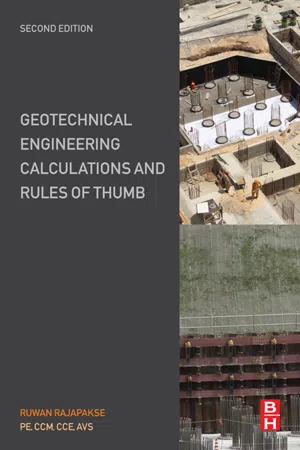
Geotechnical Engineering Calculations and Rules of Thumb
About this book
Geotechnical Engineering Calculations and Rules of Thumb, Second Edition, offers geotechnical, civil and structural engineers a concise, easy-to-understand approach to selecting the right formula and solving even most difficult calculations in geotechnical engineering. A "quick look up guide", this book places formulas and calculations at the reader's finger tips. In this book, theories are explained in a "nutshell" and then the calculation is presented and solved in an illustrated, step-by-step fashion.In its first part, the book covers the fundamentals of Geotechnical Engineering: Soil investigation, condition and theoretical concepts. In the second part it addresses Shallow Foundations, including bearing capacity, elastic settlement, foundation reinforcement, grillage design, footings, geogrids, tie and grade beams, and drainage. This session ends with a chapter on selecting foundation types. The next part covers Earth Retaining Structures and contains chapters on its basic concepts and types, gabion walls and reinforced earth walls. The following part covers Geotechnical Engineering Strategies providing coverage of softwares, instrumentation, excavations, raft design, rock mechanics, dip angle and strike, rock stabilization equipment, soil anchors, tunnel design, seismology, geosynthetics, and slurry cutoff walls. The final part is on Pile Foundations including content on design on sandy soils, clay soils, pin piles, negative skin friction, caissons and pile clusters.In this new and updated edition the author has incorporated new software calculation tools, current techniques for foundation design, liquefaction information, seismic studies, laboratory soil tests, geophysical techniques, new concepts for foundation design and Dam designs. All calculations have been updated to most current material characteristics available in the market.Practicing Geotechnical, Civil and Structural Engineers may find in this book an excellent companion to their day-to day work, benefiting from the clear and direct calculations, examples, and cases. Civil Engineering students may find particular interest in the concise theory presented in the beginning of each chapter.
- Calculations both in FPS and SI metric systems;
- Convenient access to all needed calculations;
- Access to concise theory that helps understand the calculations;
- Case studies from around the world;
- Includes new software calculation tools.
Information
Part 1
Geotechnical Engineering Fundamentals
1: Geology and geotechnical engineering
2: Site investigation
3: Groundwater
4: Soil laboratory testing
5: Geotechnical engineering theoretical concepts
1
Geology and geotechnical engineering
Abstract
Geotechnical engineers are concerned with the strength of soils and rocks. Strength of soils and rocks comes from friction and cohesion between particles. There are three types of rocks: igneous, sedimentary, and metamorphic. Soils can be formed due to water, wind, landslides, and weathering. This chapter gives a general idea of geology, rock and soil properties, and their formation processes.
Keywords
igneous
sedimentary
metamorphic
cohesion
friction
alluvial deposits
colluvial deposits
eolian deposits
marine deposits
1.1. Introduction
Geologists are interested in the classification of soils and rocks and their history. Geotechnical engineers are primarily interested in the strength of soils and rocks. Geotechnical engineers would like to know what is the load that can be placed on a given soil or rock stratum.
1.2. Strength of soils
Let us first look at strength of soils. Strength of soils comes from two parameters: friction and cohesion.
1.2.1. Friction
Friction is a physical process. Friction of soil occurs due to friction between soil particles. Let us look at Figure 1.1. On the left side, there is a pyramid of spheres made of glass. On the right side, there is a pyramid built of oranges.

Figure 1.1 Friction in soil particles.
It is obvious that the pyramid built with oranges would be much more stable than the pyramid built with glass spheres. The friction between two orange surfaces is much higher than the friction between two glass surfaces. The same can be said of soils. When the friction between individual soil particles is high, the load that can be placed on soil will be greater. The issue is how to measure the friction in soil. A number of methods have been developed to measure the friction in soils. We would discuss these methods later in this book.
Figure 1.2 shows a failed building. The building load was too much for the soil. The friction in soil was not enough to accommodate the building load.

Figure 1.2 Bearing failure.
1.2.2. Cohesion
As mentioned earlier, friction is a physical process. In ...
Table of contents
- Cover
- Title page
- Table of Contents
- Copyright
- Part 1: Geotechnical Engineering Fundamentals
- Part 2: Shallow Foundations
- Part 3: Earth Retaining Structures
- Part 4: Geotechnical Engineering Strategies
- Part 5: Pile Foundations
- Subject Index
Trusted by 375,005 students
Access to over 1.5 million titles for a fair monthly price.
Study more efficiently using our study tools.
Frequently asked questions
Yes, you can cancel anytime from the Subscription tab in your account settings on the Perlego website. Your subscription will stay active until the end of your current billing period. Learn how to cancel your subscription
No, books cannot be downloaded as external files, such as PDFs, for use outside of Perlego. However, you can download books within the Perlego app for offline reading on mobile or tablet. Learn how to download books offline
Perlego offers two plans: Essential and Complete
- Essential is ideal for learners and professionals who enjoy exploring a wide range of subjects. Access the Essential Library with 800,000+ trusted titles and best-sellers across business, personal growth, and the humanities. Includes unlimited reading time and Standard Read Aloud voice.
- Complete: Perfect for advanced learners and researchers needing full, unrestricted access. Unlock 1.5M+ books across hundreds of subjects, including academic and specialized titles. The Complete Plan also includes advanced features like Premium Read Aloud and Research Assistant.
We are an online textbook subscription service, where you can get access to an entire online library for less than the price of a single book per month. With over 1.5 million books across 990+ topics, we’ve got you covered! Learn about our mission
Look out for the read-aloud symbol on your next book to see if you can listen to it. The read-aloud tool reads text aloud for you, highlighting the text as it is being read. You can pause it, speed it up and slow it down. Learn more about Read Aloud
Yes! You can use the Perlego app on both iOS and Android devices to read anytime, anywhere — even offline. Perfect for commutes or when you’re on the go.
Please note we cannot support devices running on iOS 13 and Android 7 or earlier. Learn more about using the app
Please note we cannot support devices running on iOS 13 and Android 7 or earlier. Learn more about using the app
Yes, you can access Geotechnical Engineering Calculations and Rules of Thumb by Ruwan Abey Rajapakse in PDF and/or ePUB format, as well as other popular books in Physical Sciences & Applied Mathematics. We have over 1.5 million books available in our catalogue for you to explore.