- 398 pages
- English
- ePUB (mobile friendly)
- Available on iOS & Android
eBook - ePub
About this book
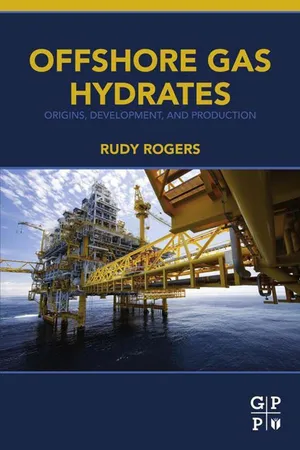
Gas hydrates collect and store both thermogenic and biogenic methane generated in deep ocean sediments that, over geologic time, forms vast methane repositories. Offshore Gas Hydrates: Origins, Development, and Production presents gas hydrates as an emerging, clean energy source possibly more abundant than all other fossil fuels and especially important for countries geographically and economically restricted from conventional fossil fuel resources. The book explores feasible methods to produce offshore hydrate gas, the means to store and transport the remotely produced gas, new hydrate inhibitors for conventional and hydrate production in ultra-deep waters, instability manifestations of seafloor hydrates, and hydrate roles in complex ecological scenarios. Complementing production and drilling method presentations are computer simulation studies, hydrate field tests, and seismic and logging developments. Offshore Gas Hydrates delivers a well-developed framework for both the oil and gas researcher and corporate engineer to better exploit this future unconventional resource, empowering the oil and gas professional with the latest data and information on sophisticated challenges that offshore hydrates present.
- Addresses the technical, economic, and environmental problems of producing hydrate gas.
- Introduces the overlooked and unchartered role of microbes in catalyzing offshore hydrate formations with attendant effects on stability/dissociation.
- Reviews the latest world-wide field tests, research, and case studies involving seafloor hydrates, inclusive of most known hydrate provinces.
- Displays two videos within the e-book only: (1) hydrates, carbonates, chemosynthetic communities, and natural hydrocarbon leakages on the seafloor at the Mississippi Canyon hydrate observatory site; (2)hydrate nucleation, migration and self-packing in a laboratory test cell under the influence of anionic surfactants.
- Extends deep-water hydrate knowledge regarding the hydrate formation and protective cover for microbes within the extreme environment of Mars.
Information
Table of contents
- Cover image
- Title page
- Table of Contents
- Copyright
- Dedication
- Preface
- Acknowledgments
- List of Videos
- Chapter One. Introduction
- Chapter Two. Deep Ocean Sediment–Hydrate Relationships
- Chapter Three. Gulf of Mexico, Thermobiogenic Hydrates
- Chapter Four. Producing Methane from Offshore Hydrates
- Chapter Five. Hydrate Inhibition During Drilling and Production
- Chapter Six. Hydrate-Associated Seafloor Instabilities
- Chapter Seven. Biogenic Hydrate Provinces
- Chapter Eight. Microbe, Mineral Synergy, and Seafloor Hydrate Nucleation
- Chapter Nine. Hydrate Zone Ecology
- Chapter Ten. Martian Hydrate Feasibility: Extending Extreme Seafloor Environments
- Subject index
Trusted by 375,005 students
Access to over 1.5 million titles for a fair monthly price.
Study more efficiently using our study tools.
Frequently asked questions
Yes, you can cancel anytime from the Subscription tab in your account settings on the Perlego website. Your subscription will stay active until the end of your current billing period. Learn how to cancel your subscription
No, books cannot be downloaded as external files, such as PDFs, for use outside of Perlego. However, you can download books within the Perlego app for offline reading on mobile or tablet. Learn how to download books offline
Perlego offers two plans: Essential and Complete
- Essential is ideal for learners and professionals who enjoy exploring a wide range of subjects. Access the Essential Library with 800,000+ trusted titles and best-sellers across business, personal growth, and the humanities. Includes unlimited reading time and Standard Read Aloud voice.
- Complete: Perfect for advanced learners and researchers needing full, unrestricted access. Unlock 1.5M+ books across hundreds of subjects, including academic and specialized titles. The Complete Plan also includes advanced features like Premium Read Aloud and Research Assistant.
We are an online textbook subscription service, where you can get access to an entire online library for less than the price of a single book per month. With over 1.5 million books across 990+ topics, we’ve got you covered! Learn about our mission
Look out for the read-aloud symbol on your next book to see if you can listen to it. The read-aloud tool reads text aloud for you, highlighting the text as it is being read. You can pause it, speed it up and slow it down. Learn more about Read Aloud
Yes! You can use the Perlego app on both iOS and Android devices to read anytime, anywhere — even offline. Perfect for commutes or when you’re on the go.
Please note we cannot support devices running on iOS 13 and Android 7 or earlier. Learn more about using the app
Please note we cannot support devices running on iOS 13 and Android 7 or earlier. Learn more about using the app
Yes, you can access Offshore Gas Hydrates by Rudy Rogers in PDF and/or ePUB format, as well as other popular books in Technology & Engineering & Oceanography. We have over 1.5 million books available in our catalogue for you to explore.