eBook - ePub
Ground-Source Heat Pumps
Fundamentals, Experiments and Applications
- 216 pages
- English
- ePUB (mobile friendly)
- Available on iOS & Android
eBook - ePub
About this book
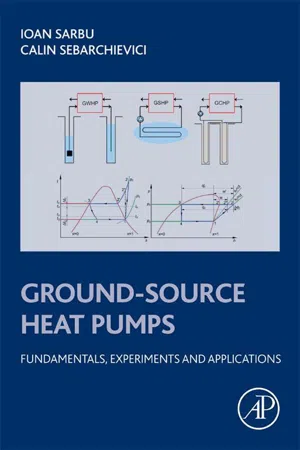
Ground-Source Heat Pumps presents the theory and some of the most recent advances of GSHPs and their implementation in the heating/cooling system of buildings. The authors explore the thermodynamic cycle with calculation, operation regimes and economic indicators and GHG emissions of a vapor compression heat pump. They go on to examine substitution strategies of non-ecological refrigerants and types of compressors and heat pumps, before delving into the different GSHP systems, as well as their compared economic, energy and environmental performances using classical and optimized adjustment for various operating modes. Surface water heat pumps and ground water heat pumps are covered, and special focus is given to both vertical and horizontal ground-coupled heat pump systems, for which modelling and simulation is discussed, and experimental systems are described. Due to its advanced approach to the subject, this book will be especially valuable for researchers, graduate students and academics, and as reference for engineers and specialists in the varied domains of building services.
- Explores fundamentals and state-of-the-art research, including ground-coupled heat pump (GCHP) systems.
- Includes performance assessment and comparison for different types of GSHP, numerical simulation models, practical applications of GSHPs with details on the renewable energy integration, information on refrigerants, and economic analysis.
Information
Chapter 1
Introduction
Abstract
This chapter summarises a description of renewable energy, concentrating on geothermal energy, and presents the operation principle of a heat pump and the necessity for using heat pumps in the heating/cooling systems of buildings.
Keywords
Renewable energy; geothermal energy; building heating/cooling; heat pump; operation principle
1.1 Generalities
Buildings are an important part of European culture and heritage, and they play an important role in the energy policy of Europe. An economic strategy of sustainable development certainly promotes efficiency and rational energy use in buildings, which are the major energy consumer in Romania and the other member states of the European Union (EU). EU energy consumption patterns reveal that buildings are the greatest energy consumer, using approximately 40% of the total energy demand, followed by industry and transportation, which consume approximately 30% each [1]. Buildings offer the greatest and most cost-effective potential for energy savings. Studies have also shown that saving energy is the most cost-effective method for reducing greenhouse gas (GHG) emissions.
Currently, heating is responsible for almost 80% of the energy demand in houses and utility buildings, used for the purpose of space heating and hot-water generation, whereas the energy demand for cooling is growing yearly. Pollution emissions of GHGs, rising energy demand and an increasing dependence on imports are important energy problems for any country to solve.
To realise the ambitious goals for reducing the consumption of fossil fuel as primary energy and the related CO2 emissions, and to reach the targets of the Kyoto Protocol, improved energy efficiency and the use of renewable energy in the existing building stock must be addressed in the near future.
The European strategy to decrease energy dependence rests on two objectives: the diversification of the various sources of supply and policies to control consumption. The key to diversification is renewable energy sources (RES) because they have significant potential to contribute to sustainable development [2].
This chapter summarises a description of renewable energy, concentrating on geothermal energy, and presents the operation principle of a heat pump (HP) and the necessity for using HPs in the heating/cooling systems of buildings.
1.2 Renewable Energy
The term “renewable energy” refers to energy that is produced from natural resources that have the characteristics of inexhaustibility over time and natural renewability.
RES include wind, solar, geothermal, biomass and hydro energies [3]. An efficient utilisation of renewable resources has significant potential to both stimulate the economy and reduce pollution. Thus, many governments have implemented various policies that support renewable energy generation. One of the key components of any renewable energy policy is the setting of renewable energy targets.
Numerous efforts have been undertaken by developed countries to implement different renewable energy technologies, and in particular, the use of wind energy has increased over the last few years [4]. For example, the Netherlands, Germany, India and Malaysia use wind turbines to produce electricity [5]. In northwestern Iran, mineral materials are used for the production of geothermal energy, and in Iceland, 70% of factories use geothermal energy for industrial purposes [6].
Although Romania has a high potential of RES, in 2010, the RES share of the total energy consumption was 23.4%. Romania ranked second place in the EU for the portion of energy from renewable sources out of gross final consumption from 2006 to 2010 [7].
Among the energy alternatives to fossil fuels, RES such as solar and wind are more available.
On 23 April 2009, the European Parliament and the Council adopted the Renewable Energy Directive 2009/28/EC, which establishes a common framework for the promotion of RES. This directive has stated that by the year 2020, the average energy percentage from renewable sources will be approximately 20% of the total energy consumption (Table 1.1). The 2009/28/EC directive opens up a major opportunity for the further use of HPs for heating and cooling of new and existing buildings. HPs enable the use of ambient heat at useful tem...
Table of contents
- Cover image
- Title page
- Table of Contents
- Copyright
- Author Biographies
- Preface
- Chapter 1. Introduction
- Chapter 2. Vapour Compression-Based Heat Pump Systems
- Chapter 3. Substitution Strategy of Non-Ecological Refrigerants
- Chapter 4. Types of Compressors and Heat Pumps
- Chapter 5. Ground-Source Heat Pump Systems
- Chapter 6. Heat Pump Heating and Cooling Systems
- Chapter 7. Experimental Ground-Coupled Heat Pump Systems
- Index
Trusted by 375,005 students
Access to over 1.5 million titles for a fair monthly price.
Study more efficiently using our study tools.
Frequently asked questions
Yes, you can cancel anytime from the Subscription tab in your account settings on the Perlego website. Your subscription will stay active until the end of your current billing period. Learn how to cancel your subscription
No, books cannot be downloaded as external files, such as PDFs, for use outside of Perlego. However, you can download books within the Perlego app for offline reading on mobile or tablet. Learn how to download books offline
Perlego offers two plans: Essential and Complete
- Essential is ideal for learners and professionals who enjoy exploring a wide range of subjects. Access the Essential Library with 800,000+ trusted titles and best-sellers across business, personal growth, and the humanities. Includes unlimited reading time and Standard Read Aloud voice.
- Complete: Perfect for advanced learners and researchers needing full, unrestricted access. Unlock 1.5M+ books across hundreds of subjects, including academic and specialized titles. The Complete Plan also includes advanced features like Premium Read Aloud and Research Assistant.
We are an online textbook subscription service, where you can get access to an entire online library for less than the price of a single book per month. With over 1.5 million books across 990+ topics, we’ve got you covered! Learn about our mission
Look out for the read-aloud symbol on your next book to see if you can listen to it. The read-aloud tool reads text aloud for you, highlighting the text as it is being read. You can pause it, speed it up and slow it down. Learn more about Read Aloud
Yes! You can use the Perlego app on both iOS and Android devices to read anytime, anywhere — even offline. Perfect for commutes or when you’re on the go.
Please note we cannot support devices running on iOS 13 and Android 7 or earlier. Learn more about using the app
Please note we cannot support devices running on iOS 13 and Android 7 or earlier. Learn more about using the app
Yes, you can access Ground-Source Heat Pumps by Ioan Sarbu,Calin Sebarchievici in PDF and/or ePUB format, as well as other popular books in Technology & Engineering & Power Resources. We have over 1.5 million books available in our catalogue for you to explore.