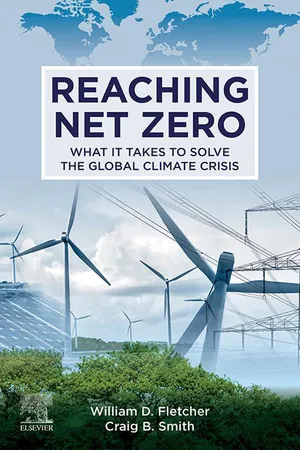
eBook - ePub
Reaching Net Zero
What It Takes to Solve the Global Climate Crisis
- 350 pages
- English
- ePUB (mobile friendly)
- Available on iOS & Android
eBook - ePub
Reaching Net Zero
What It Takes to Solve the Global Climate Crisis
About this book
Reaching Net Zero: What It Takes to Solve the Global Climate Crisis addresses the imminent need to fully understand the causes, effects, and evidence of global warming; due to the large amount of climate disinformation and complexity of much of the available valid science, this book addresses the science of global warming in a concise, readable manner while providing an in-depth reference for readers who want more details or to study the sources of information. This book also investigates potential practical next steps of interest to concerned scientists, engineers, and citizens, with an aim to further discuss and achieve the eventual Intergovernmental Panel on Climate Change (IPCC) 'Net Zero' goals. Solving the problem of reaching net zero requires educating others to support the changes that must occur and to provide the possible solutions required. This is a necessary read for academics in climate and environmental science, and specialists such as those in earth science or environmental studies, covering the science, technology, economics, politics, international, and other issues involved in doing something about global warming. It is also important for those interested in global warming and anyone involved in decision-making processes and legislation that deal with reduction in carbon footprints.
- Provides in-depth discussion of understanding the problem of global warming, with clear explanations of the science behind global warming and climate change
- Features case studies of successes and failures in reducing carbon footprints, with advised potential solutions for reaching net zero
- Takes a realistic approach to the problems and solutions of global warming in light of all available evidence across multiple disciplines
Trusted by 375,005 students
Access to over 1.5 million titles for a fair monthly price.
Study more efficiently using our study tools.
Information
Subtopic
Environmental ScienceIndex
Biological SciencesChapter 1
Introduction
Abstract
A plain English overview summarizing the key points in the book without figures or tables. It will be useful for readers deciding if the book is worth reading.
Keywords
Global warming; greenhouse effect; key points of book; global warming dangers
This introductory chapter is for concerned readers who may not have a science background but want to know more about global warming and what to do about it. It includes an overview of the book and presents the key points with a minimum use of figures and analysis.
Throughout the book we use metric units for the data presented. This is because the metric system is the global standard measurement system and because this book is written for a global audience. Where appropriate, we also show units that U.S. readers are more familiar with, such as degrees Fahrenheit (°F) when temperatures are shown as centigrade degrees (°C). The Appendices have conversion tables that can be consulted if needed.
Should we be concerned about global warming?
Global warming is a serious threat to life on earth as we know it and cannot be ignored. Most importantly, due to vested interests by the petroleum, coal, and natural gas businesses, the public has been subjected to conflicting and misleading information, and politicians have refrained from passing meaningful legislation for fear of losing financial or political support. The public hesitates to press their governmental representatives about a matter that seems to be far in the future and that might impact them financially through higher costs for fuel and electricity. To better understand the need for immediate action, we need to recognize that latency, or possible catastrophic delayed effects of global warming, is extremely important. Chapter 2, Addressing Global Warming, addresses latency and other challenges and outlines in summary form what needs to be done.
What about solar radiation?
As we all know, the earth is warmed by solar radiation as it travels around the sun. The earth’s orbit is not constant; the earth wobbles, it tilts back and forth a small amount, and the orbit changes shape a bit. Every day the earth receives an excess of energy in the form of solar radiation. Fortunately, some of this energy is reflected by the earth’s atmosphere and most of the rest that hits earth is reradiated back into space. Otherwise, the earth would become too warm. CO2 and other greenhouse gases in the atmosphere are transparent to incoming solar radiation, but trap some of sun’s heat on earth that otherwise would go back into space. Over the last several million years, the balance of these two effects—incoming and outgoing solar energy—have kept the earth’s temperature in a range where human life is possible.
The greenhouse effect
Most readers are familiar with a greenhouse. The phenomenon is the same as what we experience when an automobile is parked outside on a sunny day. Radiant energy from the sun penetrates the windows and warms the interior of the vehicle. Some of this radiant energy is absorbed by the automobile’s interior. The rest attempts to leave the vehicle as radiant energy but is reflected back in by the window glass, heating the interior. This is very important for the earth. Trapping some of the sun’s radiant energy warms the earth and makes it habitable. The problem arises when there is too much greenhouse gas in the atmosphere. This is like adding thicker glass to the greenhouse. More heat is trapped and the earth gets hotter. This change began following the Industrial Revolution and is continuing. The earth’s average temperature has already increased 1.0°C (1.8°F) since the start of the Industrial Revolution in England in 1750. Our concern is that unless early and effective actions to reduce CO2 and other greenhouse gas emissions are taken, the earth’s average temperature rise could increase to 2°C (3.6°F) or more. As pointed out in the Preface, 2°C may not seem like much, but to life on earth it would be very significant.
What are the greenhouse gases?
Carbon dioxide is the most common greenhouse gas and accounts for about 76% of greenhouse gases. The next largest greenhouse gas is methane, followed by nitrous oxides and fluorinated gases released by industrial processes. Most of the carbon dioxide, 90%, comes from the burning of fossil fuels, namely coal, oil, and natural gas. Coal- and natural gas-fired power plants generate electricity. Oil-based products such as gasoline, diesel fuel, and aviation fuel provide most of the energy used in transportation. Industry also uses fossil fuel to produce power and heat needed by industrial processes. Residential and commercial buildings use electricity for air-conditioning and lighting and oil and natural gas for heating (Photo 1.1).

Land-use changes, mainly the destruction of forests to clear land for crops and animals, are another source of carbon dioxide. Trees and other plant materials absorb carbon dioxide as part of photosynthesis and naturally remove carbon dioxide from the atmosphere. When forests are destroyed, more carbon dioxide has to remain in the atmosphere or is absorbed by the oceans.
Why is carbon dioxide suddenly a problem? For a long time, probably at least 100 years, few people thought anything about the fact that human beings were now burning increasing amounts of coal and then oil and natural gas. We were too busy enjoying the benefits provided by abundant low-cost energy.
In 1958 a young atmospheric scientist employed by Scripps Institution of Oceanography named Charles Keeling began making measurements from an observatory on the top of Mauna Loa, on the Big Island of Hawaii. This site was selected because it was in the middle of the Pacific Ocean and relatively unaffected by air pollution and other effects from the continents. After several years of measurements, Keeling discovered that the concentration of carbon dioxide in the atmosphere was steadily increasing. He subsequently devoted his life to continuing these measurements and was followed later by his son and other research institutions. As a result, we now know that there has been an ever-increasing concentration of carbon dioxide in the atmosphere. Other measurements indicate that the average temperature of the earth has been increasing simultaneously with the increase in carbon dioxide. In effect, adding carbon dioxide to the atmosphere is equivalent to adding more layers of glass to the greenhouse, causing the earth’s temperature to rise (Photo 1.2).

What are the signs of global warming?
Other than the fact that the earth’s average temperature has suddenly started to increase at an unusually rapid pace, what other symptoms of global warming have been observed? For one, sea levels are rising. This is due to the fact that oceans are warmer (water expands when heated) and due to melting of glaciers and polar ice. In the northern latitudes, permafrost is also melting, with the potential to release trapped methane, a potent greenhouse gas. Deserts are expanding and droughts are becoming more frequent. Extreme weather events are occurring more often.
What are the dangers of global warming?
A major concern is that earth’s temperature will continue to rise. Global warming can be compared to driving an automobile with a sticky accelerator and no brakes. We expect the automobile to start to slow down as soon as we take our foot off the accelerator. If the car does not slow down fast enough, we can step on the brakes to slow it down or even bring it to a complete stop.
Global warming does not work that way. When carbon is released to the atmosphere, it stays there for hundreds of years. The temperature will not go down for a long time after greenhouse gas emissions cease. It is as if we took our foot off the accelerator, but the automobile will not slow down. We have essentially put thicker glass in our “greenhouse” that perpetuates global warming until slow-acting natural processes gradually remove carbon dioxide from the atmosphere over hundreds of years.
We can step on the accelerator, emit more greenhouse gases, and increase global warming but we cannot slow it down once the greenhouse gases have been put into the atmosphere. What about brakes? The equivalent of brakes would be the ability to actually remove greenhouse gases from the atmosphere. At present, there is no practical or economical process to do this other than planting billions of trees to expand the earth’s forests. Even if artificial methods for removing carbon dioxide become practical, it would take huge amounts of energy and be very expensive, to remove enough carbon dioxide to actually lower the earth’s temperature.
Other known risks include increasing air pollution, rising sea levels that will cause coastal damage and flooding, and ocean warming that will affect weather, fish populations, and coral. As more carbon dioxide dissolves in the oceans, they become more acidic, affecting shellfish and coral. A very serious risk is the melting of glaciers, polar ice caps, and sea ice, not only because of rising sea levels but also because of the potential reduction in freshwater supplies. As deserts expand and the earth continues to warm, high temperature zones will tend to move northward. This will cause plant and animal species to migrate in some cases and to become extinct in others. Insects and diseases will migrate and there will be impacts on agriculture and human health. Humanitarian crises will occur where food supplies and access to freshwater are reduced or temperatures become too hot for humans. This will lead to people migrating to other areas looking for food, water, jobs, and a more hospitable climate (Textbox 1.1).
Table of contents
- Cover image
- Title page
- Table of Contents
- Copyright
- List of Figures
- List of Tables
- Photographs
- Preface: Why read this book?
- Acknowledgments
- Acronyms
- Chapter 1. Introduction
- Chapter 2. Addressing global warming
- Part I
- Part II
- Part III
- Afterword
- Further reading
- Useful reports
- Useful websites
- Part IV: Appendices
Frequently asked questions
Yes, you can cancel anytime from the Subscription tab in your account settings on the Perlego website. Your subscription will stay active until the end of your current billing period. Learn how to cancel your subscription
No, books cannot be downloaded as external files, such as PDFs, for use outside of Perlego. However, you can download books within the Perlego app for offline reading on mobile or tablet. Learn how to download books offline
Perlego offers two plans: Essential and Complete
- Essential is ideal for learners and professionals who enjoy exploring a wide range of subjects. Access the Essential Library with 800,000+ trusted titles and best-sellers across business, personal growth, and the humanities. Includes unlimited reading time and Standard Read Aloud voice.
- Complete: Perfect for advanced learners and researchers needing full, unrestricted access. Unlock 1.5M+ books across hundreds of subjects, including academic and specialized titles. The Complete Plan also includes advanced features like Premium Read Aloud and Research Assistant.
We are an online textbook subscription service, where you can get access to an entire online library for less than the price of a single book per month. With over 1.5 million books across 990+ topics, we’ve got you covered! Learn about our mission
Look out for the read-aloud symbol on your next book to see if you can listen to it. The read-aloud tool reads text aloud for you, highlighting the text as it is being read. You can pause it, speed it up and slow it down. Learn more about Read Aloud
Yes! You can use the Perlego app on both iOS and Android devices to read anytime, anywhere — even offline. Perfect for commutes or when you’re on the go.
Please note we cannot support devices running on iOS 13 and Android 7 or earlier. Learn more about using the app
Please note we cannot support devices running on iOS 13 and Android 7 or earlier. Learn more about using the app
Yes, you can access Reaching Net Zero by William D. Fletcher,Craig B. Smith in PDF and/or ePUB format, as well as other popular books in Biological Sciences & Environmental Science. We have over 1.5 million books available in our catalogue for you to explore.