- 354 pages
- English
- ePUB (mobile friendly)
- Available on iOS & Android
eBook - ePub
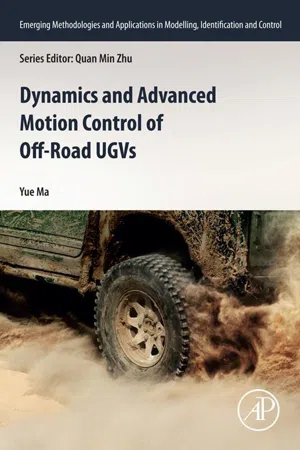
Dynamics and Advanced Motion Control of Off-Road UGVs
About this book
Dynamics and Advanced Motion Control of Unmanned Ground Off-Road Vehicles details both theoretical concepts such as planning and perception when working with UGVs, as well as more practical, hands-on aspects such as torque vectoring control. The book also covers related technologies such as intelligent and electrification of ground vehicles. After an introduction, initial chapters include an exploration of wheel-soil and track-soil interaction mechanisms, motion stability, motion control, fault detection and identification, and fault tolerance control. This book offers readers a detailed understanding of Unmanned Ground Vehicles by combining theory, applications and further developments.
Topics are covered in such a way that readers will be well versed on the current field of UGVs and will be able to implement future design and research in a feasible and effective way.
- Gives a comprehensive analysis and introduction to the dynamics and advanced motion control of unmanned ground off-road vehicles
- Covers key related technology concepts, such as intelligent and electrification of ground vehicles
- Details the entire control framework of off-road UGVs and the implementation of controller design
Trusted by 375,005 students
Access to over 1.5 million titles for a fair monthly price.
Study more efficiently using our study tools.
Information
Chapter one
Introduction
Abstract
This chapter presents a brief introduction on mobile robots and unmanned ground vehicle (UGV), describing the results of a general survey of literature. Some historic UGVs are exhibited. Next, all UGVs are classified according to the principle of driving and constraint between grounds, the basis of which, that is, concepts of terramechanics, are introduced here as well. Then, related topics on modeling of main body mechanics and driving modules of UGV are presented. Finally, a series of control algorithms, including PID, sliding mode, fuzzy logic, and artificial neural network are discussed and the comparisons and applications of the algorithms are discussed thoroughly.
Keywords
Mobile robot; unmanned ground vehicle; history
1.1 Overview
According to Gage (1995), an unmanned ground vehicle (UGV) is a piece of mechanized equipment that moves across the surface of the ground and serves as a means of carrying or transporting something, but explicitly does not carry a human being. Because of the importance of UGV, UGV attracted sustained interest and was promoted greatly. In this section, a condensed survey is presented, which covers the most important contents related to the research project.
The embryo of UGV, a mobile robot named Shakey (illustrated as Fig. 1.1), was developed in the late 1960s by Stanford Research Institute (SRI) (Nilsson, 1969), which was to serve as a prototype for Defense Advanced Research Projects Agency (DARPA)-funded artificial intelligence (AI) work. Shakey was a wheeled platform equipped with steerable TV camera, ultrasonic range finder, and touch sensors, connected via an radio frequency (RF) link to its main computer that performed navigation and exploration tasks. Furthermore, Shakey could accept English sentence commands from the terminal operator, directing the robot to push large wooden blocks around in its lab environment “world.”

Even though Shakey was failure in autonomous behavior, it did inspire many academic groups to settle down into the research of mobile robots, which is the academic field of UGVs. Hans Moravec led the Stanford Cart project at the Stanford University AI Lab, exploring navigation and obstacle avoidance issues using a sophisticated stereo vision system (Moravec, 1983). The Stanford Cart could plan an obstacle-free path to the destination, but it was incredibly slow, taking up to 15 minutes to make each 1-m move. Then, a number of other research-oriented mobile robot (or UGV) development efforts (projects or plans) were funded and put forward by the military, which was sensitive to the potential prospects of mobile robots.
The most famous project is autonomous land vehicle (ALV), which was a sponsored development thread of “mobile robots as an application domain for the demonstration of AI and high performance computing techniques.” The reemergence of Shakey in the early 1980s indicated the power of the funding. Under DARPA’s Strategic Computing (SC) Program, the ALV served as one of several application projects whose goal was to “provide a realistic task environment for technology research.” Other SC applications included Naval Fleet Command Center Battle Management, Army Air Land Battle Management, and a “Pilot’s Associate” (DARPA, 1986). The ALV was built on a stan...
Table of contents
- Cover image
- Title page
- Table of Contents
- Copyright
- Dedication
- Foreword
- Chapter one. Introduction
- Part 1: Modelling of off-road UGV
- Part 2: Advanced Motion Control of UGV
- Part 3: Fault tolerance control of off-road UGV
- Index
Frequently asked questions
Yes, you can cancel anytime from the Subscription tab in your account settings on the Perlego website. Your subscription will stay active until the end of your current billing period. Learn how to cancel your subscription
No, books cannot be downloaded as external files, such as PDFs, for use outside of Perlego. However, you can download books within the Perlego app for offline reading on mobile or tablet. Learn how to download books offline
Perlego offers two plans: Essential and Complete
- Essential is ideal for learners and professionals who enjoy exploring a wide range of subjects. Access the Essential Library with 800,000+ trusted titles and best-sellers across business, personal growth, and the humanities. Includes unlimited reading time and Standard Read Aloud voice.
- Complete: Perfect for advanced learners and researchers needing full, unrestricted access. Unlock 1.5M+ books across hundreds of subjects, including academic and specialized titles. The Complete Plan also includes advanced features like Premium Read Aloud and Research Assistant.
We are an online textbook subscription service, where you can get access to an entire online library for less than the price of a single book per month. With over 1.5 million books across 990+ topics, we’ve got you covered! Learn about our mission
Look out for the read-aloud symbol on your next book to see if you can listen to it. The read-aloud tool reads text aloud for you, highlighting the text as it is being read. You can pause it, speed it up and slow it down. Learn more about Read Aloud
Yes! You can use the Perlego app on both iOS and Android devices to read anytime, anywhere — even offline. Perfect for commutes or when you’re on the go.
Please note we cannot support devices running on iOS 13 and Android 7 or earlier. Learn more about using the app
Please note we cannot support devices running on iOS 13 and Android 7 or earlier. Learn more about using the app
Yes, you can access Dynamics and Advanced Motion Control of Off-Road UGVs by Yue Ma in PDF and/or ePUB format, as well as other popular books in Technology & Engineering & Mechanical Engineering. We have over 1.5 million books available in our catalogue for you to explore.