eBook - ePub
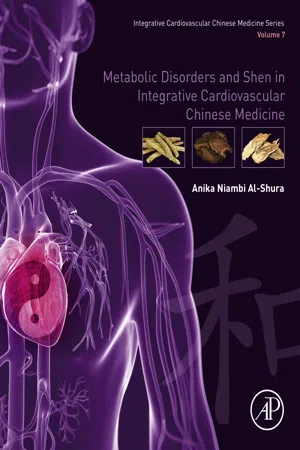
Metabolic Disorders and Shen in Integrative Cardiovascular Chinese Medicine
Volume 7
- 106 pages
- English
- ePUB (mobile friendly)
- Available on iOS & Android
eBook - ePub
Metabolic Disorders and Shen in Integrative Cardiovascular Chinese Medicine
Volume 7
About this book
Metabolic Disorders and Shen in Integrative Cardiovascular Medicine, volume seven in the Integrative Cardiovascular Chinese Medicine series, presents the connection between metabolic diseases that affect the cardiovascular system and mental health through both Chinese and Western medicine explanations. Sections discuss the etiology of metabolic disorders of blood sugar disorders, lipid disorders, inflammatory disorders and shen, the clinical significance and differentiations in both Western and Chinese medicine, and prescriptions and the medicated diet, including main acupoints, remedies and medicines used in Western and Chinese medicine and the combination of medicinal herbs and food for Chinese diet therapy.
This important reference will aid cardiovascular researchers in the study of integrative Chinese and Western medicine with its clear, structured base that not only guides clinical practice, but also encourages collaboration between Chinese and Western medicine practitioners.
- Gives basic medical science and TCM theory background on lipids, blood sugar, inflammation and shen with clinical significance and diagnosis
- Provides treatment methods and advice, including nutritional therapy and the Chinese medicine dietary plan
- Prepares readers for advanced study within Integrative Cardiovascular Chinese Medicine
Trusted by 375,005 students
Access to over 1.5 million titles for a fair monthly price.
Study more efficiently using our study tools.
Information
Part I
Etiology of metabolic disorders
1: Etiology of lipid disorders
Abstract
In integrative cardiovascular Chinese medicine, the etiology of lipid disorders includes recognizing the different types of lipids, understanding lipid metabolism, the pathology directly associated with lipid excess and the genetic involvement.
Keywords
Genetics; Integrative cardiovascular Chinese medicine; Lipids; Pathology
Chapter objectives
The objectives of this chapter are:
- 1. To discuss the etiology of lipid disorders
- 2. To describe the different lipids and lipid metabolism
- 3. To discuss pathology of lipid disorders and genetic involvement
Overview of lipid metabolism and circulation
Lipids are hydrophobic macromolecules that are obtained through bile and pancreatic enzyme breakdown of food; synthesized by Acyl-CoA: cholesterol acyltransferase (ACAT1 found in endoplasmic reticulum (ER) of all cells and ACAT 2 found in the ER of intestinal and liver cells); processed, distributed, and utilized by the liver with the presence of ACAT1.
Cholesterol is processed, circulated, absorbed, excreted, and reabsorbed between the intestines, lymphatic system, and liver.
Cholesterol specifically binds to lipoproteins for transport through water-based fluids of the body. Lipoproteins are ligands and cofactors in enzyme processing. They bind to receptors on various cell surfaces of hepatocytes and enterocytes. Niemann-Pick C1 Like 1 (NPC1L1) is a specific protein receptor that is crucial for passage of cholesterol across cell membranes and into the ER. Within the ER, ACAT2 is present and catalyzes cholesterol into an ester for utilization in protein synthesis. From the cells of the enterocytes, cholesterol that has not been esterized is reabsorbed through the intestinal lumen and moved in two directions: the blood capillaries to the hepatic portal vein and the lymphatic system to circulate through the peripheral body. From peripheral tissues, the lymphatic vessels empty fluid and cholesterol into blood circulation, which flows back to the liver. Within the liver, a process called reverse cholesterol transport (RCT) receives the cholesterol that was sent out, returns, and then processes the cholesterol into bile acid for excretion.
| Intermediate density lipoproteins | |
|---|---|
| Lipoprotein lipase (LPL) | Derived from diet, uptake by macrophages that form foam cells and contribute to atherosclerosis |
| High-density lipoproteins (HDL) | Lipoproteins without cholesterol that help scavenge the body and return cholesterol-laden proteins to the liver |
| Low-density lipoproteins (LDL) | Derived from diet, uptake by macrophages that form foam cells and contribute to atherosclerosis |
| Very low-density lipoproteins (VLDL) | Derived from diet, the result of excess liver synthesis and circulation in diabetes mellitus |
| Chylomicrons | A lipoprotein that transports lipids from the microvilli of the small intestines through blood and lymph vessels to the liver and peripheral adipose |

The liver generates hydrolyzed VLDL, which are triglycerides that form LDLs. LDLs bind to and transport cholesterol to participate in various physiological functioning throughout the body. Cholesterol is utilized by the liver as cholesterol 7-alpha hydroxylase (CYP7A1), the enzyme that synthesizes bile acids.
Low-density lipoprotein receptors (LDLR) are located mainly on the surface of hepatic cells and found throughout the body. These allow LDL to bind and allow for cholesterol to pass through cell membranes and hydrolyze for use in plasma membrane formation, synthesizing of hormones, bile acids, and elimination as waste. Lipoprotein lipase (LPL) is responsible for the transport and metabolism of various LDL and VLDL including triglycerides and cholesterol for storage regulation to attempt to maintain body-wide lipid balance.
Proprotein convertase subtilisin kexin 9 (PCSK9) circulates and regulates functioning of LDLR by degradation in lysosomes, which reduces the number for LDL binding, thus increasing blood plasma levels of LDL with vessel build-up contributing to vascular factors of heart disease.
Hepatic-derived LPL that travel in lymph and blood vessels become pa...
Table of contents
- Cover image
- Title page
- Table of Contents
- Copyright
- In Memory
- Dedication
- Preface
- Dr. Al-Shura biography
- Part I. Etiology of metabolic disorders
- Part II. Clinical presentations
- Part III. Prescriptions and the medicated diet
- Index
Frequently asked questions
Yes, you can cancel anytime from the Subscription tab in your account settings on the Perlego website. Your subscription will stay active until the end of your current billing period. Learn how to cancel your subscription
No, books cannot be downloaded as external files, such as PDFs, for use outside of Perlego. However, you can download books within the Perlego app for offline reading on mobile or tablet. Learn how to download books offline
Perlego offers two plans: Essential and Complete
- Essential is ideal for learners and professionals who enjoy exploring a wide range of subjects. Access the Essential Library with 800,000+ trusted titles and best-sellers across business, personal growth, and the humanities. Includes unlimited reading time and Standard Read Aloud voice.
- Complete: Perfect for advanced learners and researchers needing full, unrestricted access. Unlock 1.5M+ books across hundreds of subjects, including academic and specialized titles. The Complete Plan also includes advanced features like Premium Read Aloud and Research Assistant.
We are an online textbook subscription service, where you can get access to an entire online library for less than the price of a single book per month. With over 1.5 million books across 990+ topics, we’ve got you covered! Learn about our mission
Look out for the read-aloud symbol on your next book to see if you can listen to it. The read-aloud tool reads text aloud for you, highlighting the text as it is being read. You can pause it, speed it up and slow it down. Learn more about Read Aloud
Yes! You can use the Perlego app on both iOS and Android devices to read anytime, anywhere — even offline. Perfect for commutes or when you’re on the go.
Please note we cannot support devices running on iOS 13 and Android 7 or earlier. Learn more about using the app
Please note we cannot support devices running on iOS 13 and Android 7 or earlier. Learn more about using the app
Yes, you can access Metabolic Disorders and Shen in Integrative Cardiovascular Chinese Medicine by Anika Niambi Al-Shura in PDF and/or ePUB format, as well as other popular books in Biological Sciences & Biology. We have over 1.5 million books available in our catalogue for you to explore.