- 418 pages
- English
- ePUB (mobile friendly)
- Available on iOS & Android
eBook - ePub
Pipe Drafting and Design
About this book
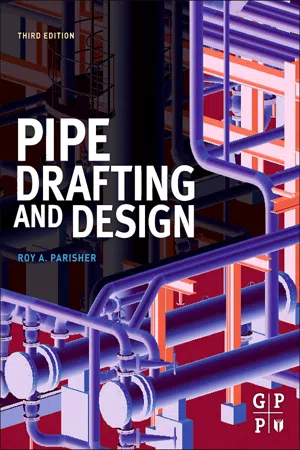
Pipe Drafting and Design, Third Edition provides step-by-step instructions to walk pipe designers, drafters, and students through the creation of piping arrangement and isometric drawings. It includes instructions for the proper drawing of symbols for fittings, flanges, valves, and mechanical equipment. More than 350 illustrations and photographs provide examples and visual instructions. A unique feature is the systematic arrangement of drawings that begins with the layout of the structural foundations of a facility and continues through to the development of a 3-D model. Advanced chapters discuss the use of 3-D software tools from which elevation, section and isometric drawings, and bills of materials are extracted.
- Covers drafting and design of pipes from fundamentals to detailed advice on the development of piping drawings, using manual and CAD techniques
- 3-D model images provide an uncommon opportunity to visualize an entire piping facility
- Each chapter includes exercises and questions designed for review and practice
New to this edition:
- A large scale project that includes foundation location, equipment location, arrangement, and vendor drawings
- Updated discussion and use of modern CAD tools
- Additional exercises, drawings, and dimensioning charts to provide practice and assessment
- New set of Powerpoint images to help develop classroom lectures
Information
Chapter 1. Overview of Pipe Drafting and Design
This chapter is an overview of the pipe drafting and design profession. It lists the various facility types where pipe drafting and design is applied and the types of companies that employ pipe drafters. The types of drawings developed by pipe drafters and the engineering groups that use them are reviewed. A brief review of the computer-aided drafting (CAD) software used to create piping drawings and models is provided.
Keywords
3D modeling; CAD software; computer-aided drafting; design projects; drawing types; employment opportunities; engineering departments; three-dimensional models
In the design of an industrial facility, engineers develop process flow sheets, set up project specifications, and design or select equipment. The design drafters use the information supplied by engineers and equipment vendors and apply the knowledge and experience gained in the office and field to design and lay out the facility.
In the design and layout of an industrial complex, thousands of piping drawings are needed to provide detailed information to the craftsmen who will construct the facility. Facility design and layout must meet the customer’s expectations as well as comply with safety codes, government standards, client specifications, budget, and start-up date.
The piping group has the main responsibility for the design and layout of the facility. Drafters and designers must coordinate their efforts with the civil, structural, electrical, and instrumentation groups throughout the design process. The piping group must provide all other design groups with the information they need to complete their part of the project. This timely ‘sharing’ of information will guarantee the complete set of construction drawings will be finished on schedule. During this time, it may be necessary for designers to visit the plant construction site to establish tie-ins or verify information necessary to complete the design.
Types of Projects
The pipe drafting and design discipline includes the widest range of opportunities in the field of design drafting. The types of design projects one could expect to work on may include
• power plants;
• petrochemical complex;
• pulp and paper plants;
• fertilizer plants;
• pipe systems for hospitals and high-rise office buildings;
• pharmaceutical plants;
• food and beverage processing plants;
• synthetic fuel plants;
• offshore platforms;
• pipe line installations;
• water treatment facilities;
• environmental waste disposal.
Many projects will be designed for construction in other countries, offering the designer opportunities for travel. Each project presents drafters and designers with opportunities to expand their skills and knowledge of the field of piping design.
Employers of Pipe Drafters and Designers
Employers seek to hire pipe drafters and designers range for various companies. Among them are
• engineering and construction companies;
• operating companies;
• architectural firms;
• construction companies;
• fabrication companies.
Engineering and Construction Companies
Engineering and construction companies provide the design and layout of a facility. Many clients award the engineering and design phase of a project to one firm and the construction phase to another. Although many operating companies have a small engineering staff who handle the day-to-day needs of changing and updating drawings, such as adding a pump or other small equipment, they do not have the manpower to design and engineer a grassroots plant or major add-on. Total plant design and construction may require hundreds of workers and may entail years in the design and construction of the plant.
Operating Companies
Operating companies are the clients who engage in the day-to-day operation of a facility and who seek out the services of engineering and construction firms when expanding existing facilities or constructing a new project. Many operating companies keep a small engineering staff in the home office or at the plant job site. Designers are exposed to the day-to-day operations of the facility and follow the construction of small projects. This situation may require that the designer have a broad range of knowledge and skills, as he or she often may be asked to design and lay out the complete project. The design may prepare foundation, steel, and piping drawings as needed, and may even do some electrical and instrumentation design when required.
Architectural Engineering Companies
Pipe drafters and designers employed by architectural engineering companies apply their skills to commercial and high-rise buildings. These may include multistory office buildings, hospitals, condominiums, shopping malls, or other similar structures. In addition to the industrial piping components such as those found in a typical boiler room, supplementary piping systems must be designed for plumbing, HVAC (heating, ventilating, and air conditioning), and drainage systems that are also required in these structures.
Pipe drafters and designers must therefore be able to develop drawings such as
• piping flow sheets;
• plot plans;
• equipment location drawings;
• piping arrangement drawings;
• piping isometric drawings.
Learning the “language” of piping prepares employees for advancement to other departments within the engineering firms. These departments include not only the drafting and design departments but also
• purchasing;
• material control;
• material takeoff;
• estimating;
• pipe stress and pipe supports;
• computer-aided drafting (CAD) support;
• project management.
Construction Companies
Many firms specialize only in the construction of plants. Here the piping designer may actually help oversee the construction of the facility while working under the supervision of a construction superintendent. The designer is often called upon to make small design changes resulting from mistakes discovered during the construction phase or as customers dictate changes. At the completion of the project, drawings are updated to reflect the many changes made during construction. These drawings are called or referred to as “as-built” drawings.
Fabrication Companies
Fabrication companies fabricate and ship much of the piping necessary for the construction of the plant to the job site. Many fabrication drawings called piping spool drawings must be prepared. These drawings give detailed dimensions from which welders can fabricate the pipe. The drafter who prepares these drawings will not be required to have an extensive background in plant layout; however, the position provides the drafter with valuable experience in materials and material science.
Preparation for Piping Drafting
Students must have a good background in basic drafting before pursuing a job in the field of pipe drafting and design. Students should have good manual drafting skills related to line quality and freehand lettering. At the same time, students must acquire knowledge of the latest drafting software programs such as AutoCAD1 and MicroStation2. As students advance, they may use sophisticated three-dimensional (3D) software programs that automatically generate plotted drawings and isometrics from a 3D model.
1Autodesk. Inc.
2Bentley Systems, Inc.
Technical Skills
A pipe drafter must become familiar with the numerous symbols used to represent fittings, flanges, valves, and mechanical equipment. This will require the time and effort needed to draw the symbol shapes by searching through catalogs and dimensioning charts in order to find the size dimensions needed to draw each piping component to scale. Often beginning drafters start out making corrections to existing drawings. This is where they acquire the skills and knowledge of piping that will allow them to advance to the position of piping designer.
Drafters who have held field positions as pipe fitters or welders find this real-world experience valuable. Many times this experience allows them to advance at a faster pace.
Personal Skills
Students should not neglect their speaking, writing, and math skills. Every company appraises future employees during the interview process not only for technical skills but also for the personal skills needed to interact with the engineering team. This interaction is a must for the team in order to complete the job with a minimal amount of mistakes. Honesty, reliability, dedication to improving skills, and a positive attitude contribute much to the successful career of the designer. You will be a member of a design team...
Table of contents
- Cover image
- Table of Contents
- Front-matter
- Dedication
- Copyright
- Preface
- Acknowledgments
- About the Authors
- Chapter 1. Overview of Pipe Drafting and Design
- Chapter 2. Steel Pipe
- Chapter 3. Pipe Fittings
- Chapter 4. Flange Basics
- Chapter 5. Valves
- Chapter 6. Mechanical Equipment
- Chapter 7. Flow Diagrams and Instrumentation
- Chapter 8. Codes and Specifications
- Chapter 9. Equipment Layout
- Chapter 10. Piping Arrangement Drawings, Sections, and Elevations
- Chapter 11. Standard Piping Details
- Chapter 12. Piping Systems
- Chapter 13. Piping Isometrics
- Chapter 14. Building 3D Piping Models
- Chapter 15. Project Coordination
- Appendix A. Dimensional Data
- Appendix B. Alphabet of Lines
- Appendix C. Review of Math
- Appendix D. Use of the Calculator
- Appendix E. Architect’s Scale
- Glossary
- Index
Trusted by 375,005 students
Access to over 1.5 million titles for a fair monthly price.
Study more efficiently using our study tools.
Frequently asked questions
Yes, you can cancel anytime from the Subscription tab in your account settings on the Perlego website. Your subscription will stay active until the end of your current billing period. Learn how to cancel your subscription
No, books cannot be downloaded as external files, such as PDFs, for use outside of Perlego. However, you can download books within the Perlego app for offline reading on mobile or tablet. Learn how to download books offline
Perlego offers two plans: Essential and Complete
- Essential is ideal for learners and professionals who enjoy exploring a wide range of subjects. Access the Essential Library with 800,000+ trusted titles and best-sellers across business, personal growth, and the humanities. Includes unlimited reading time and Standard Read Aloud voice.
- Complete: Perfect for advanced learners and researchers needing full, unrestricted access. Unlock 1.5M+ books across hundreds of subjects, including academic and specialized titles. The Complete Plan also includes advanced features like Premium Read Aloud and Research Assistant.
We are an online textbook subscription service, where you can get access to an entire online library for less than the price of a single book per month. With over 1.5 million books across 990+ topics, we’ve got you covered! Learn about our mission
Look out for the read-aloud symbol on your next book to see if you can listen to it. The read-aloud tool reads text aloud for you, highlighting the text as it is being read. You can pause it, speed it up and slow it down. Learn more about Read Aloud
Yes! You can use the Perlego app on both iOS and Android devices to read anytime, anywhere — even offline. Perfect for commutes or when you’re on the go.
Please note we cannot support devices running on iOS 13 and Android 7 or earlier. Learn more about using the app
Please note we cannot support devices running on iOS 13 and Android 7 or earlier. Learn more about using the app
Yes, you can access Pipe Drafting and Design by Roy A. Parisher in PDF and/or ePUB format, as well as other popular books in Technology & Engineering & Civil Engineering. We have over 1.5 million books available in our catalogue for you to explore.