- 96 pages
- English
- ePUB (mobile friendly)
- Available on iOS & Android
eBook - ePub
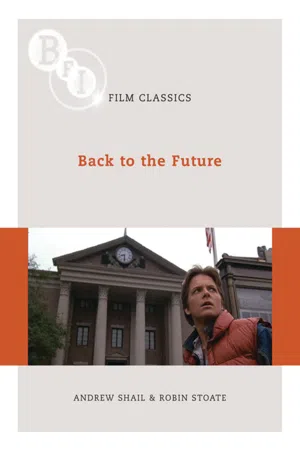
Back to the Future
About this book
This compelling study places 'Back to the Future' in the context of Reaganite America, discusses Robert Zemeckis's film-making technique and its relationship to the 'New New Hollywood', explores the film's attitudes to teen culture of the 1950s and 1980s and its representation of science, atomic power and time travel.
Trusted by 375,005 students
Access to over 1 million titles for a fair monthly price.
Study more efficiently using our study tools.
Information
1 ‘You’re gonna see some serious shit’: New New Hollywood in Action
Form and style
If Stephen Prince’s ‘Spielberg–Lucas style’ was the light-hearted and comedic presentation of action-heavy and spectacle-oriented adventure melodrama, then Back to the Future clearly signals Zemeckis’s participation in this. As Peter Krämer notes, Zemeckis has told
intimate stories, either about childlike men (Marty McFly, Roger Rabbit, Forrest Gump, even to some extent Chuck Noland in Cast Away) and their familial or quasi-familial relationships in a largely fantastic (or exotic) universe, or about women and their fantasies, desires, and anxieties (concerning adventurous romance, eternal youth, and murderous husbands) which, quite shockingly, become real.24
These women include Joan Wilder in Romancing the Stone, Madeline Ashton and Helen Sharp in Death Becomes Her, Eleanor Arroway in Contact and Claire Spencer in What Lies Beneath (2000). Kristin Thompson has charted, in a sequence-by-sequence analysis, Back to the Future’s narrative process, and shows just how indebted the film is to classical narrative structures, indicating Zemeckis’s wholehearted participation in Spielberg–Lucas Hollywood revivalism.25 This is not to deny the formal particularity of Zemeckis’s work, however.
For example, Zemeckis tends towards the use of a highly mobile camera. While establishing shots from a moving camera are common, Zemeckis employs particularly lengthy examples, and then, when a breakdown into static coverage would be expected, uses movement wherever possible. In Back to the Future, although his camera was often static when action necessitated it, when it did not, he tended to incorporate a mobile point of view, known as ‘reframing’. Consequently, 42 per cent of the shots in Back to the Future include appreciable movement. Marty’s journey to school in 1985 is all moving shots (which underlines the mobility he achieves using the skateboard), and the musical number, even Marvin’s call to Chuck Berry, is composed virtually entirely of moving shots, as is the scene where Marty and Doc retrieve the hidden DeLorean. Zemeckis is also fond of the slow dolly-in, often to connote increased intimacy or intensity, and (in Back to the Future in particular) eeriness, in such instances as Lorraine’s ‘I don’t know, but I’m gonna find out’, and Marty’s uncomfortable writing of the warning letter to Doc.
New Hollywood had made much of using camera movement as a method of transferring the point of view from location to location, which, in the place of edits, made for shots of relatively long duration. Back to the Future, by contrast, with an average shot duration of 5.5 seconds, reflected a general decrease in average shot duration that had begun in earnest during the 1970s. As David Bordwell points out, between 1930 and 1960, the average shot duration of most films fell between 8 and 11 seconds. During the 1970s, roughly three-quarters of films averaged between 5 and 8 seconds, and during the 1980s this narrowed to 5 to 7 seconds.26 Although Zemeckis did not seek to make extensive use of camera movement in place of edits until Cast Away, Back to the Future achieved this low average shot duration in spite of his use of camera movement as the basis for some noticeably lengthy shots. The opening shot lasts for 2 minutes and 6 seconds, a brief insert reveals the pile of dog food, then a further 30-second shot shows Marty’s entrance. The later shot in this scene, where Marty talks to Doc on the phone, is 41 seconds long. The lack of incidental music in this 5 minute and 39 second opening scene also directs attention to the visual track (a trait Zemeckis would also take to an extreme in Cast Away, which lacks incidental music for its first 70.8 per cent). Other shots that are deliberately lengthened by the decision to use camera movement in place of editing include the coverage of Marty and Jennifer’s encounter with Strickland (56 seconds); their ensuing conversation while walking through the square (48 seconds); Doc and Marty’s discussion when alone in the school corridor (57 seconds); Marty following George home (35 seconds) and Doc setting up the ‘experiment’ by the clock tower (30 seconds). After all, if ‘New Hollywood’ was Hollywood under the invited influence of the techniques of the various post-war European ‘new waves’, then ‘New New Hollywood’ was a resurgence of classical Hollywood that was nonetheless unwittingly influenced by the techniques of New Hollywood.
Zemeckis’s fondness for camera movement also meant making extensive use of focus racks. For example, rather than cutting from the close-up of Doc’s remote to a medium shot of the DeLorean reversing, the camera merely racks focus from the one to the other. The urgency of the alarm clock going off on the dashboard is underlined by the use of a focus rack rather than a cut. Just after Marty is hit by Lorraine’s father’s car, George sits up into the frame (which involves a quick double focus rack away from Marty onto George and then onto Lorraine’s father). The beginning of the culminating race-against-time sequence is signalled by a shot that begins at a steep upward angle on the clock tower, rapidly refocuses on the foreground when Doc walks into the shot, and then tilts down to become level as he walks away from the camera, panning left and right as he moves about in anticipation. The loudhailer of the ‘battle of the bands’ judge is deliberately allowed to loom out of focus, as is the Libyan ‘nationalist’s’ rocket-launcher, both for comedic effect.

The unacknowledged influence of New Hollywood’s heightened camera movement (although movement was also notable in the work of Alfred Hitchcock and Orson Wells) was also retuned by Zemeckis: he made use of camera movement in three dimensions rather than maintaining any equivalent of a human observer’s standard head height. The camera moves above and around the DeLorean when it first backs out of the van, it cranes down from above to show the DeLorean covered in ice when it returns from the first time experiment, and it cranes up and tilts down when Marty inserts the connecting hook. It is persistently placed at the height of the DeLorean’s bumper when it is in motion, and, linked to the skateboarding and dancing, frequently returns to this position to follow characters’ feet. Zemeckis also often ‘allows’ his camera to lose track of its subject, which usually, in the place of a cut, leaves the camera on the next relevant part of the mise en scène. When Lorraine and her friends run off at the sound of the bell, the camera backs away to initially track them but then stops so as to let them leave the shot, which leaves the shot composed on Doc. Although the introduction to Marty in the first scene follows the common filmic pattern of establishing a protagonist by ‘listing’ shots of their body parts before finally revealing their face (we see his eyes 1 minute and 35 seconds after first encountering his body), the first of these, showing Marty’s lower legs as he enters Doc’s workshop, is taken from ‘dog height’ (appropriate given the preceding action with the dog food) and framed in this way only incidentally (at least overtly), because this is where the camera was positioned at the end of the previous event (the dog food can falling into the bin).
Zemeckis’s camera movement also, at least overtly, wanders away from the main action (another New Hollywood trait). After the camera shows Marty’s lower legs entering Doc’s workshop, it then allows him to walk out of shot, instead following his skateboard as it trundles along the floor to bump into the plutonium case. When Marty leaves, he is again ignored and disappears, out of focus, in deep space, while the plutonium is kept in focus in the immediate foreground, filling just under half of the frame. Before the audition, the last of the shots following Marty to school allows him to leave the frame when it ‘notices’ the Goldie Wilson van, and after the audition, a shot following the now moving Goldie Wilson van allows it to leave the frame to follow Marty and Jennifer. Nonetheless, true to New New Hollywood form, such camera movement is motivated: all these shots reveal pertinent details. The case of plutonium marked ‘HANDLE WITH CARE’ (and which will not be handled with care) is handled carelessly when Marty’s skateboard bumps into it. The film extensively foreshadows future events in this way (events also mostly located in the historical past). When Marty arrives home, the camera stops following him to dwell on the wrecked car, but this is to emphasise what it means for his nascent sexuality. When the camera moves away from Marty and George in the diner to follow Goldie Wilson soliloquising about the possibility of becoming mayor (in a shot that is 26 seconds long), this occurs so that, once the camera returns to Marty, the audience will share his surprise that George is gone. The camera then also briefly lingers in the diner, watching Marty’s frantic pursuit of George through the window along with the diner staff, rather than, for example, using an edit to an exterior shot to follow him outside; keeping the viewpoint with the diner staff also serves to express Marty’s sense of alienation in 1955.
Zemeckis’s frequent use of movement and focus racks also means that actors often have to undertake complex and precise choreography relative to the camera, as in the lengthy shot when Jennifer is consoling with Marty after his failed audition. The 1985 Strickland slowly draws in towards Marty’s face, the camera moving closer to them both to eliminate any empty space. When the DeLorean is revving up to drive towards Marty and Doc, and Marty is edging off to one side, the camera moves in to eliminate the gaps on either side and exaggerate the gap between them. Marty’s improvised 1955 skateboard turns in the immediate foreground, and the camera follows it with a drastic pan.
In those shots where he did not employ appreciable reframing, Zemeckis often made comedic use of off-screen space. After Doc finishes his obscure reverie about Peabody, he looks at his van and then determinedly exits the frame, leaving a panicked Marty to take his place in a visual augur of things to come. When Biff is about to leave the McFly home, the set-up places him close to the camera and large in the frame; thus, when he leaves both the house and the frame, George is revealed, diminutively, much further away and much smaller in the frame. Marty baffles Lou the diner owner for 28 seconds, throughout which time Lou’s body fills most of the frame, so obscuring another customer sitting next to Marty at the bar; when Lou finally moves aside, the reveal on George sitting in exactly the same posture as Marty is all the more comedic. The shot where Lorraine runs out of frame, throws Marty’s trousers into the shot, appears in a reflection in a mirror and then vacates both the room and the reflection in the mirror, leaving Marty to fall out of the shot while trying to put his trousers on, is rapid-fire visual comedy.


After bringing Marty down to dinner, Lorraine’s mother walks right up to the camera while Marty, Lorraine and the three children eat in the background, and then shouts into close off-screen space for Lorraine’s father, who subsequently backs into the frame with the television, a structure that emphasises the strangeness of the technology recently introduced into mealtime experience.
Genre
Back to the Future is a comedy adventure science-fiction time-travel love story.
Robert Zemeckis, 198527
Zemeckis wasn’t exaggerating. But Back to the Future is not multi-generic in the sense of mere light-hearted irreverence for the supposed mutual exclusivity of genre. He and Gale built together a broad catalogue of implicit and explicit references to established genre tropes. The time-travel concept encapsulated in the title and the poster certainly made claims about Back to the Future’s membership of the science-fiction genre, as did such minor details as the electronic sounds that issue when the solely mechanical back door of Doc’s van opens to reveal the DeLorean, and the unexplained smoke that escapes from the DeLorean when Doc opens the door; and, as will be discussed in Chapter 2, the film’s trailer all...
Table of contents
- Cover Page
- Title Page
- Contents
- Introduction
- 1. ‘You’re gonna see some serious shit’: New New Hollywood in Action
- 2. The 1950s and Teen Culture
- 3. The 1950s Imagined in the 1980s
- 4. Film and Time
- Conclusion: ‘Your kids are gonna love it’
- Notes
- Credits
- eCopyright
Frequently asked questions
Yes, you can cancel anytime from the Subscription tab in your account settings on the Perlego website. Your subscription will stay active until the end of your current billing period. Learn how to cancel your subscription
No, books cannot be downloaded as external files, such as PDFs, for use outside of Perlego. However, you can download books within the Perlego app for offline reading on mobile or tablet. Learn how to download books offline
Perlego offers two plans: Essential and Complete
- Essential is ideal for learners and professionals who enjoy exploring a wide range of subjects. Access the Essential Library with 800,000+ trusted titles and best-sellers across business, personal growth, and the humanities. Includes unlimited reading time and Standard Read Aloud voice.
- Complete: Perfect for advanced learners and researchers needing full, unrestricted access. Unlock 1.4M+ books across hundreds of subjects, including academic and specialized titles. The Complete Plan also includes advanced features like Premium Read Aloud and Research Assistant.
We are an online textbook subscription service, where you can get access to an entire online library for less than the price of a single book per month. With over 1 million books across 990+ topics, we’ve got you covered! Learn about our mission
Look out for the read-aloud symbol on your next book to see if you can listen to it. The read-aloud tool reads text aloud for you, highlighting the text as it is being read. You can pause it, speed it up and slow it down. Learn more about Read Aloud
Yes! You can use the Perlego app on both iOS and Android devices to read anytime, anywhere — even offline. Perfect for commutes or when you’re on the go.
Please note we cannot support devices running on iOS 13 and Android 7 or earlier. Learn more about using the app
Please note we cannot support devices running on iOS 13 and Android 7 or earlier. Learn more about using the app
Yes, you can access Back to the Future by Robin Stoate,Andrew Shail in PDF and/or ePUB format, as well as other popular books in Media & Performing Arts & Film History & Criticism. We have over one million books available in our catalogue for you to explore.