Documentary films constitute a major part of film history. Cinema's origins lie, arguably, more in non-fiction than fiction, and documentary represents the other - often submerged and barely visible - 'half' of cinema history. Historically, documentary cinema has always been an important point of reference for fiction cinema, and the two have often overlapped. Over the last two decades, documentary cinema has enjoyed a revival in critical and commercial success.
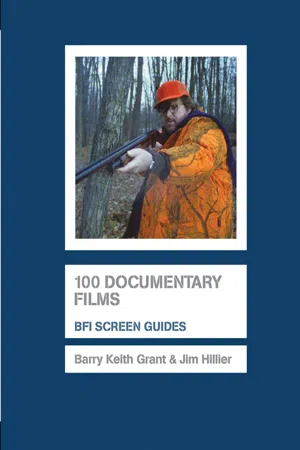
100 Documentary Films is the first book to offer concise and authoritative individual critical commentaries on some of the key documentary films - from the Lumière brothers and the beginnings of cinema through to recent films such as Bowling for Columbine and When the Levees Broke - and is global in perspective. Many different types of documentary are discussed, as well as films by major documentary directors, including Robert Flaherty, Humphrey Jennings, Jean Rouch, Dziga Vertov, Errol Morris, Nick Broomfield and Michael Moore. Each entry provides concise critical analysis, while frequent cross reference to other films featured helps to place films in their historical and aesthetic contexts.
Barry Keith Grant is Professor of Film Studies and Popular Culture at Brock University, Ontario, Canada. He is the author of Film Genre: From Iconography to Ideology (2007), Voyages of Discovery: The Cinema of Frederick Wiseman (1992) and co-author, with Steve Blandford and Jim Hillier, of The Film Studies Dictionary (2001).
Jim Hillier is Visiting Lecturer in Film at the University of Reading. He is the author of The New Hollywood (1993), the co-author of The Film Studies Dictionary (2001) and, with Alan Lovell, of Studies in Documentary (1972). His edited books include American Independent Cinema (2001) and two volumes of the English translation of the selected Cahiers du cinema (1985, 1986).
- 272 pages
- English
- ePUB (mobile friendly)
- Available on iOS & Android
eBook - ePub
100 Documentary Films
About this book
Trusted by 375,005 students
Access to over 1 million titles for a fair monthly price.
Study more efficiently using our study tools.
Information
Why We Fight 1: Prelude to War
US, 1943 – 53 mins
Frank Capra
When the US entered World War II, the government was aware that it had to overcome a pronounced isolationist sentiment that had prevailed during the 1930s. As part of its effort to mobilise Americans for the war, Frank Capra, one of the most popular Hollywood directors of the pre-war era, was given an officer’s commission and charged with the task of making a series of documentary films that, as instructed by Chief of Staff General George C. Marshall, would explain to troops the reasons ‘as to the causes, the events, leading up to our entry into the war and the principles for which we are fighting’. Major Capra went on to produce a number of war-related documentaries, including a series of seven films on Why We Fight (1941–5, several co-directed by another Hollywood director, Anatole Litvak). They were viewed as part of military training by millions of US and Allied military personnel, becoming some of the most influential and effective propaganda films (‘information films’, as the series describes itself in the opening credits) in the history of documentary.
Prelude to War, the first film in the series, cannily relies on the iconography of patriotism and righteous sentiment, setting the tone for the films to follow. Capra brought to Prelude to War his ability to touch his viewers’ emotions by invoking American cultural myths, as demonstrated so successfully in his earlier Hollywood hits It Happened One Night (1934), Mr Deeds Goes to Town (1936) and Mr Smith Goes to Washington (1939). As in these films, Capra creates a folksy populist vision that in this case spoke effectively to the swelling ranks of inductees as the country geared up for war on several fronts. Prelude to War addresses the viewer as an American Everyman, a conceit literalised as the imaginary ‘John Q. Public’ in the voiceover narration spoken by Hollywood actor Walter Huston, whose image was already associated with American patriotism through his portrayal of the President of the United States in two films, Gabriel over the White House (1933) and The Tunnel (1935), the former characterising him as a spiritually reborn New-Dealer fighting for social reform.
Prelude’s use of Huston, who brings a perfect tone of common-sense righteous indignation to his narration, is indicative of the film’s overall effective mix of exhortatory commentary with footage culled from newsreels, fiction films and documentaries from other nations. Capra relies heavily on shots from Leni Riefenstahl’s pro-Nazi film TRIUMPH OF THE WILL (1935), but recontextualises the footage by contrasting it with potent images of Americana in which American children laugh and play in the sun instead of donning gasmasks and rehearsing trench warfare, to suggest that its depiction of what the commentary refers to as the ‘inbred German love of regimentation’ is ghastly rather than glorious. Original footage was shot by Robert Flaherty, whose approach to film-making was markedly different from that of the Hollywood director, but here they blend perfectly. The film offers a stark contrast between what it describes as a slave world and a free world (‘it’s us or them, the chips are down’), reinforced with graphic animated sequences created by the Walt Disney Studios that show maps of the Axis countries spreading inky darkness across the world. Such images effectively explained the war to all the John Qs who were now in uniform. Prelude’s self-righteousness builds to the point of referring to the Japanese as Hitler’s ‘buck-toothed pals’ and concludes with an image of the Axis leaders, Hitler, Mussolini and Hirohito, as Huston exhorts us to ‘Remember their faces . . . If you ever meet them, don’t hesitate.’ BKG
Dir/Scr: Frank Capra, Anatole Litvak; Prod: Julius J. Epstein, Philip G. Epstein, Robert Heller; Phot: Robert J. Flaherty (b/w); Ed: William Hornbeck; Music: Hugo Friedhofer, Leigh Harline, Arthur Lange, Cyril J. Mockridge, Alfred Newman, David Raksin; Narrator:Walter Huston; Prod Co: US War Department.
Woodstock
US, 1970 – 184 mins (Director’s Cut, 1994, 228 mins)
Michael Wadleigh
The mother of all concert films and winner of the Academy Award for Best Documentary Feature, Woodstock chronicles the Woodstock Music and Art Fair (‘three days of peace and music’) held at Max Yasgur’s 600-acre farm in the town of Bethel near Woodstock, New York, from 15–18 August 1969. Attended by an unexpectedly large crowd of close to half a million people, the festival proceeded peacefully despite inadequate toilet facilities, insufficient supplies and a rainstorm that turned the fields into muddy bogs. The event was regarded as the pinnacle of the hippie movement (immortalised in Joni Mitchell’s song ‘Woodstock’), an image of harmonious pastoral community that was shattered only four months later at another epic musical event in December, the Rolling Stones’ free concert at Altamont Speedway in northern California, which culminated in violence and the murder of a fan in the crowd – captured in Gimme Shelter (1970) by Albert and David Maysles (SALESMAN, 1968, GREY GARDENS, 1975).
Woodstock includes sequences of the performances, interviews with the organisers and the response of local citizens, and montages of people listening to the music, dancing, bathing, smoking marijuana and swimming in the nude. Among the musical artists whose performances are captured in the film are Crosby, Stills and Nash, Richie Havens, Joan Baez, The Who, Joe Cocker and Country Joe and the Fish. (Artists who performed at Woodstock but do not appear in the film include The Grateful Dead, Creedence Clearwater Revival, Jefferson Airplane and Janis Joplin, though the latter two make it into the Director’s Cut.) The five cameras that filmed the event combine shots of great intimacy and images of impressive scope: on the one hand, in close-ups taken from under Richie Havens’s face as he sings, we can see the roof of his mouth and then, shown in profile after he finishes, sweat dripping from his nose; on the other, long shots from the stage show a sea of people stretching as far as the eye can see, and helicopter shots sweeping across the ground emphasise the enormity of the crowd. The film periodically employs a split screen, occasionally even becoming a triptych, as if to suggest the impossibility of capturing an event of such epic scale within one frame.
The film often emphasises the idea of the generation gap, casting the ‘Woodstock nation’ as an alternative to the bourgeois and outdated adult world. Often prodded by the film-makers, local residents and shopkeepers either express moral outrage about the behaviour of the young people, or see them as polite and merely having fun. Three nuns at the festival, one of whom flashes a peace sign at the camera, are shown in a brief freeze-frame, suggesting the ephemeral utopian potential signified by Woodstock. Similarly, much of the music included in the film protests the Vietnam War. Hendrix’s riveting performance of ‘The Star-Spangled Banner’, its melodic beauty alternating with screaming electronic distortion, perfectly captured the social and political tensions of the era.
Shot on 16mm, Woodstock was edited from more than 1,210 hours of footage by Thelma Schoonmaker, who was nominated for an Academy Award (Schoonmaker also edited numerous Martin Scorsese films, including The Last Waltz, 1978, the acclaimed documentary about The Band). Documentary films have also been made about the follow-up Woodstock concerts in 1994 and 1999, the most interesting of which is My Generation (2000) by Barbara Kopple (see HARLAN COUNTY USA, 1976), which contrasts all three events and focuses on the changing values that informed them. BKG
Dir: Michael Wadleigh; Prod: Bob Maurice; Phot: Michael Wadleigh, David Myers, Richard Pearce, Donald Lenzer, Michael Margetts, Al Wertheimer (colour); Ed: Michael Wadleigh, Martin Scorsese, Stan Warnow, Jere Huggins, Yeu-Bun Yee, Thelma Schoonmaker; Sound and Music Ed: Larry Johnson (et al.); Prod Co:Wadleigh-Maurice Ltd.
Zidane: A 21st Century Portrait (Zidane: un portrait du 21ième siècle)
France/Iceland, 2006 – 90 mins
Douglas Gordon, Philippe Parreno
Several films in this volume – see, for example, THE ACT OF SEEING WITH ONE’S OWN EYES (1971), LOST LOST LOST (1976), NEWS FROM HOME (1976) – blur the boundaries between ‘documentary’ and ‘avant-garde’ film, but Zidane pushes that blurring further: though distributed theatrically, it is easy to imagine it as a video installation. The film’s co-directors are both best known as film/video gallery artists (Douglas Gordon being best known for 24 Hour Psycho – Hitchcock’s Psycho slowed down to two frames per second).
Zidane was filmed at a football match between Real Madrid and Villareal in Madrid on 23 April 2005; it used seventeen cameras and unfolds in real time. It is nothing like a conventional documentary about football or a football player: the cameras focus on one player, Zinédine Zidane, for the entire match. It may seem counter-intuitive to make a film about a team sport that systematically excludes all but one player, even one considered the world’s greatest footballer – and, moreover, a determinedly reflexive film as fascinated by the fluid boundary between photographic representation and abstraction (are we looking at Zidane’s feet, or at pixels?), and the differences between high- and low-definition images, as by football. Whether this is a film for football fans or not, it does provide what the title suggests, a portrait of Zidane that tries to capture the ‘flow’ of the player rather than the ‘flow’ of the game. The film gets ‘inside’ Zidane by closely observing his ‘outside’ – facial expression, body language, physical tics (for example, his characteristic toe-stubbing/dragging movement) and, of course, moments of sublime soccer action. The perception of Zidane’s subjectivity is bolstered by intermittent subtitles that make us privy to his thoughts and impressions, such as his fragmentary memory of games or his selective perception of game noise (enhanced by the film’s sound design, which weaves music with different levels of crowd noise and grunts, sighs, intakes of breath).

To be precise, the film does occasionally cut to other material, such as the production’s control room, empty areas of the stadium, a central montage of other world events, large and small, taking place the same day and bits of televised recording of the match (reminding us how single-mindedly television coverage follows the ball, with limited context, constantly describing and interpreting). There is none of that here: we rarely see how the ball comes to Zidane, or what happens after he passes it on. Even the fracas that results in Zidane being sent off – ending the film before the final whistle – is only glimpsed in his facial expressions and gestures. It is not quite true that we only see Zidane: the presence of his galácticos teammates and, indeed, the opposition, on screen or off, is readable in his spontaneous looks and reactions.
The film is intended – and works – as a paean to Zidane’s rich talent, but the near-exclusive focus on him suggests some odd undercurrents. His grizzled, unshaven, tough looks and his fixed, undemonstrative expression (except for a revealing moment when he shares a joke with Roberto Carlos and breaks into a wide smile), plus his sweating, bald patch, age, his implied solitariness and the amount of time spent running around to no obvious purpose, generate a mood of fatuousness and fatigue: is this all there is, running about after a ball? Why go through all this nonsense? A year later, Zidane was sent off for another violent incident, in the World Cup, and retired. Perhaps Parreno was right when he called Zidane ‘an exercise in solitude’. JH
Dir/Scr: Douglas Gordon, Philippe Parreno; Prod: Sigurjón Sighvatsson, Anna Vaney, Victorien Vaney; Phot: Darius Khondji (et al.) (colour); Ed: Hervé Schneid; Music: Mogwaï; Prod Co: Anna Lena Films (Fr...
Table of contents
- Cover
- Title Page
- Contents
- Acknowledgments
- Introduction
- À propos de Nice, Jean Vigo, 1930
- The Act of Seeing with One’s Own Eyes, Stan Brakhage, 1971
- The Atomic Café, Jane Loader, Kevin Rafferty, Pierce Rafferty, 1982
- The Battle of Chile/La batalla de Chile, Patricio Guzmán, 1975–9
- Berlin: Symphony of a Great City/Berlin: Die Sinfonie der Großstadt, Walter Ruttmann, 1927
- Bowling for Columbine, Michael Moore, 2002
- A British Picture: Portrait of an Enfant Terrible, Ken Russell, 1989
- British Sounds, Jean-Luc Godard, Jean-Henri Roger, 1969
- Bus 174, José Padilha, 2002
- Cane Toads: An Unnatural History, Mark Lewis, 1988
- Le Chagrin et la pitié/The Sorrow and the Pity, Marcel Ophüls, 1969
- Chronique d’un été/Chronicle of a Summer, Jean Rouch, Edgar Morin, 1961
- Close-Up, Abbas Kiarostami, 1990
- Coal Face, Alberto Cavalcanti, 1935
- Crisis: Behind a Presidential Commitment, Robert Drew, 1963
- Daughter Rite, Michelle Citron, 1980
- David Holzman’s Diary, Jim McBride, 1967
- Dead Birds, Robert Gardner, 1965
- A Diary for Timothy, Humphrey Jennings, 1945
- Dont Look Back, D. A. Pennebaker, 1967
- The Emperor’s Naked Army Marches On, Hara Kazuo, 1987
- Être et avoir, Nicolas Philibert, 2002
- The Fall of the Romanov Dynasty, Esfir Shub, 1927
- Farrebique, Georges Rouquier, 1946
- Fast, Cheap and Out of Control, Errol Morris, 1997
- For Freedom, Hossein Torabi, 1979
- Forgotten Silver, Peter Jackson, Costa Botes, 1995
- Les Glâneurs et la glâneuse/The Gleaners and I, Agnès Varda, 2000
- Grey Gardens, Albert and David Maysles, Ellen Hovde, Muffie Meyer, 1975
- Grizzly Man, Werner Herzog, 2005
- Handsworth Songs, John Akomfrah, 1986
- A Happy Mother’s Day, Richard Leacock, Joyce Chopra, 1963
- Harlan County USA, Barbara Kopple, 1976
- Harvest of Shame, David Lowe, 1960
- Heidi Fleiss: Hollywood Madam, Nick Broomfield, 1995
- Hoop Dreams, Steve James, 1994
- The Hour of the Furnaces/La hora de los hornos, Octavio Getino, Fernando Ezequiel Solanas, 1968
- Housing Problems, Edgar Anstey, Arthur Elton, 1935
- Las Hurdes/Land without Bread, Luis Buñuel, 1933
- I for India, Sandhya Suri, 2005
- In the Year of the Pig, Emile de Antonio, 1968
- Jazz, Ken Burns, 2001
- Kon-Tiki, Thor Heyerdahl, 1950
- Koyaanisqatsi: Life Out of Balance, Godfrey Reggio, 1982
- Lessons in Darkness/Lektionen in Finsternis, Werner Herzog, 1992
- Let There Be Light, John Huston, 1946
- The Life and Times of Rosie the Riveter, Connie Field, 1980
- Lonely Boy, Wolf Koenig, Roman Kroitor, 1962
- Lost Lost Lost, Jonas Mekas, 1976
- Lumière Programme, Louis and Auguste Lumière, 1895
- Les Maîtres fous, Jean Rouch, 1955
- Manhatta, Charles Sheeler, Paul Strand, 1921
- Man of Aran, Robert Flaherty, 1934
- Man with a Movie Camera, Dziga Vertov, 1929
- March of the Penguins/La Marche de l’empereur, Luc Jacquet, 2005
- A Married Couple, Allan King, 1969
- Minamata, Tsuchimoto Noriaki, 1971
- My Winnipeg, Guy Maddin, 2007
- Nanook of the North, Robert Flaherty, 1922
- Native Land, Leo Hurwitz, Paul Strand, 1942
- Necrology, Standish Lawder, 1971
- New Earth/Nieuwe gronden, Joris Ivens, 1934
- News from Home, Chantal Akerman, 1976
- North Sea, Harry Watt, 1938
- Nuit et brouillard/Night and Fog, Alain Resnais, 1955
- Not a Love Story: A Film about Pornography, Bonnie Sherr Klein, 1981
- One Man’s War/La Guerre d’un seul homme, Edgardo Cozarinsky, 1982
- Paris Is Burning, Jennie Livingston, 1990
- People on Sunday/Menschen am Sonntag, Robert Siodmak, Edgar G. Ulmer, 1930
- The Plow that Broke the Plains, Pare Lorentz, 1936
- Portrait of Jason, Shirley Clarke, 1967
- Primary, Robert Drew, 1960
- Primate, Frederick Wiseman, 1974
- Les Racquetteurs/The Snowshoers, Michel Brault, Gilles Groulx, 1958
- Roger and Me, Michael Moore, 1989
- Salesman, Albert and David Maysles, Charlotte Zwerin, 1968
- Le Sang des bêtes, Georges Franju, 1949
- Sans soleil/Sunless, Chris Marker, 1983
- 79 Primaveras/79 Springs, Santiago Alvarez, 1969
- Shipyard, Paul Rotha, 1935
- Shoah, Claude Lanzmann, 1985
- El sol del membrillo/The Quince Tree Sun/The Dream of Light, Victor Erice, 1992
- The Spanish Earth, Joris Ivens, 1937
- Surname Viet Given Name Nam, Trinh T. Minh-ha, 1989
- Talking Heads, Krzysztof Kieślowski, 1980
- The Thin Blue Line, Errol Morris, 1988
- This Is Spinal Tap, Rob Reiner, 1984
- Time Indefinite, Ross McElwee, 1993
- Titicut Follies, Frederick Wiseman, 1967
- Tongues Untied, Marlon Riggs, 1990
- Triumph of the Will/Triumph des Willens, Leni Riefenstahl, 1935
- Truth or Dare, Alek Keshishian, 1991
- Turksib, Victor A. Turin, 1929
- Very Nice, Very Nice, Arthur Lipsett, 1961
- Waiting for Fidel, Michael Rubbo, 1974
- The War Game, Peter Watkins, 1965
- We Are the Lambeth Boys, Karel Reisz, 1958
- When the Levees Broke, Spike Lee, 2006
- Why We Fight 1: Prelude to War, Frank Capra, 1943
- Woodstock, Michael Wadleigh, 1970
- Zidane: A 21st Century Portrait, Douglas Gordon, Philippe Parreno, 2006
- References
- Select Bibliography
- Index
- List of Illustrations
- eCopyright
Frequently asked questions
Yes, you can cancel anytime from the Subscription tab in your account settings on the Perlego website. Your subscription will stay active until the end of your current billing period. Learn how to cancel your subscription
No, books cannot be downloaded as external files, such as PDFs, for use outside of Perlego. However, you can download books within the Perlego app for offline reading on mobile or tablet. Learn how to download books offline
Perlego offers two plans: Essential and Complete
- Essential is ideal for learners and professionals who enjoy exploring a wide range of subjects. Access the Essential Library with 800,000+ trusted titles and best-sellers across business, personal growth, and the humanities. Includes unlimited reading time and Standard Read Aloud voice.
- Complete: Perfect for advanced learners and researchers needing full, unrestricted access. Unlock 1.4M+ books across hundreds of subjects, including academic and specialized titles. The Complete Plan also includes advanced features like Premium Read Aloud and Research Assistant.
We are an online textbook subscription service, where you can get access to an entire online library for less than the price of a single book per month. With over 1 million books across 990+ topics, we’ve got you covered! Learn about our mission
Look out for the read-aloud symbol on your next book to see if you can listen to it. The read-aloud tool reads text aloud for you, highlighting the text as it is being read. You can pause it, speed it up and slow it down. Learn more about Read Aloud
Yes! You can use the Perlego app on both iOS and Android devices to read anytime, anywhere — even offline. Perfect for commutes or when you’re on the go.
Please note we cannot support devices running on iOS 13 and Android 7 or earlier. Learn more about using the app
Please note we cannot support devices running on iOS 13 and Android 7 or earlier. Learn more about using the app
Yes, you can access 100 Documentary Films by Barry Keith Grant,Jim Hillier in PDF and/or ePUB format, as well as other popular books in Media & Performing Arts & Film History & Criticism. We have over one million books available in our catalogue for you to explore.