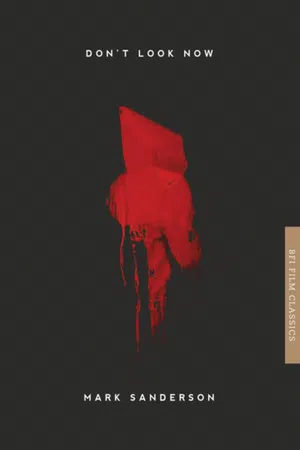
Don't Look Now, released in 1973, confirmed director Nicolas Roeg as one of the
most stylish and innovative British directors of the postwar period. Adapted
from a short story by Daphne du Maurier, it is both a complex study of how
people come to terms with grief and a chilling tale of murder set among the
canals and churches of Venice. Featuring telling performances by Julie Christie
and Donald Sutherland as the couple whose daughter has tragically died,
Don't Look Now depicts the way in which the macabre and the everyday are
intertwined.
In his lucid, subtle account, Mark Sanderson describes the collaboration
between director and actors that sustained the film's emotional richness.
He returns to du Maurier's original text and to the traditions of Gothic writing
that underpin Don't Look Now's combination of horror, melodrama and black
comedy. Sanderson examines the film's intricate visual style, uncovering the
way in which particular motifs are used to amplify its depiction of two terrible
deaths. He finds compensation for the film's grimly fatalistic view of life in its
celebration of sexual relationships and the power of recollection. The book
includes an exclusive and in-depth interview with Roeg as well as rare and
unpublished comments from Christie.
In his foreword to this special edition, published to celebrate the 20th
anniversary of the BFI Film Classics series, Jason Wood places Don't Look Now
in the context of Roeg's film-making careeer, and draws upon Roeg's revealing
insights into the film's production.
- 88 pages
- English
- ePUB (mobile friendly)
- Available on iOS & Android
eBook - ePub
Don't Look Now
About this book
Trusted by 375,005 students
Access to over 1 million titles for a fair monthly price.
Study more efficiently using our study tools.
Information
1 ‘I’m getting out of here.’
October 1995. A glossy commercial for the Ford Mondeo, featuring the actor David Threlfall as a man who leaves Venice because he misses his motor-car, is being shown on British television. The Times publishes its Top 100 Cult Films: the holder of position number five is a ‘hypnotic chronicle of a death foretold’ whose ‘horrific, heart-stopping climax … gives you an even bigger shock second time around’. And Haunted, a ghost story starring Aidan Quinn and directed by Lewis Gilbert, is released in Britain. This pedestrian movie is enlivened by a seance attended by, among others, actress Hilary Mason. All three pay tribute to a film that was released in the same month twenty-two years ago: Nicolas Roeg’s Don’t Look Now.
The TV ad is a cunning pastiche of the movie: sun glinting on water, pigeons fluttering, thirty seductive seconds of perpetual motion. But, because cars would not sell if they were associated with corpses, the floating funeral cortège featured at the end of the film has been replaced by a wedding flotilla.
The four films that came higher in The Times list were, inevitably, Jim Sharman’s The Rocky Horror Picture Show (1975); Performance (1970) – also directed by Roeg, with Donald Cammell; John Waters’s Pink Flamingos (1972); and Todd Browning’s Freaks (1932). The fact that Roeg’s work figures twice in the top five testifies to his ability to hit a nerve – if not tap a vein – but the word ‘cult’ implies appreciation by a discriminating, or wilfully undiscriminating, few; and it is Roeg’s uncompromising approach to his material that has occasionally caused him to be discriminated against. Don’t Look Now, however, is one of his most accessible films and warrants a wider audience.
Hilary Mason plays Heather, the blind clairvoyant, in Don’t Look Now. Haunted also refers to Roeg’s film by way of plot, as well as echoing two other excellent British pictures of the 60s: Jack Clayton’s The Innocents (1961) and Robert Wise’s The Haunting (1963). It is not surprising that a film made in the mid-90s should hark back to one made in the 70s: once seen, Don’t Look Now is impossible to forget. If such disparate details are anything to go by, the film has made an indelible impression on the cinematic imagination, and Roeg, certainly the greatest living director in Britain, deserves wider recognition.
There was still another month to go till my eleventh birthday when Don’t Look Now was given its British release on 16 October 1973. I did not get to see it until it was first shown on television six years later (by the BBC on 30 December 1979) but even then, besides scaring the hell out of me, it suddenly made me appreciate the true potential of cinema. Having been made to study the multiple intricacies of irony at school, I soon saw that even the title of the film was ironic: what it was really saying was ‘Look at Me!’
And Don’t Look Now can be looked at in several ways: as a brilliant example of literary adaptation; as Gothic thriller; as black comedy; as an exploration of grief. As a teenager I was struck by the second; as a student I was impressed by the first; in my twenties I appreciated the third; and now, in my thirties, I have been made to realise by force of circumstances – the loss of someone close – just how sensitive and perceptive is its handling of bereavement. The flashy technique and dazzling style masks a strong undertow of genuine feeling that has often been overlooked. This is what makes Don’t Look Now much more than a consummate chiller: there is genius in its treatment of genre.
Of course the movie is actually all of these things at the same time. Roeg is having his cake and eating it, sending up the conventions of ghost stories while investing them with new meaning; having it both ways is one of the hallmarks of a masterpiece. Don’t Look Now is also a film about film. He uses light to illuminate life.
In the course of writing this book, I conducted interviews with Roeg and with Julie Christie. Extracts from these interviews form part of Chapter Three. An edited version of the complete interview with Roeg makes up Chapter Nine.
2 ‘So many impressions to seize and hold.’
Unlike the other chapter titles in this book, the above line does not appear in the script of Don’t Look Now. But it epitomises the film. It is taken from page 31 of the short story of the same name – its first three words providing the title – by Daphne du Maurier. The story was adapted for the screen by Allan Scott – who also collaborated with Roeg on Castaway (1986), The Witches (1989) and Cold Heaven (1990) – and Chris Bryant. First published in 1970, it tells the tale of John and Laura Baxter who, in an attempt to come to terms with the death of their daughter Christine, take a trip to Venice. Laura soon falls under the spell of two sisters, one of whom, a blind psychic called Heather, claims to have received a message from Christine telling her parents that they are in danger while they remain in the city. John pooh-poohs the suggestion and is subsequently murdered by a female dwarf. His final thought provides the last line: ‘Oh God, what a bloody silly way to die ...’ (p. 55). It is a superb conclusion: horror, embarrassment and comedy collide to produce a punch line with real punch. ‘I wanted to clap when I read that line,’ Roeg told Sight and Sound in 1973. ‘I did think of keeping the line at one time, but at that point it would have been crazy for him to say anything.’ Instead Roeg transforms the verbal flourish into an equivalent sequence of stunning visual bravura (analysed in Chapter Eight).
Even though the film is a remarkably faithful adaptation – in spirit as well as substance – some crucial changes have been made. When the story begins Christine has already died of meningitis. The opening sequence of the film – analysed shot by shot in Chapter Five – shows her drowning. Besides providing a much more dramatic start, this enables Roeg to set up the correspondence between the little girl and the dwarf straightaway, to emphasise the importance of water in the story and to ensure that the colour red is immediately associated with danger and death. In the story it is Laura who wears a ‘scarlet coat’ (p. 30) and Christine a ‘blue dress’ (p. 13). Roeg reverses the colours so that the dwarf can be a little red riding-hoodlum, and thus all the more conspicuous.
Christine is the Baxters’ second child. Their first, Johnny, attends boarding school in England but is still the means by which his parents are separated. Du Maurier has the Baxters holidaying in Venice, which would be an odd choice if your daughter had drowned, so the film provides them with a pretext: John is overseeing the restoration of a church dedicated to Saint Nicholas. In case we miss the point, Bishop Barbarrigo (Massimo Serato) – who does not appear in the story – tells Laura that Saint Nicholas is the patron saint of scholars and children: ‘An interesting combination, don’t you think?’. He is, of course, also known as Santa Claus, whose garb is traditionally red. John will soon be seeking help at the police station, ‘the nick’, and will eventually be killed by the devilish dwarf, the ultimate personification of evil being Old Nick. And Nicolas is Roeg’s Christian name. The film creates such an atmosphere of the paranormal and the paranoid that there seems no room for harmless coincidence.

‘Christine is the Baxters’ second child’
After Laura tells John about the weird sister’s message they are woken in the middle of the night by a telephone call from England. Communication – getting in touch, bridging the gap, crossing the threshold – is one of the main themes of Don’t Look Now. In the story Johnny has suspected appendicitis but in the film he has been injured during a fire practice. Such drills are supposed to prevent accidents not cause them: one example of how a well-intentioned attempt to achieve something ends up precipitating the direct opposite. A source of tragedy certainly, but also the mainspring of black comedy.
Laura immediately assumes that Heather’s portentous message refers to this accident; she has lost one child and does not want to lose another. She is wrong. Roeg, like du Maurier, is in two minds about the Scottish sisters, seeing them as both silly and sinister.

Laura meets two sisters who claim to be able to contact her dead child. ‘Helping people in Roeg’s films is always dangerous’
On the first page of the story Laura tells John, ‘They’re not old girls at all ... They’re male twins in drag.’ They are portrayed with great skill on the screen by Mason (Heather), who is English, and Clelia Matania (Wendy), who is Italian. The suspicion that they may be tweedy lesbians is given a comic twist by Roeg when he has them inadvertently entering the male lavatories in the restaurant. Wendy, the sighted sister, has something in her eye and so neither of them can see where they are going. Laura’s decision to help them prompts Heather’s confession that she has ‘seen’ Christine.
Helping people in Roeg’s films is always dangerous. Turner (Mick Jagger) helps Chas (James Fox) in Performance by granting him sanctuary but ends up being shot. The Aborigine (David Gumpilil) in Walkabout (1970) saves the lives of the girl (Jenny Agutter) and boy (Roeg’s son Lucien John) but ends up hanging from a tree. And John’s attempts to help what he thinks is a distressed little girl only succeed in getting him hacked to death. All three selfless acts turn out to be different forms of suicide – half-wished, half-feared – which, depending on your point of view, can either be seen as the utter loss of self or the ultimate act of self-possession. It would seem that the only way to survive is to keep yourself to yourself – but that way, as Jack McCann (Gene Hackman) finds to his cost in Eureka (1982), madness lies. You have to keep trying to reach out. As E. M. Forster wrote in Howard’s End: ‘Only connect!’
But are the sisters helpful or harmful? Du Maurier’s sceptical ‘a seance in the living room, tambourines appearing out of thin air’ (p. 52) finds it equivalent (when Laura asks, ‘Can you ever contact people?’) in Heather’s outburst, ‘They all want a lot of mumbo-jumbo about ectoplasm and holding hands’, which is soon unconsciously echoed by John: ‘I’m not going to get involved with two neurotic old women in a session of mumbo-jumbo. No way.’ Holding hands is an important gesture throughout the film.
It is essential to mark out one’s territory – the familiar haunt of such ghost writers as M. R. James, Henry James and James Herbert – so that one can begin to undermine it. John’s ‘sudden rather unkind picture of the two sisters putting on headphones in their bedroom, listening for a coded message from poor Christine’ (p. 51) transfers to the screen as the sudden cut to the scene in which the two sisters are laughing their heads off in a hotel room. It suggests that, along with the Church of St Nicholas, they may be phonies: ‘I’m restoring a fake,’ says John. But the viewer has no idea what has caused their laughter: it may be a memory evoked by one of the photographs of the children; it may be something one of them has said. Their cackling could be the horrid laughter of Jacobean tragedy or the helpless giggling of two sweet old ladies. Either way, whether they are guilty or innocent, the startling scene is simultaneously scary and amusing. Both du Maurier and Roeg want to keep us guessing, to unsettle us, thus enhancing the creepy atmosphere. In the story the hotel manager is always helpful and the policeman always reassuring but in the film they soon cease to be so. As John becomes ever more distraught the people he turns to for help – those ordinarily expected to be of service – only increase his sense of discomfort.
Alfred Hitchcock, like du Maurier, was a master of unease and filmed three of her works: Jamaica Inn (1939), Rebecca (1940) and The Birds (1963). In each case it is not just a question of plot: her insistence on sound and vision makes her an intensely cinematic writer. In ‘Don’t Look Now’ her repeated use of the word ‘glittering’ to describe Venice – ‘a bright facade put on for show, glittering by sunlight’ (p. 25) – is matched by Roeg’s repeated use of shots of sunshine reflected in water, windows and mirrors. The effect is literally dazzling, often making the viewer squint or think about holding up a hand to shield the eyes: don’t look now. And her attention to the noise things make – ‘there was a crunch of feet on the gravel’ (p. 11); ‘he heard the quick patter of feet’ (p. 20); ‘their heels made a ringing sound on the pavement and the rain splashed from the gutterings above’ (p. 20) – is literally echoed by Roeg on an exceptionally complex soundtrack. It is a truism that the unsighted can hear better than the sighted: Heather – who, like Tiresias, can also ‘see’ better – tells John that she likes Venice for this very reason: ‘It’s so safe for me to walk ... the sound changes you see as you come to a canal and the echoes off the walls are so clear.’ Don’t Look Now reveals Roeg’s admiration for Hitchcock, and, indeed, contains one direct tribute to him. The jump-cut at the end of the opening sequence in which Laura’s short, sharp scream merges with the drill as it pierces the stone of St Nicholas’s mirrors the cut in The Thirty-Nine Steps (1935) when a woman’s terrified scream merges with that of a steam train’s whistle.
It is Hollywood tradition for the ori...
Table of contents
- Cover
- Title Page
- Dedication
- Contents
- Foreword: Nicolas Roeg Jason Wood
- 1. ‘I’m getting out of here.’
- 2. ‘So many impressions to seize and hold.’
- 3. ‘We’ve been trying to reach you.’
- 4. ‘What is it you fear?’
- 5. ‘The deeper we get the more Byzantine it gets.’
- 6. ‘It’s incredible you can’t change your course.’
- 7. ‘Nothing can take the place of the one that’s gone.’
- 8. ‘We’re almost there.’
- 9. ‘I know where we are now.’
- Credits
- Bibliography
- eCopyright Page
Frequently asked questions
Yes, you can cancel anytime from the Subscription tab in your account settings on the Perlego website. Your subscription will stay active until the end of your current billing period. Learn how to cancel your subscription
No, books cannot be downloaded as external files, such as PDFs, for use outside of Perlego. However, you can download books within the Perlego app for offline reading on mobile or tablet. Learn how to download books offline
Perlego offers two plans: Essential and Complete
- Essential is ideal for learners and professionals who enjoy exploring a wide range of subjects. Access the Essential Library with 800,000+ trusted titles and best-sellers across business, personal growth, and the humanities. Includes unlimited reading time and Standard Read Aloud voice.
- Complete: Perfect for advanced learners and researchers needing full, unrestricted access. Unlock 1.4M+ books across hundreds of subjects, including academic and specialized titles. The Complete Plan also includes advanced features like Premium Read Aloud and Research Assistant.
We are an online textbook subscription service, where you can get access to an entire online library for less than the price of a single book per month. With over 1 million books across 990+ topics, we’ve got you covered! Learn about our mission
Look out for the read-aloud symbol on your next book to see if you can listen to it. The read-aloud tool reads text aloud for you, highlighting the text as it is being read. You can pause it, speed it up and slow it down. Learn more about Read Aloud
Yes! You can use the Perlego app on both iOS and Android devices to read anytime, anywhere — even offline. Perfect for commutes or when you’re on the go.
Please note we cannot support devices running on iOS 13 and Android 7 or earlier. Learn more about using the app
Please note we cannot support devices running on iOS 13 and Android 7 or earlier. Learn more about using the app
Yes, you can access Don't Look Now by Mark Sanderson in PDF and/or ePUB format, as well as other popular books in Media & Performing Arts & Film & Video. We have over one million books available in our catalogue for you to explore.