- 320 pages
- English
- ePUB (mobile friendly)
- Available on iOS & Android
eBook - ePub
About this book
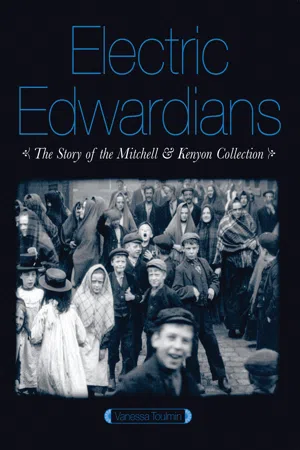
Electric Edwardians presents a stunning visual record of the films of Sagar Mitchell and James Kenyon, combined with an illuminating discussion of the films and the social context of their production by Vanessa Toulmin, a leading authority on the collection. Advertised as 'local films for local people', the films of Mitchell and Kenyon were commissioned by travelling exhibitors in the early twentieth century for screening in town halls, village fetes and local fairs. Audiences paid to see their neighbours, families and themselves on the screen, glimpsed at work and at play. This attractive volume includes over 200 illustrations drawn from the Mitchell and Kenyon collection, as well as contemporary posters and handbills from the National Fairground Archive. Vanessa Toulmin's lucid accompanying text provides an introduction to the work of the M&K company, the showmen who commissioned their films, and their place in early British cinema. Focusing on major themes, such as Leisure and Recreation, Sport, Industry, the Boer War and the City, Toulmin explores how the M&K collection deepens our understanding of these key aspects of Edwardian life.
Trusted by 375,005 students
Access to over 1 million titles for a fair monthly price.
Study more efficiently using our study tools.
Information


The Mitchell & Kenyon Film Company
The mass of actuality films from the first decades of film history in our archives around the world are ripe for rediscovery and re-examination. They constitute a neglected and, indeed, repressed aspect of film history. They present an incredibly rich reserve of information about the foundation of our modern culture . . .1
DISCOVERY
What we now know as the Peter Worden Mitchell & Kenyon Collection first became a historical reality when three large drums containing over 800 reels of nitrate film were acquired by the BFI in July 2000. The Collection came to light in June 1994 when Peter Worden, a Blackburn businessman, arranged for two local workmen to bring the films they had found in a local shop to him. Worden recalls the moment thus:
On 23rd June 1994 my wife and I went to the Pavarotti concert at the Birmingham NEC . . . On our return, there was a message for me from the owner of a local wedding video and film to video transfer company who knew I had an interest in old, especially Blackburn orientated, film. Several specimen rolls of 35mm film had been brought in to him, which he wanted me to look at. On examination, these were all stylus-inscribed at the ‘head’, were typically 50´ to 100´ in length, and clearly M&K because they had been found in the cellar of 40 Northgate. This building had been unoccupied for about 18 months . . . In the cellar had been found 3 metal drums approximately the size of milk churns minus the conical upper section. All were crammed solid with film, and if I didn’t ‘rate’ them, they were going into the skip! I contacted the foreman of the work-gang and, curbing my excitement, arranged for the drums to be delivered to me.2

Operatives of Acme Spinning Co., Pendlebury (1901), including James Kenyon captured at the front of the picture
When the drums were inspected, they were found to contain separate layers of between fifteen and twenty films per layer, with sixteen layers in total. Each roll of film was wrapped with a rubber band and many had scraps of paper attached to them. These pieces of paper invariably contained information pertaining to the location of the film, the name of the exhibitor or a date of filming. In all instances, they corroborated the information on the first two frames of the negatives, which were either inscribed with a stylus or black ink. The scraps measured between one-and-three-quarter inches in length and one-and-a-half inches wide and were either blank pieces of paper cut to size or unused handbills produced by Mitchell & Kenyon in association with a travelling exhibitor.
Over the next three months, each layer of film was carefully taken out of the drums, the dust and debris that had formed between the films carefully vacuumed out, and then placed into small plastic sandwich bags. The paper inscriptions were placed in the bags and the information from the first two frames copied onto a sticky label on the outside of the sandwich bags. The films were numbered and placed in plastic cartons and stored in the unplugged refrigeration unit.3 The work undertaken nightly over three months by Peter Worden and Robin Whalley produced a working list of the showmen/exhibitors who were associated with Mitchell & Kenyon, a timescale of the film production and the geographical boundaries where the firm operated. The numbering system employed by Peter and Robin has been retained for the filmography and all film titles in the collection are preceded by the original number that was assigned to them immediately after their discovery.4
The discovery was first premiered in Blackburn in November 1994 when Peter Worden presented a selection of newly restored material on 16mm to an audience consisting of local people, predominantly members of the Blackburn Local History Society.5 Between 1994 and 1999, Peter sent various batches of films to a commercial laboratory to be printed, and showed a selection of this material to local interest groups in the Lancashire region.
Eventually, in July 2000, with the aid of the NFA at the University of Sheffield, 830 camera negative rolls were acquired by the BFI to form the Peter Worden Mitchell & Kenyon Collection. Alongside the discovery of the Peter Worden Collection, two smaller collections of Mitchell & Kenyon material, numbering approximately seventy camera negatives, appeared between 1994 and 1997 and are now held by the Cinema Museum in London and Lobster in Paris.6 A selection of the fiction films will be considered in the following chapter.
Together with the existing titles held in the NFTA, the Imperial War Museum and the North-West Film Archive, over 900 films relating to the company now survive, making it the third largest film collection associated with one company from the early film period after the Edison Collection in the United States and the Lumière Collection in France.7 Although the filmic record is immensely rich, one major disappointment was the lack of any contemporary archival material or business records associated with the company, either in Blackburn itself or in the hands of private collectors. The existence of this material was cited in an interview with Sagar Mitchell published in 1951 and in obituaries following his death in 1952.8 When Sagar’s son, John Mitchell, retired from the family business in 1959, according to John’s daughter, June Witter, the family offered the films, costumes, studio equipment, cameras and business records to Walter W.Yeates, the Librarian and Curator of the Museum of Blackburn. When the offer was rejected, a local authority refuse wagon was hired and all extant material relating to the company was disposed of by Blackburn Council.9
The importance of business records in assessing the wider social and economic significance of early British film companies cannot be underestimated.10 The absence of any business records for Mitchell & Kenyon means that we have only the films themselves, and the advertisements placed in local, national and trade press in the 1900s, with which to understand their expansion and development as a company. This is in contrast to other companies like the Warwick Trading Company, Pathé, Edison and the American Biograph Company, where the filmic record is balanced by important archival material. Over the course of a decade of research, the only business record found in relation to the company is one memo written to Sydney Carter of New Century Pictures in Bradford, offering their services as a company for the taking of local views.11 Consequently, any consideration of the importance of Mitchell & Kenyon in relation to their contemporaries must rely mainly on the historical record of the rich visual treasure of films. In order to create an overview of Mitchell & Kenyon as a company, we must view the inscriptions left on the negatives as a record of a business transaction, as they document the company’s relationship with the travelling exhibitors. In addition, the advertisements placed by the company in contemporary newspapers of films for sale, or the services they offered to the trade, are a supplementary source of information (see Plate 1).
It is only through studying these sources alongside the films that the company’s impact as a business in the rapidly expanding world of Edwardian film-making and exhibition can be examined and evaluated. Finally, it must be understood that although the company produced films from 1899 to 1913, the largest body of material relates from 1900 to 1905, with only 10 per cent of the collection relating to the period...
Table of contents
- Cover
- Title Page
- Contents
- Acknowledgments
- Foreword
- 1. The Mitchell & Kenyon Film Company
- 2. The Films
- 3. Showmanship
- 4. Leisure and Entertainment
- 5. Sport in the Edwardian Era
- 6. The Edwardian City
- 7. Edwardian Industries and the Workforce
- 8. Militarism in the Edwardian Age
- Afterword
- Filmography – Subject
- Filmography – Location
- Further Reading
- Additional Sources
- Index
- eCopyright
Frequently asked questions
Yes, you can cancel anytime from the Subscription tab in your account settings on the Perlego website. Your subscription will stay active until the end of your current billing period. Learn how to cancel your subscription
No, books cannot be downloaded as external files, such as PDFs, for use outside of Perlego. However, you can download books within the Perlego app for offline reading on mobile or tablet. Learn how to download books offline
Perlego offers two plans: Essential and Complete
- Essential is ideal for learners and professionals who enjoy exploring a wide range of subjects. Access the Essential Library with 800,000+ trusted titles and best-sellers across business, personal growth, and the humanities. Includes unlimited reading time and Standard Read Aloud voice.
- Complete: Perfect for advanced learners and researchers needing full, unrestricted access. Unlock 1.4M+ books across hundreds of subjects, including academic and specialized titles. The Complete Plan also includes advanced features like Premium Read Aloud and Research Assistant.
We are an online textbook subscription service, where you can get access to an entire online library for less than the price of a single book per month. With over 1 million books across 990+ topics, we’ve got you covered! Learn about our mission
Look out for the read-aloud symbol on your next book to see if you can listen to it. The read-aloud tool reads text aloud for you, highlighting the text as it is being read. You can pause it, speed it up and slow it down. Learn more about Read Aloud
Yes! You can use the Perlego app on both iOS and Android devices to read anytime, anywhere — even offline. Perfect for commutes or when you’re on the go.
Please note we cannot support devices running on iOS 13 and Android 7 or earlier. Learn more about using the app
Please note we cannot support devices running on iOS 13 and Android 7 or earlier. Learn more about using the app
Yes, you can access Electric Edwardians by Vanessa Toulmin in PDF and/or ePUB format, as well as other popular books in Mezzi di comunicazione e arti performative & Storia e critica del cinema. We have over one million books available in our catalogue for you to explore.