This official history of the British Board of Film Classification (BBFC) draws on unprecedented access to the BBFC's archives to trace 100 years of film classification, with contributions from leading film critics and historians and case studies of controversial films such as Battleship Potemkin and A Clockwork Orange.
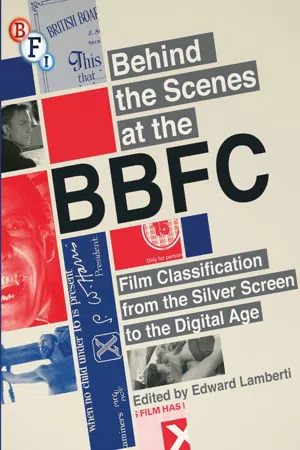
eBook - ePub
Behind the Scenes at the BBFC
Film Classification from the Silver Screen to the Digital Age
- 240 pages
- English
- ePUB (mobile friendly)
- Available on iOS & Android
eBook - ePub
Behind the Scenes at the BBFC
Film Classification from the Silver Screen to the Digital Age
About this book
Trusted by 375,005 students
Access to over 1.5 million titles for a fair monthly price.
Study more efficiently using our study tools.
Information
1
CENSORSHIP UNDER SIEGE : THE BBFC IN THE SILENT ERA
Simon Brown
From the very beginning, the British Board of Film Censors found itself under siege. Its early years were categorised by considerable uncertainty as its motives and decisions were questioned and its very existence challenged. As an organisation it sat at the centre of a maelstrom of powerful, combative and competing institutions, each with their own agenda and each regarding the BBFC with varying degrees of suspicion, indifference and, at times, contempt. These institutions form the major players in the story of the origins and development of the BBFC during the silent era. First was the Home Office, the government department responsible for public order in the UK. Second were the hundreds of local authorities around the country, each of which was responsible for granting licences to cinemas that allowed them to operate within their boundaries. The third was the film trade itself, made up of the three separate areas of production, exhibition and distribution (here in the form of renters). Each of these was represented by separate and often warring trade organisations, respectively the Kinematograph Manufacturers’ Association (KMA), the Cinematograph Exhibitors’ Association (CEA) and, later, the Kinematograph Renters’ Society (KRS). Between them the Home Office, local authorities and the trade brought issues of public safety, legal authority and economic necessity to bear on what was a young, small and often powerless organisation, making its formative years ones of insecurity. The story of the BBFC in the silent era is the story of a struggle for recognition, respect and validation.
The Origins of the BBFC, 1909–12
The origins of the BBFC initially lay in the Cinematograph Act 1909, which was designed primarily to regulate film shows for the purpose of public safety. At that time cinema shows were a combustible mixture of dangerous ingredients. First, the strip of film was made of cellulose nitrate, which was highly flammable, burned extremely quickly and was very difficult to put out. Second, this dangerous material ran through a projector which had to produce a strong beam of light in order to project the image on the film strip onto a screen. One common source of illumination for early film projectors was limelight, in which a piece of lime was heated by a gas jet to produce a bright white light. The heat produced by the lime was intense, and while normally a strip of nitrate passing through the gate of the projector at around sixteen frames per second was exposed to the heat for too short a time to catch alight, if the film got stuck in the gate for only a few seconds it would be enough for it to burn.1 The third danger element was the venue itself. Up until around 1906 the main venues for showing films were music halls and travelling shows in fairgrounds. From 1906 onwards, there was a proliferation of fixed-site cinema shows, commonly referred to nowadays as ‘penny gaffs’ and generally considered to be akin to the more famous early American cinemas known as Nickelodeons. Recent research by film historian Jon Burrows suggests, however, that the term ‘penny gaff’ was nowhere near as ubiquitous as has been frequently suggested, and that the term ‘penny cinema’ was more common, ‘gaff’ being a more derogatory term.2
Regardless of the name, penny cinemas tended to be small and cheap, often located in empty shops that were crudely converted for the purpose of film shows, with a few seats, a screen or sheet at one end and a projector at the other. More often than not there was only one door, which doubled as both entrance and exit and next to which the projector would be located. In the event of a projector fire, this one door and only route of escape could easily be cut off by the swiftly burning film and the resulting large amounts of toxic smoke. Reports of fires in penny cinemas were actually few and far between, but the potential for public-safety disasters did not go unnoticed. There were some high-profile catastrophes, including an appalling fire at a film show in Paris in 1897 in which around 140 people lost their lives. Other examples of the dangers of nitrate film included a fire in 1907 in Cecil Court, a small alleyway between St Martin’s Lane and Charing Cross Road in London which was home to many early British film businesses, a fatal fire at the Hepworth Manufacturing Company studios in Walton-on-Thames, also in 1907 and a fire at Newmarket Town Hall in September the same year.3 While only one of these was a public venue, incidents such as these served to highlight the dangers.
The London County Council (LLC), one of the hundreds of local councils in Great Britain, had already drawn up a series of rules to regulate cinema shows in the capital, including placing the projector in a fireproof box and banning the use of certain illuminants. The regulations, drawn up initially in January 1898 shortly after film shows began and revised in 1906, were enforceable under the Disorderly Houses Act 1751. They specifically related to venues featuring music and dancing (such as music halls), which distinguished such venues from the so-called legitimate theatres (where plays were put on) regulated by central government through the Lord Chamberlain’s Office.4 The problem was that while the regulations specifically related to cinema exhibition, they could only be enforced where the premises were actually licensed. The LCC only had authority over venues which had a music and dancing licence and it was not clear whether cinemas required a licence or not, since cinemas did not always involve live music and rarely, if ever, involved dancing. While it was common for a pianist to accompany the films, many other options were also available, including a lecturer who would speak alongside the films, as well as mechanical pianos that would play standard pieces without the need for a pianist, and even sound effects machines. There was some debate around the issue of whether the presence of a mechanical piano would mean a venue required a licence and thus make it eligible for prosecution under the law.
None of this, however, detracted from the basic principle of public safety. The LCC’s main expert on cinematograph shows, Walter Reynolds, strongly advocated new national legislation specifically targeting film shows, stating that, as noted by David R. Williams, ‘Twentieth-century amusements needed twentieth-century regulations.’5 As unlicensed cinematograph shows spread throughout the country, many local councils around Britain moved to impose their own regulations. The desire for national legislation grew to the point that an announcement was made in February 1909 that such legislation would be drawn up and presented to Parliament.6 The Cinematograph Act 1909 was passed by both Houses and received Royal Assent in November, coming into force on 1 January 1910. The enforcement of the Act was given over to the various local authorities that were to be responsible for licensing premises under their jurisdiction.
While certain clauses in the Act did cause concern among film exhibitors, in general the trade supported its implementation because the main target was not the growing exhibition chains or circuits but rather the small-scale penny operations which were, in Reynolds’s own words, run by ‘rapacious, unscrupulous manager(s) […] wilfully placing […] exploited patrons in danger’.7 As much as this Act was about public safety, bringing in a formal system for licensing cinemas that required a minimum set of standards to be met was also therefore about ridding the trade of opportunist businessmen out to make quick money by charging low prices for poor-quality films – often scratched prints bought cheaply through secondhand sales companies – in grubby, unsuitable premises. The Act was therefore very welcome for an industry struggling not only with an apparently undesirable subgroup of entrepreneurs but also with a poor reputation as a working-class form of largely sensationalist entertainment that for many in society was a cause for concern. The Daily Telegraph in March 1908 published a letter by a vicar in Whitechapel who complained about a film called The Life of Charles Peace (1905). Peace was a burglar who had been executed for murder in 1879 and whose exploits, including a daring escape from a moving train, had been widely reported by the press. The film, made by William Haggar in South Wales, recounted key moments of Peace’s life and was considered, by the vicar at least, to be violent and sensationalist.8 In February 1909, the Commissioner of Police asked for tighter control over films that glorified crime, while more controversially in July 1910, the LCC banned a film of the famous prizefight between Jack Johnson and James Jeffries. Johnson was a black man, and at the time was the heavyweight champion. Jeffries came out of retirement to win back the title for white America and his defeat caused race riots throughout the US. The film was banned in the US and concern that it could spark similar violence in the UK prompted the LCC’s decision.9 Thus not only did the Act encompass issues of public safety, indirectly it also addressed the question of low-quality working-class film shows, as well as the morality of the subject matter of films playing, often to children, in these penny cinemas.

The Life of Charles Peace (1905), one of a number of early films accused of glorifying crime
Concerns over what were seen to be controversial films playing to working-class audiences led a number of local authorities to request the power to prohibit exhibition of films they disliked and, in early 1911, legal precedent made this possible. The LCC commonly stipulated in its music-hall licences that venues could not open on Sunday and this condition was transferred to the licensing of cinema shows under the 1909 Act. In early 1910, the LCC issued a summons to the Bermondsey Bioscope Company for breach of the licence, having discovered they were showing films on Sundays. The Bermondsey Bioscope Company claimed that the LCC exceeded the bounds of the Act by including the Sunday stipulation. Having lost the case initially, the LCC appealed and won in December 1910. The Divisional Court scrutinised the Act and focused on section 2, which allowed that any county council could grant a licence ‘under such restrictions as […] the council may by the respective licences determine’. In the judgment of the court, this phrase permitted the LCC to impose any conditions it wanted in granting a licence, regardless of whether or not they related to safety. This decision formed the legal structure under which film censorship was, and continues to be, based, because it enshrined in law the fact that county councils could, if they wished, restrict the types of films which were shown as a condition of granting a licence.
It did not take long for some local authorities to add to any licence the condition that the films shown must not be improper or indecent. Beyond statutory legislation such as obscenity and libel laws, the concept of indecency was left largely to matters of individual taste, which made the situation very difficult for exhibitors who, with perhaps a few obvious exceptions, could not be certain if a film would attract complaints. This gave rise to a potential situation in which any exhibitor showing a film which just happened to offend one of the council members or a number of influential patrons could find themselves in court and fined for a breach of licence, while another exhibitor within a few miles might have no problems at all.
Faced with a tarnished public image, and this unworkable situation for exhibitors, the filmmakers’ trade body, the KMA, met and agreed that they should approach the Home Office and suggest a form of self-regulated censorship. They approached a number of influential film renters who also agreed and, in February 1912, a deputation met with the Home Secretary, Reginald McKenna, to put forward their proposal.10 The stakes were high, and so to demonstrate both its seriousness and its commitment to the concept of an independent body, the trade approached George A. Redford to be the President of the new organisation. Redford had no connection to the film industry but had been Examiner of Plays at the Lord Chamberlain’s Office. Thus he brought with him knowledge and experience of censorship and ties to government but not of the film business.11 He also had a certain middle-class respectability due to his links with the theatre; this would add an air of authority and responsibility to the proposed body. In addition, the trade suggested that while the censors would be independent of government, the Home Office could appoint a referee to act as a kind of appeal court in the event of disputes. McKenna was broadly supportive but firmly rejected the idea of either involving the Home Office directly or offering its formal support, since it had no actual authority over the process as it was envisaged and suggested by the trade.12 The power to regulate film content was held by the local authorities as a condition for granting a ci...
Table of contents
- Cover
- Title Page
- Contents
- Acknowledgments
- Notes on Contributors
- Foreword
- Preface
- Introduction: A Centenary Book
- 1. Censorship Under Siege: The BBFC in the Silent Era
- 2. ‘The People’s Amusement’: Cinemagoing and the BBFC, 1928–48
- 3. From the Snake Pit to the Garden of Eden: A Time of Temptation for the Board
- 4. The Trevelyan Years: British Censorship and 1960S Cinema
- 5. Wake of the Flood: Key Issues in UK Censorship, 1970–5
- 6. The ‘Poacher Turned Gamekeeper’: James Ferman and the Increasing Intervention of the Law
- 7. More than Just A ‘Nasty’ Decade: Classifying the Popular in the 1980s
- 8. Head-on Collisions: The BBFC in the 1990s
- 9. ‘The Last Days of the Board’
- 10. The Director’s Commentary
- 11. On the BBFC in the Digital Age
- Notes
- Index
- List of Illustrations
- eCopyright
Frequently asked questions
Yes, you can cancel anytime from the Subscription tab in your account settings on the Perlego website. Your subscription will stay active until the end of your current billing period. Learn how to cancel your subscription
No, books cannot be downloaded as external files, such as PDFs, for use outside of Perlego. However, you can download books within the Perlego app for offline reading on mobile or tablet. Learn how to download books offline
Perlego offers two plans: Essential and Complete
- Essential is ideal for learners and professionals who enjoy exploring a wide range of subjects. Access the Essential Library with 800,000+ trusted titles and best-sellers across business, personal growth, and the humanities. Includes unlimited reading time and Standard Read Aloud voice.
- Complete: Perfect for advanced learners and researchers needing full, unrestricted access. Unlock 1.5M+ books across hundreds of subjects, including academic and specialized titles. The Complete Plan also includes advanced features like Premium Read Aloud and Research Assistant.
We are an online textbook subscription service, where you can get access to an entire online library for less than the price of a single book per month. With over 1.5 million books across 990+ topics, we’ve got you covered! Learn about our mission
Look out for the read-aloud symbol on your next book to see if you can listen to it. The read-aloud tool reads text aloud for you, highlighting the text as it is being read. You can pause it, speed it up and slow it down. Learn more about Read Aloud
Yes! You can use the Perlego app on both iOS and Android devices to read anytime, anywhere — even offline. Perfect for commutes or when you’re on the go.
Please note we cannot support devices running on iOS 13 and Android 7 or earlier. Learn more about using the app
Please note we cannot support devices running on iOS 13 and Android 7 or earlier. Learn more about using the app
Yes, you can access Behind the Scenes at the BBFC by Edward Lamberti in PDF and/or ePUB format, as well as other popular books in Media & Performing Arts & Film & Video. We have over 1.5 million books available in our catalogue for you to explore.