- 168 pages
- English
- ePUB (mobile friendly)
- Available on iOS & Android
eBook - ePub
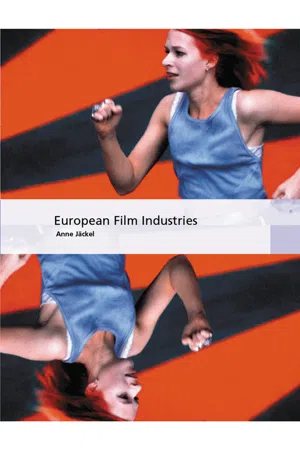
European Film Industries
About this book
In what kind of state is the European film business? This study is the first in a series that provides an accessible understanding of how the world's contemporary screen industries function. It looks at all the factors in play, from government regulation to the marketing strategies behind an international success like 'Run Lola Run'/'Lola Rennt'. Anne Jackel evaluates how Europe's film industries operate, their working practices and the region's place within the global business of cinema. Exploring trends in production, distribution and exhibition, the book considers a range of national and pan-regional developments. Key areas of critical debate are highlighted, including private and public financing, co-production, film policy, links between the film and television industries, and the threats to 'art cinema' from within and without Europe.
Trusted by 375,005 students
Access to over 1 million titles for a fair monthly price.
Study more efficiently using our study tools.
Information
1
Historical Developments in Europe's Film Industries
Historically, Europe's film industries have experienced periods of competitive strength and weakness. Rather than internal competition between nations, the main challenge facing Europe's film business has been how to maintain sustainable film industries faced with the pervasive dominance of Hollywood film. This has seen film industries become a key matter of economic and cultural policy-making among European nations. Various measures have been taken to aid or protect film in Europe, including quotas, subsidies, co-production agreements and initiatives to form pan-European distribution alliances. Tracing the history of Europe's film industries therefore involves exploring connections between market forces, conditions of cultural production, and state intervention.
THE EARLY YEARS
The early history of the film industry in Europe is one of inventors (the Lumière brothers, Max Skladanowsky, Kazimierz Proszynski) and entrepreneurs (Louis Gaumont and Charles Pathé in France, the Skladanowsky brothers and Oskar Messter in Germany and Ole Olsen, the founder of Nordisk, in Denmark). Until 1910, the majority of films distributed in the world were French. By producing and distributing films, or setting up chains of cinemas abroad, Gaumont and Pathé-Frères became powerful forces in the international film market. Early in the 20th century, other territories in Europe established film studios and began national production, Hungary in 1901, Poland in 1902 and Italy in 1905. Through the powerful cartel of the Motion Picture Patents Company, the US industry was able to restrict imports. In response, during 1909, European manufacturers made a failed attempt to form a trust in an effort to 'exercise market control and rationalise the European film industry' (Higson and Maltby, 1999: 23).1
World War I would strike a decisive blow to the French and other European film industries. Even before the war, the French monopoly of the film market had already ceased due to lack of investment, the failure of French companies to modernise, and strong competition from abroad (Sadoul, 1962; Thompson, 1985; Abel, 1993; Billard, 1995). Apart from Germany and its vertically integrated conglomerate Ufa, 'no European country survived World War I with a film industry' (Vincendeau, 1995: xiii).
INTER-WAR YEARS
World War I put an end to the global ambitions of European entrepreneurs and marked the beginning of Hollywood's domination of European markets. Two countries stood as major exceptions to this situation. A ban on supplying films to Germany meant that the national film industry there maintained its strength through producing for the domestic market. In the aftermath of the Russian revolution, cinema was nationalised under the Soviet regime. A trade blockade of the Soviet Union by the Western powers (only lifted in 1921) contributed to encourage domestic production and exhibition. Lenin famously declared, 'Of all the arts, for us cinema is the most important' (quoted in Taylor, 2000: 225) and, along with film schools, a formidable machinery for the production and distribution of propaganda films was set up.
In the West, despite intense hostility between individual nations, the 1920s saw a period of fertile development by Scandinavian, British, French, Italian and German film companies. Yet attempts at creating transnational alliances to compete with the major Hollywood studios proved elusive. Countries took protectionist measures by introducing a variety of different quota systems. Germany led the way when on 1 January 1921 it instituted the policy of restricting imports to 15 per cent of the footage produced in the country during 1919 (the equivalent of 180,000 metres) (Thompson, 1985: 106). Four years later the system was revised, with distributors being granted one import licence for every German feature they had handled in the previous year, thereby restricting foreign films to 50 per cent of the market. During the second half of the 1920s and into the 1930s, other European nations established their own systems, including Italy and Hungary in 1925, Austria in 1926, France in 1928 and Czechoslovakia in 1932 (pp. 211–12). These systems varied in how they tackled imports and were frequently revised.
Quotas aimed to protect indigenous production but in many cases they introduced problems that were to the detriment of the domestic industries. For example, in Britain, the Cinematograph Films Act of 1927 legislated that 7.5 per cent of the film footage circulated by distributors, and 5 per cent of the footage shown by exhibitors, should be of British origination (Glancy, 2000: 59). A British film was defined as a film made by a British studio, with 75 per cent of labour costs going to British citizens or citizens of the Empire, and made by a British company (defined in terms of the majority proportion of the company's directors). After the introduction of the quota, film production in Britain dramatically increased. However many of the films made were low-budget 'quota quickies', poor-quality films aimed at filling the quota (Low, 1997: 186–97). To solve this problem, the quota system was revised under the Cinematograph Films Act of 1938. While retaining the same definition of a British film, a cost test was introduced, demanding that a film should have incurred labour costs of at least £7,500 to qualify for the quota. Films with labour costs of £22,500 or £37,500 could qualify for double or triple quota credit. Rather than protect the British industry, this system was ripe for exploitation by the UK subsidiaries of the Hollywood studios. These subsidiaries were able to easily satisfy the demands of the quota, for while they were US-owned, appointment of UK citizens as company directors qualified them as British companies, and they could fulfil their annual commitment by producing three to four, double or triple quota titles that complied with the definition of British production. Mark Glancy (2000: 60) suggests this situation was particularly advantageous for the Hollywood studios at this time, as Britain was the most lucrative market in Europe for the American industry, and would become more so as the protectionist measures instituted by other nations reduced earnings from elsewhere in the region.
Collaborative agreements between private companies in the leading European film industries, and a constant flow of talent (stars, directors, costume and set designers) between Berlin, London, Paris and Rome, testified to practical co-operation between Europeans (Saunders, 1999). Cross-fertilisation occurred to such an extent that film historians have described the 1919–29 period as the 'golden' era of European cinema. In this period, a strong tradition of film art and film culture (Soviet cinema, the avant-garde, surrealism, German expressionism) developed in Europe.
Through a myriad of small companies, the major European territories managed to maintain production throughout the 1920s and 30s. In Germany, Ufa provided the only example of a powerful vertically and horizontally integrated European film conglomerate.2 Elsewhere, small production units lacked the necessary capital to update studios and laboratories. Film personnel were therefore enticed to move to the more active centres (Ufa or Hollywood). At the beginning of the 1930s, Europe's film companies were badly affected by the Wall Street crash of 1929, and the coming of sound brought a further blow to film industries lacking the necessary resources to invest in the new technology. American (Paramount) and German (Tobis) companies established several partnerships with European studios (Berlin, Joinville, Epinay) in order to make multiple-language versions, but the trend did not last. With some countries (France, Germany), however, the decade did represent a golden age for domestic popular cinema (Martin, 1983).
World War II brought mixed consequences for the domestic film industries of Europe. While many individuals went into exile, a new generation of film-makers managed to emerge. In the case of France, occupation saw the country inherit an effective organisational framework for the activities of its film industry with the formation of the Comité d'Organisation des Industries Cinématographiques (COIC).3 German occupation also saw a ban on Hollywood films in the major markets of continental Europe. After the war, the huge stockpile of unreleased American productions entered European cinemas on the tails of the Marshall Plan. As this surge of US imports came at a time of great audience demand, when national cinema infrastructures needed rebuilding, European film professionals mounted concerted protests to protect their domestic industries (Jeancolas, 1992).
POST-WAR DEVELOPMENTS IN THE WEST
To combat the flood of US imports, governments implemented protective measures (quotas, subsidies and tax incentives) in support of their domestic industries.4 Some of these measures (e.g. freezing American assets) resulted in Hollywood companies setting up subsidiaries in Europe in order to take advantage of local incentives for film production (Guback, 1969). In Britain, where MGM, Columbia and Fox established studio facilities to produce films, one-third of 'British' films had US backing by 1956. Various attempts at creating a European cinema union in the post-war era failed. However, collaboration between producers from different countries flourished under the aegis of intergovernmental co-production agreements.
CASE STUDY: THE CO-PRODUCTION AGREEMENT BETWEEN FRANCE AND ITALY
Frenchman M. Fourré-Cormeray is credited with the idea of a treaty giving film dual nationality. After making an experimental co-production agreement in 1946, the governments of France and Italy responded to pressure from their domestic industries by signing the 1949 Franco-Italian Agreement. It was the aim of the Agreement to return production to pre-war levels and, by making 'quality films', compete on the international market and offset the domination of Hollywood (Jäckel, 1996). Co-production status was granted to films with equal financial, artistic and technical contributions, as well as to 'twinned' films (that is, films in pairs with complementary participation from each co-producer). It was stipulated that an Italian-French Mixed Committee meet regularly to supervise the functioning of the agreement.
The agreement supported a range of complex and contradictory objectives: pooling resources together, opening the domestic markets of both countries to co-productions, determining the eligibility of co-productions for national subsidies and other benefits such as screen quotas, and encouraging the production of prestigious films appealing to both domestic and international audiences. Not all went well between co-production partners. Employment issues, such as apportioning the nationality of technicians being employed, and which nation's studios were to be used, were constant subjects of discord between Italian and French unions. Other disadvantages seemingly inherent in the system (cost escalation, differences in investment levels, compromises concerning the creative talent and the kind of films made) also emerged.
However, despite all those drawbacks, by 1953–4 the principal aims of the treaty were fulfilled. The Italian and French film industries had substantially increased their volume of production, and employment figures had risen. In terms of quality (e.g. star appeal and technical innovation), French-Italian films ranked high: co-productions made the launching of international stars possible and, compared to non-co-productions, more were made in colour (ibid.). Several French–Italian films also won critical acclaim and prizes at film festivals around the world. Examples include Au-delà des grilles (Mura di Malapaga) (René Clément 1949) and Nous sommes tous des assassins (Are We All Murderers?) (André Cayatte 1952) at Cannes; and Touchez pas au grisbi (Honour Among Thieves) (Jacques Becker 1954) at Venice.

Thérèse Raquin (The Adulteress, 1953)
Other countries made similar agreements. By the mid-1950s, France had co-production agreements with Germany, Spain, Argentina, Austria, Yugoslavia, Australia and the Soviet Union. Italy formed alliances with the German Federal Republic, Spain and Argentina. (The Netherlands, Sweden, Denmark and Hungary would also sign co-production agreements in the 50s.) However, by then, a significant number of films were already made with the participation of one or several foreign companies from countries that had not signed an agreement but that nevertheless benefited from the aid granted by national governments, pro-rata of their investment in the country. Designed to encourage production, the system had inevitably started to attract foreign (largely American but also British) producers eager to take advantage of the financial incentives offered by the governments of France and Italy. With the authorities often turning a blind eye to the penetration of foreign capital and personnel, Italian studios soon became service studios for wealthy, expatriate American producers.
Regularly revised – more often to allow flexibility between partners than to strictly enforce nationality criteria – for the next fifty years the Franco–Italian agreement became a model in Europe and beyond for countries seeking to secure a sustained production output.
POST-WAR DEVELOPMENTS IN THE EAST
In the post-war period, the Communist regimes of the Eastern Bloc (with the exception of Albania) made a strong commitment to supporting their film industries, as well as film education, even in periods of economic crisis. The USSR established a Ministry of Cinematography in 1946. Poland restructured and nationalis...
Table of contents
- Cover Page
- Title Page
- Contents
- Acknowledgments
- Introduction
- 1 Historical Developments in Europe's Film Industries
- 2 Developing and Facilitating Production
- 3 Production Financing and Co-production
- 4 European and Pan-European Production Initiatives
- 5 Film Distribution Networks within Europe
- 6 Film Exhibition and the European Box Office
- Conclusion
- Bibliography
- Index
- eCopyright
Frequently asked questions
Yes, you can cancel anytime from the Subscription tab in your account settings on the Perlego website. Your subscription will stay active until the end of your current billing period. Learn how to cancel your subscription
No, books cannot be downloaded as external files, such as PDFs, for use outside of Perlego. However, you can download books within the Perlego app for offline reading on mobile or tablet. Learn how to download books offline
Perlego offers two plans: Essential and Complete
- Essential is ideal for learners and professionals who enjoy exploring a wide range of subjects. Access the Essential Library with 800,000+ trusted titles and best-sellers across business, personal growth, and the humanities. Includes unlimited reading time and Standard Read Aloud voice.
- Complete: Perfect for advanced learners and researchers needing full, unrestricted access. Unlock 1.4M+ books across hundreds of subjects, including academic and specialized titles. The Complete Plan also includes advanced features like Premium Read Aloud and Research Assistant.
We are an online textbook subscription service, where you can get access to an entire online library for less than the price of a single book per month. With over 1 million books across 990+ topics, we’ve got you covered! Learn about our mission
Look out for the read-aloud symbol on your next book to see if you can listen to it. The read-aloud tool reads text aloud for you, highlighting the text as it is being read. You can pause it, speed it up and slow it down. Learn more about Read Aloud
Yes! You can use the Perlego app on both iOS and Android devices to read anytime, anywhere — even offline. Perfect for commutes or when you’re on the go.
Please note we cannot support devices running on iOS 13 and Android 7 or earlier. Learn more about using the app
Please note we cannot support devices running on iOS 13 and Android 7 or earlier. Learn more about using the app
Yes, you can access European Film Industries by Anne Jäckel in PDF and/or ePUB format, as well as other popular books in Media & Performing Arts & Film History & Criticism. We have over one million books available in our catalogue for you to explore.