eBook - ePub
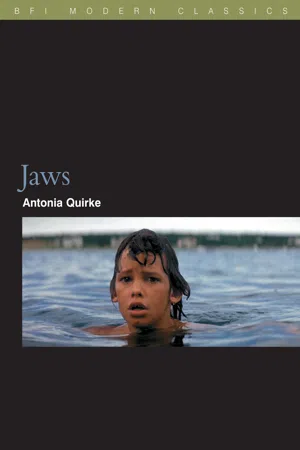
Jaws
About this book
Jaws divides critics into those who dismiss it as infantile and sensational, and those who see the shark as freighted with political and psychosexual meaning. The author argues that both interpretations obscure the film's success as a work of art.
Tools to learn more effectively

Saving Books

Keyword Search

Annotating Text

Listen to it instead
Information
The Land
THIRD FISHERMAN: Master, I marvel how the fishes live in the sea.
FIRST FISHERMAN: Why, as men do a-land; the great ones eat up the little ones.
William Shakespeare, Pericles
1. Shame
Before you know it, before you expect it, there’s a sound. The screen is dark, giving us time to settle down, that private second before it all begins. But there’s a sound, and we have to listen.
It’s the sound of marine life. A whale, perhaps? Dolphins. Sonar. At first it seems to reflect us. Sea-babble to accompany audience-babble, the sea version of the chatter of the cinema audience finding seats and taking off coats and finishing arguments and keeping an eye out for latecomers. But really it’s the sound of a sea orchestra tuning up, waiting for the soloist. The shark.
As soon as he starts playing, the blather is silenced, on screen and off. He moves through the water – this tuba, this double bass, this far end of the piano – with a roving eye. He’s at the bottom of the sea, brushing through kelp forests, like a convict escaping through some strange field. John Williams’ theme is at once serious and comical, solemn and skittish, building until it’s almost a refrain from West Side Story – that scene at the dance when the Jets and the Sharks circle each other with crouching daring, sure that everything to come is going to be heroic and mutinous and fun. But it’s over very quickly.
The break of rhythm in the credits is so unusual, a jump-cut, and the next wail we hear comes very much from the land, from a harmonica played badly round a beach fire. It is night. Someone else is playing the guitar. You know this group of people are not really hippies – they’re smoking cigarettes rather than roll-ups, and there’s something about their hair that suggests it can be made to look neat for the country club.
Any one of these kids could be Steven Spielberg. Before he made Jaws, he’d sit on the beach in LA watching Brian De Palma and Paul Schrader and the rest of that gang as they felt up each other’s girlfriends, did a line, got in a mess. He knew it wasn’t for him, that he wasn’t curious like that. And he was suspicious of the kind of person who pretended to be.
Eight years earlier Spielberg had made a card-calling short Amblin’ which was all about a guy who chased a free-spirited girl across southern California en route to the Pacific coast. Just a preppy slumming it for a week or two, a poser with mouth wash and loo roll secreted in his backpack. The blonde man that the camera now finds on the Jaws beach, sloshed in a mumsy jumper, is rather like that character. He’s sitting with his back against the fire looking at the blonde girl in the shadows near the fence.
She seems to be the real thing, her eyes properly bright. She’s clearly not one of this gang, this summer seascape family. She’s not sheltering by the cosy fire, not swigging from a can. She keeps her little tasselled bag at her feet like someone used to making a quick getaway, someone who leaves nothing behind. The two blondes run down to the sea. Her voice is childish. She says her name. Chrissie. He’s having trouble taking off his clothes (good cords, a good shirt) but she’s naked in seconds (clothes? disposable!) and in the water. You wonder if Chrissie is a conventional siren, luring this mummy’s boy to a watery death, but what’s the worry? You don’t care for him much.

The drunk and predatory preppy
Suddenly, our anxiety switches on. Chrissie is shown at a distance, making her leg disappear into the water like a gentle periscope. It’s so Bond girl. As are the first shots of her from beneath – a mermaid gliding and tumbling to a new Williams theme, a harp in ecstasy, tumescent and hallucinatory.
Back on the beach mummy’s boy collapses saying: ‘I can swim. Just can’t walk, or dress myself.’ He might be speaking for the shark, who now watches this girl as she floats, bright against the moonlight. But it could be day. She’s a sun-ray to the eyes of one who spends his life hidden in a one-windowed pit. His is an ancient gaze of longing and envy. He wants her and her medium. He wants to break out of his psychopathic haze and capture the world of health and air and brown limbs and thick golden hair. If she were wearing a skirt he’d look up it now, because he’s powerless, a dirty little beast, a Humbert Humbert who fears this particular Dolores might ‘explode in screams if I touched her with any part of my wretchedness’.
As the shark moves in on Chrissie it’s almost as though he’s stepping in, knowing she’s been let down by a lover, tapping on her foot, trying to be gallant. But she won’t go down to him willingly. You notice her earrings. Silver hoops. They surprise you, remind you that she is human. Not a siren come from a coral cave to bewitch a sailor. Not a mermaid who belongs to the sea. She’s a bold girl wearing nothing but a pair of silver hoops, looking mildly humorous and intent, waiting for some college kid to finally get his kit off, brave the waves, and kiss her. That’s why her death is unconventionally protracted, longer than your average screen murder.

Chrissie as siren
Chrissie turns her secret suitor down and suffers something as long as a screen rape. You wonder if the shark is under the impression she’s enjoying it, because he takes his time, takes her for a ride. Literally. She is swept along to the right and then to the left, the graceful curve of her wet shoulders the only thing that’s visible. For a second she turns her head to look down, like someone hoping to emerge out of the sea on someone’s shoulders, having taken part in nothing more than a cruel play-fight.
The shark even gives her (and us) a moment’s break, a mini interval, allowing Chrissie to hold on to a buoy, to catch her breath, to shiver. We know that she’s praying and sobbing, but the shark doesn’t. He isn’t listening. He can’t perceive what happens above the surface. Chrissie’s death is the perfect metaphor for casual sex – a communication breakdown between above and below, mental and physical.
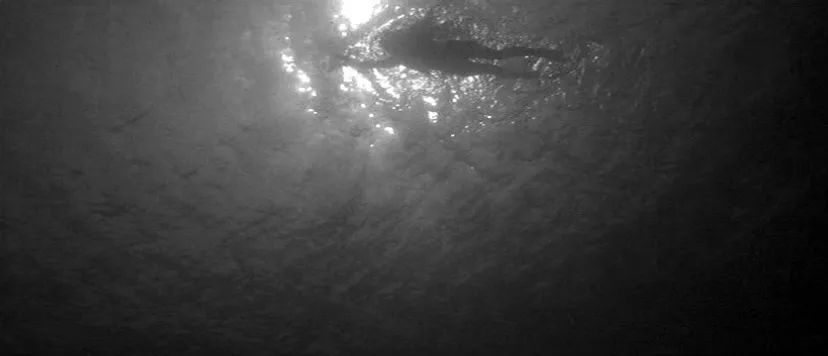
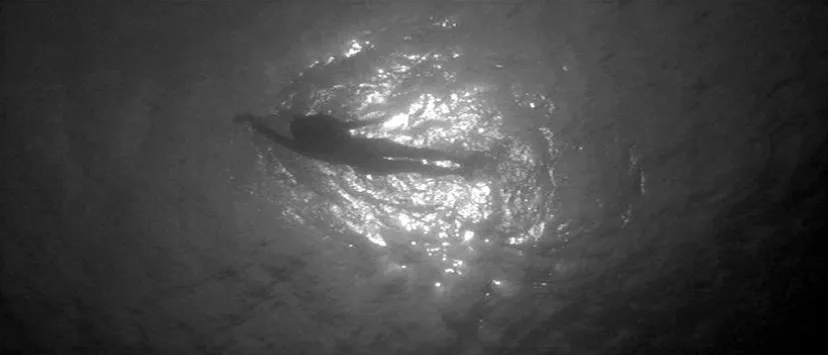
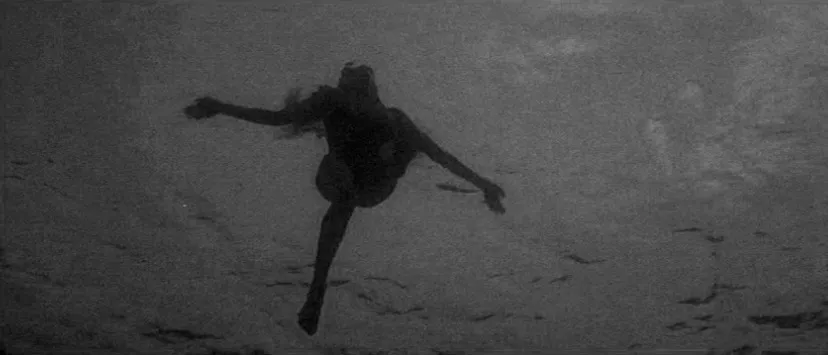
The shark gazes longingly at this mermaid or angel
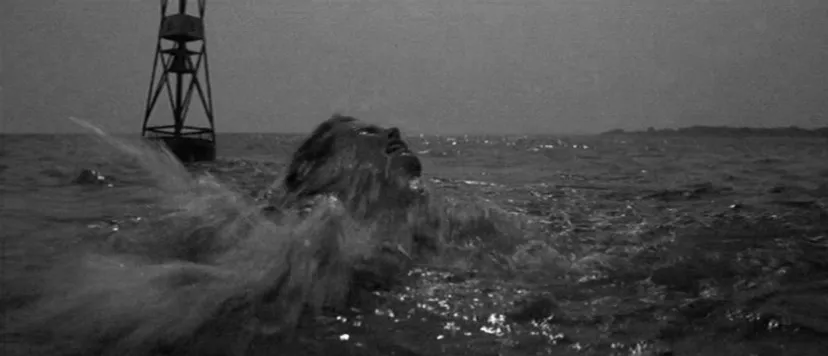
The rape: as in Psycho’s shower scene, the violence is both implied and overwhelming
When she’s gone the music stops, and there’s nothing but the sound of the sea and the buoy, which doesn’t so much give our guts time to settle down, as leave us incontrovertibly aware of the mute act of witnessing.
What’s next? Where to now? Should we giggle? The still-dressed blonde guy lies prone in the surf. He burps.
2. Denial
It’s the exposure Martin Brody can’t get used to. In New York he couldn’t sleep for the weight. But here it’s just miles of air and he can’t shake this feeling of being opened. Look at the Atlantic! His house is full of it. And all this demanding light come to wake him! How come the sun never used to shine out here?
‘Because we bought the house in the fall,’ says his wife. ‘Now it’s summer.’ Ellen tastes her own early-morning metallic breath. She watches her husband get slowly out of bed. His shorts are too big at the back, hinting that weariness has withered his bottom. Their dog sits in the bed like marriage, glancing at the camera until it remembers Mr Spielberg told it not to. There was a time when Michael and Sean jumped in and forced Ellen and Martin up at six, but since the family moved to Amity Island the kids are straight out of the house in the mornings. That’s something you don’t get in the city, the kids playing in the innocent yard. ‘In Amity,’ teases Ellen, ‘you say yaad.’
‘They’re in the yaad not too faar from the caar,’ manages Brody with elongated Boston vowels. ‘How’s that?’
‘Like you’re from New York,’ says Ellen.
Which Brody doesn’t like to remember. It’s so easy to imagine this man returning home every night from the streets of Brooklyn, feeling the city like an ache under the skin, needing to be comforted by his wife. But Chief of Police in Amity is about as far from the front line as you can get. When the station calls him with news of a girl possibly drowned, it’s the most excitement there’s been for a month.

Roy Scheider and his amazing skin

The film’s crisp, toy-bright, painterly look
Here’s Brody in the kitchen on the phone, so neat. Spielberg shoves the camera right up to Roy Scheider’s face, a thirty-nine year-old New York actor who wanted to be in Jaws because he met Spielberg at a Christmas party and liked the sound of this more-than-a-sidekick cop, a character slightly more median than his star turn in The French Connection. And like all actors, he needed the work. The whole notion of actors making choices is a journalistic distortion: very few of them are prom queens holding out for the best-looking date, and even those prom queens are at the mercy of random accident. We notice, as we always do with Scheider, his perfect parting. His antelope eyes. His skin tanned and creased like a loved handbag. And Ellen over his shoulder as he hangs up rinsing her eldest son’s cut hand under the tap. Blood and water.
When Brody leaves he’s holding his wife’s mug and is sashed with her prim tea-towel. Outside it’s wildly bright and the house looks shocking. It’s a toy house, a holiday home, coy with its powder-blue shutters. Surely adults can’t really live here, rounded every day by sand? But Ellen wanted it on first sight. New Yorkers too smart to go to Coney Island or the Jersey shore come to Amity for their holidays, and she adored the island’s clapboard clarity, its promise of eternal breeze. And so the family migrated from the urban breeding grounds. They’re on permanent vacation. Like that Amazonian beach babe on the billboard near the house, Amity’s Statue of Liberty, laughing in her bikini season round.
Like I’m from New York thinks the man who didn’t stay and fight, the man who rejected the present tense, the one thing worth fighting for. The act of down-shifting, the Peter Mayle dream, is almost always a cover-up. You can’t, with physical well-being and nursery paint, mask everything you’ve known, everything you’ve seen. Because the act of retreat is a regression through time. You will never belong. And if you run to the past you’re using up civilisation instead of adding to it. Which is something Ellen and Martin don’t talk about. It’s the silence in their marriage, emerging in tiny accidental needlings. But isn’t this preferable to New York? The air is pure, the traffic non-existent, and here he is in his pride-and-joy jeep going to work on a beach! Not even the kid from last night can put him off his stride.
In the daylight he looks ironed, this kid. Richer, more spoilt and seemingly more concerned above all to conceal the damage to his sexual pride. ‘No sir! She didn’t run out on me!’ He’s no longer a resident of the island notes Brody as they proceed along the shoreline, and yet still retains that unpierceable them-and-us parochialism he and Ellen keep bumping up against. Oh! There’s a blast on the whistle from Brody’s deputy, and everything starts to go wrong.
No-one can look at what’s left of Chrissie. Neither the kid, nor the camera, which shows us only the crabs crawling over her nails – sharp objects to needle our nerves. The deputy has fallen to the sand, his mouth wet with panic, his face averted, like James Dean a...
Table of contents
- Cover Page
- Title Page
- Contents
- Introduction
- The Land
- The Sea
- Credits
- Note on Sources
- eCopyright
Frequently asked questions
Yes, you can cancel anytime from the Subscription tab in your account settings on the Perlego website. Your subscription will stay active until the end of your current billing period. Learn how to cancel your subscription
No, books cannot be downloaded as external files, such as PDFs, for use outside of Perlego. However, you can download books within the Perlego app for offline reading on mobile or tablet. Learn how to download books offline
Perlego offers two plans: Essential and Complete
- Essential is ideal for learners and professionals who enjoy exploring a wide range of subjects. Access the Essential Library with 800,000+ trusted titles and best-sellers across business, personal growth, and the humanities. Includes unlimited reading time and Standard Read Aloud voice.
- Complete: Perfect for advanced learners and researchers needing full, unrestricted access. Unlock 1.4M+ books across hundreds of subjects, including academic and specialized titles. The Complete Plan also includes advanced features like Premium Read Aloud and Research Assistant.
We are an online textbook subscription service, where you can get access to an entire online library for less than the price of a single book per month. With over 1 million books across 990+ topics, we’ve got you covered! Learn about our mission
Look out for the read-aloud symbol on your next book to see if you can listen to it. The read-aloud tool reads text aloud for you, highlighting the text as it is being read. You can pause it, speed it up and slow it down. Learn more about Read Aloud
Yes! You can use the Perlego app on both iOS and Android devices to read anytime, anywhere — even offline. Perfect for commutes or when you’re on the go.
Please note we cannot support devices running on iOS 13 and Android 7 or earlier. Learn more about using the app
Please note we cannot support devices running on iOS 13 and Android 7 or earlier. Learn more about using the app
Yes, you can access Jaws by Antonia Quirke in PDF and/or ePUB format, as well as other popular books in Media & Performing Arts & Film & Video. We have over one million books available in our catalogue for you to explore.