- 208 pages
- English
- ePUB (mobile friendly)
- Available on iOS & Android
eBook - ePub
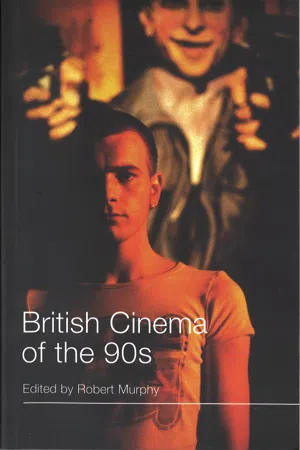
British Cinema of the 90s
About this book
This work examines major box office hits like 'The Full Monty' as well as critically acclaimed films like 'Under the Skin'. It explores the role of distribution and exhibition, the Americanisation of British film culture, Hollywood and Europe, changing representations of sexuality and ethnicity.
Trusted by 375,005 students
Access to over 1.5 million titles for a fair monthly price.
Study more efficiently using our study tools.
Information
Chapter 1
A Path through the Moral Maze
Robert Murphy
. . . it may be no bad thing that the British film industry is suffering a near terminal decline. The weaker it gets, the more likely it is that the philistines will be driven out and the old methods of work – so inimical to creativity – will be defeated. In their place will come, with luck, new creative and entrepreneurial talents.
(Terry Ilott, 1992)1
The British film industry in 1990 seemed a sickly plant unlikely to survive the millennium. The number of films produced – sixty – was double that of the previous year and, despite a blip in 1991, numbers continued to rise. But the euphoria brought about by the Oscar success of Chariots of Fire (Hugh Hudson, 1982) and Gandhi (Richard Attenborough, 1983) and the first wave of Channel Four films had long evaporated. Goldcrest had been brought down by the failure of Revolution (Hugh Hudson, 1985) and Palace Pictures, which had seemed to represent a daring, thrusting new generation of cine-literate film-makers expired amidst a cloud of acrimony in 1992.2 David Puttnam, despite being knighted by the government, complained that ‘In Nicholas Ridley, we’ve got a Secretary of State who gives the impression that he would regard his greatest success at the Department of Trade and Industry if he could close the British film industry down.’3
Cinemagoing had continued to expand with the proliferation of the multiplexes, but what most people were going to see were Hollywood movies. Between 1990 and 1993 the only British films to figure in the top twenty box-office films in Britain were Alan Parker’s The Commitments – an American-backed film shot in Ireland and Kenneth Branagh’s Much Ado About Nothing (1993), shot in Tuscany with American money. Whereas The Commitments grossed nearly £7 million (and an American box-office hit like Robin Hood: Prince of Thieves grossed over £20 million) a typically British film, such as Ken Loach’s Riff-Raff (1991) took £61,069.4 Hardly surprising then that budgets were kept low and most films were aimed at the television audience.
In this depressing environment the emergence of a ‘Brit-pack’ of young British directors determined to launch themselves into the industry without serving a laborious and frustrating apprenticeship was seen as a promising sign.5 There were two rather different impulses – to make films on shoestring budgets which might – like those of contemporary American independents Sam Raimi, Steven Soderbergh and the Coen brothers – achieve a cult success; and rather more hard-headed attempts to emulate American action movies which it was hoped would attract a measure of financial backing and a mainstream audience.
Of the micro-budget films, Vadim Jean and Gary Sinyor’s Leon the Pig Farmer (1992) attracted the most attention, though it was the unpretentious Staggered (1993), directed by and starring the television comedy actor Martin Clunes, that was commercially most successful. Leon the Pig Farmer, an ethnic comedy which reverses the message of Hanif Kureishi’s My Beautiful Laundrette (Stephen Frears, 1985) to advocate sexual conformity and the importance of family values, now seems primarily of interest for the way in which it embodies a ‘Majorite’ ethos of mild, middlebrow conservatism.6 It lacks the subtlety and originality of the Frears/Kureishi film, but it is uncannily prescient of future trends, beginning among smart but rather wacky young people in London and then moving up to Yorkshire for broad comedy. Made on a budget of £160,000, it earned enough to make a profit, as did Stefan Schwartz’s road movie, Soft Top, Hard Shoulder (1994) but most of these films were disappointingly amateurish and fared badly. Blonde Fist (Frank Clarke, 1992), Beyond Bedlam (Vadim Jean, 1993), Mad Dogs and Englishmen (Henry Cole, 1994), White Angel (Chris Jones, 1994), The Mystery of Edwin Drood (Timothy Forder, 1993) and Clockwork Mice (Vadim Jean, 1994) took little over £200,000 between them and others like Savage Hearts and Seaview Knights failed to reach the cinema screen. They also attracted industry criticism about their abuse of the system of deferred payments which encouraged technicians and actors to work for nothing in the hope of future rewards.7
Of the bigger budget genre films aimed at the multiplex market – Young Americans (Danny Cannon, 1993), Dust Devil (Richard Stanley, 1994), Crime Time (George Sluizer, 1994) and Shopping (Paul Anderson, 1994) – only Young Americans made much impact on the box-office, and it was an Anglo-American adaptation of a Stephen King story, The Lawnmower Man (Brett Leonard, 1993), which really cleaned up, taking £3.6 million in Britain (compared to Shopping’s £101,286 and Dust Devil’s £2,836) and $32 million in America. However, Cannon and Anderson sufficiently impressed Hollywood to win themselves major blockbuster assignments, Cannon directing Judge Dredd (1995), Anderson directing Mortal Kombat (1995) and Event Horizon (1997).
The early 90s renaissance seemed even weaker and shorter-lived than the one a decade earlier. Thus the unprecedented box-office success of Four Weddings and a Funeral (Mike Newell) in 1994 (it earned £28 million in the UK, somewhere around US $250 million world-wide) was treated with a degree of scepticism.8 The fact that it had proved a success in America before it reached Britain, that it had an American female lead, that it was nominated for Oscars, marked it out as a fluke, a single swallow which was not going to make a summer. The impression was confirmed when Newell’s next film, An Awfully Big Adventure (1995) made the modest sum of £600,000 and he went off to Hollywood to direct Johnny Depp and Al Pacino in Donnie Brasco.
Fortunately there were other signs of change. Shallow Grave (Danny Boyle, 1995), a slick, cynical black comedy was rapturously received by the critics and became an unexpected hit. Danny Boyle had a respectable record as a television director but the project was initiated by producer Andrew Macdonald (the grandson of scriptwriter Emeric Pressburger) and writer John Hodge. From the start it was conceived as a clever commercial package rather than a deeply personal film. But as Ian Conrich points out, whereas the ‘Brit-pack’ films had failed by modelling themselves too closely on American films, Four Weddings and Shallow Grave succeeded ‘by drawing on their environment or the attributes of British culture’.9 Shallow Grave could be seen as a reworking for the 90s of the darker elements of Hamer and Mackendrick’s Ealing comedies and, although Four Weddings has been criticised as a ‘heritage’ view of Britain, packaged for the American market, Richard Curtis’s script is a direct descendant of the well-made comedies of upper-middle class life epitomised by Dodie Smith’s Dear Octopus and Esther McKracken’s Quiet Wedding, and Hugh Grant’s bumbling hero is a worthy successor to the sort of silly asses played by Ralph Lynn, David Tomlinson and Ian Carmichael.10

An unexpected hit, Shallow Grave (1995)
Hodge, Boyle and Macdonald followed up their success with Trainspotting (1996), which made £12.3 million at the British box-office (Shallow Grave had taken just over £5 million). In retrospect it seems an obvious choice – a cult novelist with particular appeal to the youth market, an opportunity to do visually interesting things around the activities of its drug-taking protagonists, an appeal to trendy rebelliousness in the dog days of a discredited Tory government. But success was by no means guaranteed. Of the cast, only Ewan McGregor and Robert Carlyle were known, and Carlyle’s character was an irredeemably vicious hard man. Though the action was again based in Edinburgh, the switch from yuppies to junkies risked alienating the affluent thirtysomethings who had applauded Shallow Grave – and there were precedents to warn that Irvine Welsh’s Scottish vernacular might not reach beyond the relatively small circle of his admirers. David Leland’s adaptation of William McIlvanney’s The Big Man (1990) had flopped and James Kelman’s Booker Prize-winning How Late It Was, How Late (1995) had not sold well. A brilliant marketing campaign overcame these obstacles and though Trainspotting’s box-office earnings were less than half those of Four Weddings, it could be seen as innovative and different, a harbinger of a real renaissance in British film production. As Tom Charity told his Time Out readers: ‘Trainspotting is the movie we have all been waiting for, the first British film of the ’90s generation to speak to the way we live here and now.’11
Even so, there were worrying signs. Of the forty-five feature films made in 1979, all but one were released theatrically, in 1996 eighty-five films were made but only forty per cent of them received theatrical distribution.12 As production grew, the distribution logjam worsened. Thirty-three of the films made in 1996 had failed to secure a distribution deal by June 1998, seven had bypassed the cinema and been shown on television, three had been glimpsed only briefly, at the National Film Theatre in London and six had been abandoned uncompleted.13
The way in which films are distributed and exhibited cinematically has been fundamentally changed by the multiplex revolution. In the heyday of cinemagoing from the 1920s to the early 1960s, most films were slotted into a place on the circuits and guaranteed an audience. Some films did much better than others but a circuit release guaranteed a return of sorts and it was rare for a film to be excluded entirely.14 Theoretically the multiplexes offered greater flexibility and greater choice, but according to one estimate, ‘of the 30–40 films on release in Britain at any one time, 90 per cent of revenues are taken by the top three, the next four take 9 per cent, and the remaining 25 scramble for the last 1 per cent’.15 Despite the proliferation of markets, film-making seems to be more of a gamble than ever. Neil Jordan’s The Crying Game (1992), for example, which took over £2 million at the UK box-office (and a huge amount world-wide) may be a better film than his previous one, The Mi...
Table of contents
- Cover
- Title Page
- Dedication
- Contents
- Acknowledgements
- Notes on Contributors
- Introduction
- 1. A Path through the Moral Maze
- 2. The British Film Industry in the 1990s
- 3. Something for Everyone: British Film Culture in the 1990s
- 4. The Film Industry and the Government: ‘Endless Mr Beans and Mr Bonds’?
- 5. Spoilt for Choice? Multiplexes in the 90s
- 6. Pathways into the Industry
- 7. As Others See Us: British Film-making and Europe in the 90s
- 8. Hollywood UK
- 9. Image and Nation in 1990s British Cinema
- 10. Here and Then: Space, Place and Nostalgia in British Youth Cinema of the 1990s
- 11. Black British Cinema in the 90s: Going Going Gone
- 12. Fewer Weddings and More Funerals: Changes in the Heritage Film
- 13. Two Sisters, the Fogey, the Priest and his Lover: Sexual Plurality in 1990s British Cinema
- 14. Unseen British Cinema
- 15. Travelling Light: New Art Cinema in the 90s
- 16. Men in the 90s
- 17. Not Having It All: Women and Film in the 1990s
- 18. Failure and Utopianism: Representations of the Working Class in British Cinema of the 1990s
- Select Bibliography
- List of Illustrations
- Index
- eCopyright
Frequently asked questions
Yes, you can cancel anytime from the Subscription tab in your account settings on the Perlego website. Your subscription will stay active until the end of your current billing period. Learn how to cancel your subscription
No, books cannot be downloaded as external files, such as PDFs, for use outside of Perlego. However, you can download books within the Perlego app for offline reading on mobile or tablet. Learn how to download books offline
Perlego offers two plans: Essential and Complete
- Essential is ideal for learners and professionals who enjoy exploring a wide range of subjects. Access the Essential Library with 800,000+ trusted titles and best-sellers across business, personal growth, and the humanities. Includes unlimited reading time and Standard Read Aloud voice.
- Complete: Perfect for advanced learners and researchers needing full, unrestricted access. Unlock 1.5M+ books across hundreds of subjects, including academic and specialized titles. The Complete Plan also includes advanced features like Premium Read Aloud and Research Assistant.
We are an online textbook subscription service, where you can get access to an entire online library for less than the price of a single book per month. With over 1.5 million books across 990+ topics, we’ve got you covered! Learn about our mission
Look out for the read-aloud symbol on your next book to see if you can listen to it. The read-aloud tool reads text aloud for you, highlighting the text as it is being read. You can pause it, speed it up and slow it down. Learn more about Read Aloud
Yes! You can use the Perlego app on both iOS and Android devices to read anytime, anywhere — even offline. Perfect for commutes or when you’re on the go.
Please note we cannot support devices running on iOS 13 and Android 7 or earlier. Learn more about using the app
Please note we cannot support devices running on iOS 13 and Android 7 or earlier. Learn more about using the app
Yes, you can access British Cinema of the 90s by Robert Murphy in PDF and/or ePUB format, as well as other popular books in Media & Performing Arts & Film History & Criticism. We have over 1.5 million books available in our catalogue for you to explore.