![]()
1 Watching the Detectives
It begins with a blare of horns – of saxophones, not automobiles as you might expect of a film set in the car-culture capital of the world – and the relentlessly cheerful dictate ‘to accentuate the positive’. Taken from Johnny Mercer’s arrangement of his and Harold Arlen’s 1944 wartime hit, ‘Ac-cent-tchu-ate the Positive’, the words ring out over the first image in L.A. Confidential, a stack of postcards, one of which bears the legend spelled out in big, bold type: ‘Greetings From Los Angeles, California’. In 1952, the year that the film opens, it was the sort of postcard a tourist might have mailed to the folks back home for a glimpse of palm trees and a stretch of beach, along with a bird’s-eye view of the city’s totemic city hall – scenes from a world of endless sunshine. Here, though, the postcard serves as a visitor’s pass both to Lost Los Angeles and to the film itself, a reassuring, gently sentimental point of entry for the extended montage which it launches. ‘Come to Los Angeles,’ exhorts an unseen male narrator. ‘The sun shines bright. The beaches are wide and inviting and the orange groves stretch as far as the eye can see.’
The voice belongs to Sid Hudgens (played by Danny DeVito), the resident scam artist for a scandal magazine called Hush-Hush. Hudgens will prove to be a linchpin in the story to come, right now, though, heard but not yet seen, he is a tour guide cum sideshow carny for an excursion into the city’s past, real and imaginary. Onscreen, booster image follows booster image, and citrus trees give way to factory workers and ‘jobs aplenty’. There are images of sylvan fields and manicured suburban lawns on which smiling children play ball. ‘Inside every house’, Hudgens promises, ‘a happy all-American family.’ Just as the vision of everyday Angeleno bliss reaches its apex, the city’s iconography is abrupt subsumed by that of Hollywood: Marilyn Monroe and Jane Russell beam their brights in front of a bulwark of waving fans. Frank Sinatra squires Deborah Kerr at one of those convergences of idols and idolatry known as The Movie Premiere. The hucksterism in Sid’s voice curves around a menacing bend. ‘It’s paradise on earth,’ he pledges, right before releasing a cascade of laughter, the rat-a-tat of sunshine cynicism. ‘That’s what they tell ya anyway. Because they’re selling an image, they’re selling it through movies, radio and television.’
Hollywood has been eclipsing Los Angeles virtually from the moment the latter swallowed the former. The small community of Hollywood incorporated in 1903; seven years later Los Angeles, which had been keeping its landlocked neighbour strategically dry, absorbed the water-thirsty burg of several thousand. It was around this same time that movie people started pouring in from the East, staking claims on the area to take advantage of the climate, variegated terrain and the distance from the patents office on the other coast. In 1909, actor-turned-director Francis Boggs set up shop behind a Chinese laundry on downtown’s Olive Street (thirty years later, novelist John Fante walked down Olive, then fallen on hard times, and wrote of houses ‘reeking with murder stories’1). The following year, writer and director D. W. Griffith arrived with over two dozen movie colonists in tow. By the end of 1911, when the Nestor Company had built the area’s first movie studio on the northwest corner of Gower Street and Sunset Boulevard, the histories of Los Angeles and Hollywood were twinned for good.
From the 1910s on, Hollywood would become a Mecca for American hopefuls (the Algonquin roundtable, Ben Hecht, countless more) and for habitués and refugees from Luis Buñuel, Sergei Eisenstein and Bertolt Brecht to Billy Wilder, Fritz Lang and Douglas Sirk. As the movies reached out to the rest of the country, seducing new audiences with each passing decade, the rest of the country reached out to Los Angeles, entranced by the area’s self-professed plenty as well as its actual potential. The nation’s dream of the city, dazzling and over-baked, would eventually transform Los Angeles into a kind of eternal frontier – the last pit stop for the American dream itself. It was a covenant that would inspire countless movies, popular songs and, later, television programmes, along with an indigenous literary tradition that was by turns idealistic and cynical. Yet while some sang the city’s praises or at least invoked its promise (‘Los Angeles, give me some of you,’ entreats Fante in his 1939 bohemian classic, Ask the Dust), it was the bitter, at times dystopian, voices that often sounded the loudest, from Nathanael West’s Depression-era dirge, The Day of the Locust, to Ellroy’s self-anointed ‘L.A. Quartet’, published some fifty years later.2
Los Angeles – from paradise to sprawl
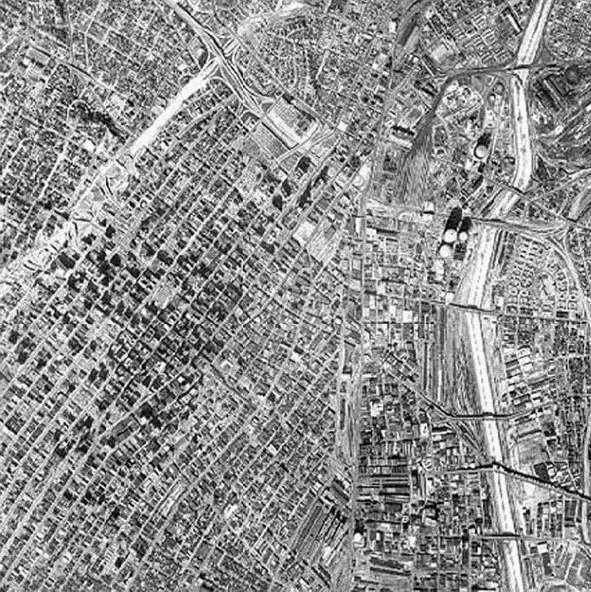
The third novel in the quartet, L.A. Confidential, begins in early 1950 and winds through a decade that saw Los Angeles begin to shake off its identity as a rough-and-tumble backwater to become the fastest-growing metropolis in the nation. Hanson’s movie compresses the novel’s eight years into a few taut weeks, beginning on Christmas Eve night, 1952. Despite the condensation, which whittled down the original book’s 496 pages to 130 screenplay pages, with entire subplots and characters excised, the story’s backdrop remains the same, that of a city in the throes of violent transformation. There are gangland murders, corrupt police and politicians, prostitute and pornography rings, race riots as well as the quieter, insidious violence of institutionalised racism, the slander industry and the lingering tremors of anti-Communist hysteria – some of it hinted at during the opening credit montage. This seamless mixture of found footage and photographs selected by Hanson himself serves as the film’s opening credit sequence, but more instructively functions as something of a narrative road map, a guide on how to watch the ensuing film.
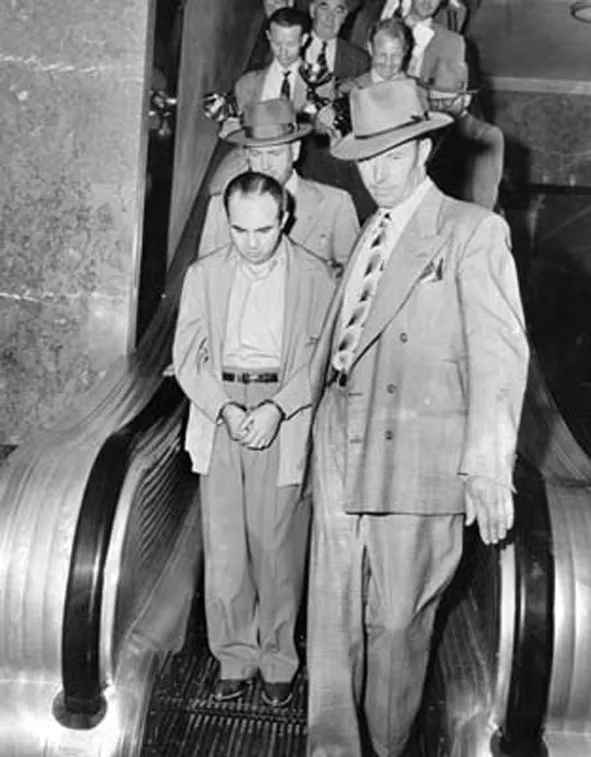
It’s to this end that when the first images of green trees, blue skies and white people flicker across the screen, they’re as unthreatening (if as suspect) as a chamber of commerce promotional reel. Even before Hollywood intrudes on the scene, though, and Hudgens’s voice grows suggestively mocking, scraping against the pictures, the original meaning of the images starts to shift. The seemingly neutral and uninflected are answered by the increasingly ridiculous and hyperbolic: empty fields turn into freeway construction sites, family meals mutate into fast-food living. Citrus groves are supplanted by toothy women swimming amid bobbing oranges, the ‘natural’ bounty transformed into a silly, vulgar public relations spectacle, some might say, as silly and vulgar as the city itself.3 Even glamour tarnishes, as footage of Monroe and Sinatra, each of whom had ties to organised crime, is followed, in turn, by the introduction of gangster Mickey Cohen, a minor character in the film, whose dramatised arrest on tax evasion concludes the montage and launches the narrative. Here, then, is the city of dreams and city of nightmares – past, present and future – in which those in L.A. Confidential find, then lose, their way.
In L.A. Confidential, no one and nothing are what they first seem. Although the film contains a central mystery – the who and the why behind a mass murder at a coffee shop called the Nite Owl – the narrative is, in classic detective fashion, an obstacle course of ruses. Even first impressions are intentionally misleading. After the arrest of Mickey Cohen, the film cuts to a series of quick-sketch scenes that offer up a fast, telling look at the three detectives at its centre: officers Wendell ‘Bud’ White and Edmund Exley, and sergeant Jack ‘Hollywood Jack’ Vincennes (played, respectively, by Russell Crowe, Guy Pearce and Kevin Spacey). In every one of his inaugural scenes, each of these three men will be caught in a revealing moment, negotiating a critical interaction that will send shock waves through their respective lives and the events that will eventually connect them. Importantly, and because this isn’t the story of God’s lonely man, each will also almost immediately be shown in the company of the secondary character who will most profoundly affect – by love, by accident and by wrong – the seismic, determining shifts in their moral landscapes. These are, then, the defining moments when Bud first meets the prostitute Lynn Bracken (played by Kim Basinger), when Jack negotiates one of his final deals with Sid Hudgens (DeVito) and when Ed makes his initial bid to outflank his superior officer, Captain Dudley Smith (played by James Cromwell).
Mickey Cohen busted, 1951
Bud and Stens at 4216 Evergreen; ‘Why don’t you dance with a man for a change?’
The introductions begin with Bud, seen in close-up behind the wheel of an unmarked police car. Slouched in the back and taking pulls off a bottle sits his long-time partner, Dick (‘Stens’) Stensland, who, with a tight corrosive laugh, says, ‘You’re like Santa Claus with that list, Bud. Except everyone on it’s been naughty.’ It’s evening and although the address Bud recites into the police radio is ‘4216 Evergreen’, this could be any one of Los Angeles’ post-war neighbourhoods, lined with modest starter homes and shrouded in quiet. Except that at 4216 Evergreen a man is roughing up a woman. As Stens keeps laughing, Bud storms the house and with a few hard tugs brings down the illuminated plastic Santa and reindeer adorning its roof. The man throws opens the front door (‘Who in the hell are you?’), and the detective starts punching. After beating the man to the ground, Bud handcuffs him to the house, warning that if he touches the woman again he’ll be arrested for a ‘kiddie raper beef ’. ‘You know’, says Bud, ‘what they do to kiddie rapers in [San] Quentin?’ He then asks the lurking woman if she has somewhere to go. She nods and heads toward the family car, adding by way of goodbye, ‘Merry Christmas, huh?’
When Hanson pitched his vision of L.A. Confidential to producer Arnon Milchan, he used a photograph of Aldo Ray to suggest his vision of Bud. A former Navy frogman and small-town California sheriff, Ray was blond and burly, with a gravel voice and a neck as thick as a tree trunk. He made his first film in 1951 and during that decade and into the next two played a series of regular Joes for which he is best remembered. He was a finer actor than many of his assignments and every bit up to his greatest movies. Two of his best – George Cukor’s 1952 melodrama The Marrying Kind and, at the opposite end of the genre spectrum, Anthony Mann’s 1957 Men in War, set in a Korean battlefield – showed that Ray’s gift was for characters who seemed somehow wounded by masculinity. The actor’s meaty physicality, combined with a voice which often seemed on the verge of re-breaking, was a prison house of sorts, at odds with the anguished machismo of Marlon Brando and the febrile neuroses of James Stewart that defined post-war Hollywood. Yet Ray’s physicality was also the citadel from which he could safely betray tender feeling as a despondent father in The Marrying Kind and as a protective surrogate son in Men in War.
Until Crowe, few Hollywood actors could embody this masculine–feminine admixture as persuasively as Ray. Born in New Zealand and raised in Australia, Crowe first came to Hanson’s notice in the 1992 film Romper Stomper, in which he starred as a skinhead who steers a gang of neo-Nazis through the usual thuggish mindlessness and ends ...