- 80 pages
- English
- ePUB (mobile friendly)
- Available on iOS & Android
eBook - ePub
Women on the Verge of a Nervous Breakdown
About this book
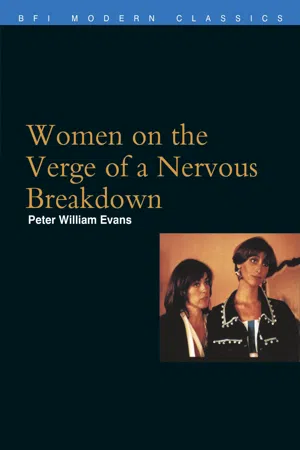
This text analyses director Pedro Almodovar's insights into gender, sexuality and subjectivity in his film Women on the Verge of a Nervous Breakdown. The author draws on a range of psychoanalytic and critical concepts and sees the film as an account of the often tyrannical spell of sexual desire, of the anxieties of relationships and families, but also of the possibilities of personal liberation. Peter William Evans also discusses the recent history of Spain and ties the film's concerns into the social revolution which occurred after the death of Franco.
Trusted by 375,005 students
Access to over 1 million titles for a fair monthly price.
Study more efficiently using our study tools.
Information
1 Synopsis
Madrid in the late 80s. Iván (Fernando Guillén) breaks up with his lover Pepa (Carmen Maura). Both are actors, appearing on TV and dubbing films. Iván's way of informing Pepa that he is finishing with her is by leaving a message on the answerphone, asking her to pack his things in a suitcase. Pepa becomes very agitated – she has also just discovered that she is pregnant – and decides to put her flat up for sale. Soon afterwards Iván's son Carlos (Antonio Banderas) and his fiancée Marisa (Rossy de Palma) visit the flat, with a view to buying it. Carlos sees his father's photograph in one of the rooms, and both he and Pepa suddenly become aware of each other's existence. Carlos' mother Lucía (Julieta Serrano), Iván's mistress in the 60s, now released from a psychiatric clinic, has recently been living at her parents' home, and is now in hot pursuit of Pepa whom she suspects of accompanying Iván on a foreign trip. Pepa has been trying to find Iván (at work and elsewhere) but unsuccessfully. On some of these journeys she is transported by a sympathetic taxi-driver (Guillermo Montesinos) who seems always to appear conveniently whenever she needs him. Meanwhile, back at the flat, Carlos and Marisa are joined by Candela (María Barranco) who has realised her Middle Eastern lover is a fundamentalist Shiite terrorist planning a bombing outrage in Madrid. She and Carlos ring the police to tip them off anonymously. But the police and a telephone repair man (who has been called in to fix the phone destroyed by Pepa in one of her fits of rage against the unreachable Iván) eventually show up at the flat. There, like Marisa, they fall victim to the drugged gazpacho that has been prepared by Pepa – for herself or for Iván? – and miss out on the chase that takes place when Pepa, transported again by her favourite taxi-driver, and Lucía, who has hijacked a motorcycle and its rider, head for the airport, where Iván is discovered on the point of embarking on a journey with his new girlfriend, the lawyer Paulina (Kitti Manver), to Stockholm. There Iván is saved by Pepa from being killed by Lucía, who is then returned to the hospital. Ivan makes an offer of reconciliation to Pepa, but she declines and returns to her flat, to be reunited with Marisa, who awakens from her slumber. For a moment both women enjoy each other's company in the stillness of a flat at last temporarily released from the spell of sexual desire.

Marisa's Pepa-induced Midsummer Night's Dream
2 Comedy and Melodrama
I wish to God I could make him cry.
I wish I could make him cry and tread
the floor and feel his heart heavy and
big and festering in him. I wish I could hurt
him like hell.
I wish I could make him cry and tread
the floor and feel his heart heavy and
big and festering in him. I wish I could hurt
him like hell.
Dorothy Parker, 'A Telephone Call'
Mujeres al borde de un ataque de nervios/Women on the Verge of a Nervous Breakdown (1988) is one of the most commercially successful films ever made in Spain. Shot on a modest budget of £700,000, it went on to gross well over £5,500,000 and in the process won both best script and best actress (Carmen Maura) awards at Venice. Women on the Verge made a major international impact after Orion took on its world-wide distribution, and was especially popular in the USA, where speculation arose over the possibility of a re-make with Jane Fonda, Goldie Hawn or Cher.1 The film's success led in Spain to imitation, with, for instance, Cómo ser mujer y no morir en el intento / How to Be a Woman and Not Die in the Attempt (Ana Belén, 1991) which not only starred Carmen Maura but also used promotional posters in the Pop Art graphics style of its forerunner.
The success of Women on the Verge can be explained in a number of ways. Marketing and publicity were adeptly handled. A poster for the film's American release, for instance, had Julieta Serrano and Carmen Maura at the centre of the frame; above, the film's topicality and relevance to contemporary US society were highlighted – 'A comedy about someone you know' – while its respectability and box-office success were underlined through approving quotations from prominent US film critics, including Pauline Kael of The New Yorker, David Denby of the New York Magazine and Steven Schiff of Vanity Fair. At the bottom of the frame the director's status as auteur was emphasised with the words, 'A film by Almodóvar'. Indeed, in general, the pressbook projected Almodóvar as a star in his own right, a ploy that recalls that adopted to promote the films of Lubitsch or Hitchcock. More importantly, the film's style and content captivated audiences, who were drawn to its ultra-modernity, its eye for colour – less garish here than in other, more Punk or Euro-Trash Almodóvar films such as Kika (1993) – and its capacity for capturing life, as Vicente Molina-Foix puts it, like an instantaneous camera recording topical priorities and obsessions (1993: 21).2 Above all, though, the film's appeal can be traced to its predominantly comic explorations of subjectivity, sexuality and the relations between the sexes. Women on the Verge confirmed Almodóvar's talent for representing complex but plausible female characters – a talent not always appreciated by Spanish film critics who sometimes damn Almodóvar with faint praise, characterising him as a director of brilliance rather than depth (see, for instance, Fernández Santos 1990: 35).

Having worked in theatre, pop music and adult comics, Almodóvar began in films by making Super 8 productions (the first in 1974) with provocative titles such as Fólleme, fólleme, fólleme, Tim / Fuck Me, Fuck Me, Fuck Me, Tim (1978). The earliest full-length feature – made largely at Carmen Maura's instigation – was Pepi, Luci, Bom y otras chicas del montón / Pepi, Luci, Bom, and the Other Girls in the Heap (1979), a film that immediately associated Almodovar with the so-called Madrid 'Movida' generation, a sort of Punk-Pop Spanish equivalent of the Bloomsbury set, made up of young artists and radicals who had quickly taken full advantage of the end of Franquismo. While a taste for outrage has never really abandoned him – even a film as late as Kika still honours the memory of Punk, especially in the characterisation of the scarred, camera-wielding, false-breasts-exposing Reality Show TV hostess played by Victoria Abril – Almodovar has gradually toned down some of the more gratuitous effects in favour of a more subtle treatment of sexuality and the relations between the sexes. Laberinto de pasiones / Labyrinth of Passions (1982) and Entre tinieblas / Dark Habits (1983) reflect this developing maturity, even though they cannot altogether resist adult comic-book style caricature (as when in the former a man habitually sleeps with his daughter because he thinks she is his wife, and in the latter, the source for Sister Act (Emile Ardolino, 1992), a woman seeking refuge from gangsters enters a convent where, among other eccentricities, one of the sisters keeps a pet tiger).
The three films leading up to Women on the Verge – ¿Qué he hecho yo para merecer esto?/What Have I Done to Deserve This? (1984), Matador (1986) and La ley del deseo / The Law of Desire (1987) – represent, together with Women on the Verge, Almodóvar's most elegant and insightful treatment of the vicissitudes of desire. In the first, the focus is on a woman's struggle for release from the brutalities and frustrations of a loveless marriage; in the second, a narrative about death-obsessed lovers is underpinned by an analysis of the complexities of sexual orientation; in the third, the depiction of the ecstasies and despair of a gay love affair foregrounds the extremes to which lovers will submit in the quest for emotional fulfilment.
In all of these films, as well as in those that follow Women on the Verge –Atame/Tie Me Up, Tie Me Down (1989), Tacones lejanos/High Heels (1991), Kika (1993) and La flor de mi secreto/The Flower of My Secret (1995) – both the sights and sounds of Hollywood and the traditions of Spanish cinema are persistently alluded to. Hollywood comedy and melodrama, above all, are recalled, but so are the conventions of the thriller. Almodóvar's films are informed by the popular comedies and melodramas of his national cinema, but sometimes also, perhaps unexpectedly, by the drives and patterns of 'auteurist' traditions (in What Have I Done to Deserve This?, for example, the Italian neo-realism of such films as Muerte de un ciclista / Death of a Cyclist (Juan Antonio Bardem, 1955) is clearly invoked).
This rich mixture of styles, blending Pop aesthetics with a powerful treatment of sexuality, has meant that in Spain Almodóvar's films have been especially popular with youth and sexually dissident audiences, whose tastes, as Marvin D'Lugo argues (1991: 48), had previously been catered for in such films as Jaime de Armiñán's Mi querida señorita / My dear Mistress (1971), Vicente Aranda's Cambio de sexo/Change of Sex (1976), Carlos Saura's Deprisa deprisa /Hurry, Hurry (1980) and Fernando Trueba's Opera prima (1980). These films had gone some way towards creating a favourable climate for the more colourful discussion of sex and gender-related issues in Almodóvar's films. To an extent, his films are the tongue-in-cheek equivalents of the sex manuals and guidebooks that flooded the market after the death of Franco, when the representation and discussion of sexuality were no longer deemed to be taboo.3
Under Franco the laws of censorship had been extremely strict (see Gubern 1980, Hopewell 1986, Vincendeau 1995). The censor's office had been set up in 1937, but only after the fall of the Republic in the Civil War were its decrees enforced with ruthless efficiency. In 1939 the public use of Catalan was prohibited, and, in order to establish the hegemony of Castilian at the expense both of regional and other languages, a policy requiring the compulsory dubbing of all foreign films was introduced. As regards the censorship of a film's content, the key player was the Catholic Church which insisted on the upholding of its values in public spectacles, and, as a result, sympathetic treatments of divorce, suicide or extramarital sex were prohibited.4 Censorship was abolished in 1977, two years after the end of the regime, and although Women on the Verge was made eleven years later, its energy still to a certain extent derives, just as much as that of Pepi, Luci, Bom (made only two years after the abolition), from the new uninhibited climate.
Leaving aside autobiographical considerations (such as Almodóvar's wish to take a parting shot at his former employers at the national telephone company), the initial inspiration for Women on the Verge was a one-act play by Cocteau entitled La Voix humaine, and more indirectly, the Spanish stage comedy tradition of dramatists such as Mihura (1905–77) and Jardiel Poncela (1901–52). Filmically, Women on the Verge was inspired by the traditions of both Hollywood and Spanish cinema. Its narrative is precariously balanced between melodrama and comedy, and this hybridity typifies Almodóvar's confessed taste for generic confusion (Kinder, 1987: 37). There are traces too, as in other Almodóvar films, of Dorothy Parker's 'Anything Goes' Algonquin Round Table narratives, especially the story entitled 'A Telephone Call', in which the female narrator becomes increasingly frantic as she awaits her lover's promised but never materialising phone-call (Parker, 1989).5
Cocteau's play, written in 1930 and performed first by Berthe Bovy and subsequently by Simone Signoret, turns on the narrative of a woman – the only character to appear on stage – abandoned by her lover, whose affections she attempts to revive by declaring her love over the phone. Cocteau's rejected mistress is a 'victime médiocre' (1983: 16) whose inexhaustible capacity for self-incrimination – 'Oh! mon chéri, ne t'excuse pas, c'est très naturel et c'est moi qui suis stupide' / 'Oh! My dear don't be sorry, it's very natural, and I'm the stupid one' (23) – brings her not the lover for whom she pines but the spectre of ever more painful memories and desperate thoughts. In its last moments, as the rejected woman repeats the phrase 'je t'aime' five times (63), the play confirms its fidelity to the conventions of melodrama. Women on the Verge, on the other hand, ends with the abandoned woman – no 'victime médiocre' by any stretch of the imagination – repaying her lover in kind, refusing an offer for reconciliation and, released at least for a time from the slavery of desire, preferring the company of another woman in his place.
Despite the far more positive ending of Women on the Verge – at least in its concession to its heroine's momentary triumph over adversity – the film's affiliation to melodrama (both indigenous and American) is never entirely relinquished. As many commentators have noted, the key Hollywood references in the film are to Screwball and 50s comedy – especially How to Marry a Millionaire (Jean Negulesco, 1953) – to the musical – especially The Apartment (Billy Wilder, 1960) and Funny Face (Stanley Donen, 1957) – and to the emotional dramas of Hitchcock, Sirk, Cukor and Ray.6 In a similar way, as it swings from one mode to another the film is poised between the chic styles designed for the film by the couturier José María de Cossío and the familiar aesthetics of a women's magazine – between stylistic distinctiveness and more conventional modes of representation. Leav...
Table of contents
- Cover Page
- Title Page
- Contents
- Acknowledgments
- 1. Synopsis
- 2. Comedy and Melodrama
- 3. Men and Women
- 4. Carmen Maura
- 5. Closure
- Notes
- Credits
- References
- eCopyright
Frequently asked questions
Yes, you can cancel anytime from the Subscription tab in your account settings on the Perlego website. Your subscription will stay active until the end of your current billing period. Learn how to cancel your subscription
No, books cannot be downloaded as external files, such as PDFs, for use outside of Perlego. However, you can download books within the Perlego app for offline reading on mobile or tablet. Learn how to download books offline
Perlego offers two plans: Essential and Complete
- Essential is ideal for learners and professionals who enjoy exploring a wide range of subjects. Access the Essential Library with 800,000+ trusted titles and best-sellers across business, personal growth, and the humanities. Includes unlimited reading time and Standard Read Aloud voice.
- Complete: Perfect for advanced learners and researchers needing full, unrestricted access. Unlock 1.4M+ books across hundreds of subjects, including academic and specialized titles. The Complete Plan also includes advanced features like Premium Read Aloud and Research Assistant.
We are an online textbook subscription service, where you can get access to an entire online library for less than the price of a single book per month. With over 1 million books across 990+ topics, we’ve got you covered! Learn about our mission
Look out for the read-aloud symbol on your next book to see if you can listen to it. The read-aloud tool reads text aloud for you, highlighting the text as it is being read. You can pause it, speed it up and slow it down. Learn more about Read Aloud
Yes! You can use the Perlego app on both iOS and Android devices to read anytime, anywhere — even offline. Perfect for commutes or when you’re on the go.
Please note we cannot support devices running on iOS 13 and Android 7 or earlier. Learn more about using the app
Please note we cannot support devices running on iOS 13 and Android 7 or earlier. Learn more about using the app
Yes, you can access Women on the Verge of a Nervous Breakdown by Peter William Evans in PDF and/or ePUB format, as well as other popular books in Media & Performing Arts & Film History & Criticism. We have over one million books available in our catalogue for you to explore.