- 96 pages
- English
- ePUB (mobile friendly)
- Available on iOS & Android
eBook - ePub
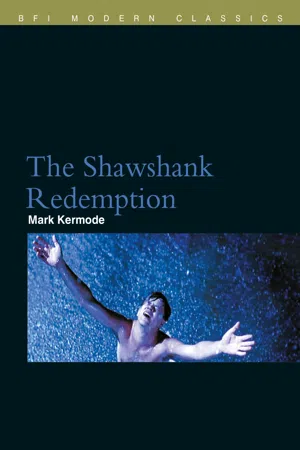
The Shawshank Redemption
About this book
How did a low-key prison movie which was considered a box-office flop on its original release become one of the most popular movies of all time? Mark Kermode traces the history of this unexpected audience favourite from the pages of Stephen King's novella 'Rita Hayworth and Shawshank Redemption', through the icy corridors of Ohio's Mansfield Reformatory (whose imposing gothic architecture dominates the film), to the television and video screens on which 'The Shawshank Redemption' became a phenomenon. This study traces the history of 'The Shawshank Redemption' and draws on interviews with writer/director Frank Darabont and leading players Tim Robbins and Morgan Freeman. The book also explores the near-religious fervour that the film inspires in a huge number of devoted fans.
Trusted by 375,005 students
Access to over 1 million titles for a fair monthly price.
Study more efficiently using our study tools.
Information
1 Deus ex Machina: The Sacred Projector
The Shawshank Redemption opens to the sounds of the Ink Spots singing the popular and instantly recognisable romantic ballad ‘If I Didn’t Care’ over the Castle Rock logo. As the credits begin, we see a bedraggled Andy Dufresne (Tim Robbins) sitting in a ’46 Plymouth outside the house in which his wife is committing adultery. As the valve radio warbles away, filling the air with the sound of close-harmony crooning, Andy’s hand reaches into the glove compartment for a gun and bullets wrapped in an oily rag, a bottle of Rosewood liquor cradled in his lap. From here, we cut to the bright interior of a courtroom where the District Attorney confronts the now shockingly sober Dufresne with the accusation that he told his recently murdered wife ‘“I’ll see you in Hell before I see you Reno.” Those were the words you used, Mr Dufresne, according to the testimony of your neighbours’. ‘If they say so,’ replies Dufresne in a state of almost catatonic serenity. ‘I really don’t remember. I was upset.’
Following his claim that he went to the house of his wife’s golf-pro lover ‘mostly to scare them’, we cut back to the night of the crime to see the ‘confused, drunk’ Andy loading bullets into his revolver (actually Darabont doing his own hand-doubling pick-ups), a look of anguished resolution on his face. According to Andy he then returned home, throwing his gun into the Royal River, a turn of events which the prosecutor describes as ‘convenient’ since it cannot be matched with the weapon which killed the lovers, but which Andy stoically deems ‘decidedly inconvenient … since I am innocent of this crime’. A few moments later, as Andy’s spatted feet are seen in close-up stumbling from the car, broken glass and bullets crushed underfoot, we hear the DA summing up his case, conceding to the jury that the lovers ‘had sinned’, but asking them to consider whether ‘their crime [was] so great as to merit a death sentence?’ As Andy is convicted, and condemned to serve ‘two life sentences … one for each of your victims’, the judge’s gavel comes down and the screen fades to black.
Although Darabont’s original screenplay depicted Andy Dufresne’s ‘crime’ as a pre-credits sequence, with the subsequent trial then playing out through the opening titles, judicious post-production editing conflated these two sequences into a more punchy opening which economically sets up many of the recurrent themes which will haunt The Shawshank Redemption. Most significantly, Andy’s alleged declaration that he will see his wife ‘in hell’, and the DA’s casual acceptance that the deceased ‘had sinned’ establishes from the very outset the quasi-theological environment in which the unfolding drama will play out. Even the most casual viewer of The Shawshank Redemption may be struck by the repetitively religious tone of the dialogue, in which biblical judgments are invoked at every turn, and each profanity tends more toward blasphemy than sexual vulgarity. In his first words in the film, Red swears by ‘God’s honest truth’; Captain Hadley invokes ‘God and Sonny Jesus’ when threatening to send every man to the infirmary on Andy’s first night in Shawshank; Heywood exclaims ‘Sweet Jesus!’ when he learns of Andy’s innocence; Haig declares ‘Oh my Holy God!’ on discovering Dufresne’s miraculous disappearance; even the demonic Warden Norton, who professes to have ‘no blasphemy’ in his prison, sarcastically screams ‘Lord it’s a miracle!’ when faced with his own undoing. Although such religious epithets may be in keeping with the film’s period setting (at least in its early stages), their constant repetition has a cumulative effect upon the viewer, suggesting one possible interpretation of the drama.
Another key signifier introduced at this early stage is memory, or more significantly the lack of it. Apparently an irrelevant throwaway comment designed (perhaps) to cover a guilty truth, Andy’s aside ‘I really don’t remember’ in fact raises an issue which will become profoundly significant for the prisoner – the transience of memory as an allegory for forgiveness. Years later, revealing his dream of escaping to Zihuatanejo, the incarcerated Andy will tell Red of his longing for ‘a warm place that has no memory’, a vision of paradise manifested in the form of a coastal resort flanking the Pacific Ocean.
Most significant, however, is the clear implication from this opening sequence that Andy Dufresne is guilty. Although cine-literate viewers may be inclined from the outset to believe that the absence of a clear-cut murder scene signals a gap in our knowledge of events, the circumstantial evidence definitely fingers Dufresne as the killer of his wife and her lover. In stark contrast to King’s source, in which Red announces from the outset that Andy Dufresne was one of fewer than ten Shawshank inmates he considered to be innocent, Darabont’s movie allows Red to describe Andy as a convicted murderer whose guilt we are encouraged to accept. This is important for two reasons. First, from the outset we are asked to accept Andy as a form of ‘justified sinner’, a man who has been driven to murderous acts by the iniquities of his situation perhaps, but still a murderer nonetheless. (Later on, Andy will tell Red that ‘on the outside I was an honest man … I had to come to prison to be a crook’.) Second, in an environment in which ‘everyone in here is innocent’ (the recurrent chant of the Shawshank inmates), Andy’s assumed ‘guilt’ puts him on a par with the men in whose company he will be forced to spend the next twenty-odd years. In particular, it creates a bond between Andy and Red, who describes himself as ‘the only guilty man in Shawshank’, and whose acceptance of his own guilt will later prove to be his very salvation. In a drama in which so much is made of the nature of innocence, there is a marked difference between portraying Dufresne as simply a wronged man and depicting him as fallen soul, sympathetic but still guilty. In Darabont’s film, it is essential that we do not dismiss Andy as the former but accept him as the latter; a good man tainted with the stench of death who has yet to achieve redemption.


Drunk, armed and convicted: Andy gets life
Up for Rejection
Having established Andy Dufresne as the central figure in his unfolding drama, Darabont now takes us through the bars of Shawshank prison, where he conducts an abrupt volte-face and introduces us to the true ‘hero’ of the story. Seen attending a parole-board hearing after serving twenty years of a life sentence, Red (Morgan Freeman) is presented at first as a naive innocent, protesting his salvation with a blinking eagerness that hints at duplicity (‘I can honestly say that I’m a changed man’). As the camera closes in for a ‘REJECTED’ stamp on his parole document (which incidentally bears a photograph of Freeman’s son Alfonso, and names the prisoner as ‘Ellis Boyd Redding’), we cut to Red re-entering Shawshank’s prison yard, now carrying himself with the demeanour of a world-weary con, simply going through the ‘same old shit, diff ’rent day’. In this environment, everyone is ‘up for rejection next week’, a patina of gallowshumour glossing the purgatorial nature of their situation in which salvation is little more than a hollow joke.


Wide-eyed, rejected and resigned: Red fails parole
With Red now revealed as a player, surrounded by prisoners eager for his services, we hear for the first time the captivating voice-over which will define this as his story (despite his protestations in the novella that ‘it’s not me I want to tell you about’8). Slightly paraphrasing the opening lines from Rita Hayworth and Shawshank Redemption, Freeman’s deliciously luxurious voice addresses the audience directly with the words, ‘There must be a con like me in every prison in America. I’m the guy who can get it for you.’ As he speaks, cinematographer Roger Deakins sneaks a long shot across the exercise yard, overcranking slightly to create an almost subliminal sense of slow motion as Red and his squat companion stroll through the crowd, a sleight of hand allowing the passing of contraband between them as they swagger like a sheriff and his deputy in a B-movie Western. Just then, a siren announcing the arrival of ‘fresh fish’ breaks into the couple’s silent reverie as we segue into what Darabont describes as ‘everybody’s favourite shot in the movie’,9 an astonishing aerial view of Shawshank prison which gives us, for the first time, a sense of the awesome landscape in which this drama will be played out.
‘Welcome to Shawshank’
Although Rita Hayworth is set, like so much of King’s fiction, in the relatively idyllic surroundings of Maine, New England, Darabont’s movie was shot in Mansfield, Ohio, the proud possessor of an extraordinary building which would become a defining character in The Shawshank Redemption. Originally the site of Camp Mordecai Bailey, a Union training base for civil war soldiers, this looming landmark – which is known interchangeably as Mansfield Reformatory and The Ohio State Reformatory – is one part cathedral, two parts Castle Frankenstein. Designed by architect Levi T. Scofield, a native of Cleveland who had travelled widely in Europe, the building is correctly described by tour guide and guardian angel Jan Demyan as ‘an odd mixture of architectural styles; it’s Richardsonian Romanesque, chateau-esque, and also gothic in the overtones of the interior’.10 According to Demyan, the architecture is specifically designed to draw the eyes skywards, suggesting to those who walk its halls and corridors that they are in a church.


‘Everybody’s favourite shot’: welcome to Shawshank

Darabont directs Andy’s arrival at Shawshank
From the state authorities’ point of view, these peculiarly religious overtones exactly fitted their designs for the building, which, from 1896 to 1990, functioned as a reformatory which attempted to combine the fortressed needs of a prison with the evangelising zeal of a correctional facility. Mansfield is a religious town, a place where today the greatest tourist attraction (other than the Reformatory) is a waxwork museum depicting scenes from the Bible, and where meals are served in restaurants in which every attention is given to family seating, and very little to the availability of alcohol. (Tim Robbins remembers Mansfield as ‘a very dull Midwestern town, very religious’, and j...
Table of contents
- Cover Page
- Title Page
- Contents
- Acknowledgments
- Prologue: A Redeeming Feature
- 1. Deus ex Machina: The Sacred Projector
- 2. The Ass and the Angel: Raquel Welch vs. Richard Nixon
- Notes
- Credits
- eCopyright
Frequently asked questions
Yes, you can cancel anytime from the Subscription tab in your account settings on the Perlego website. Your subscription will stay active until the end of your current billing period. Learn how to cancel your subscription
No, books cannot be downloaded as external files, such as PDFs, for use outside of Perlego. However, you can download books within the Perlego app for offline reading on mobile or tablet. Learn how to download books offline
Perlego offers two plans: Essential and Complete
- Essential is ideal for learners and professionals who enjoy exploring a wide range of subjects. Access the Essential Library with 800,000+ trusted titles and best-sellers across business, personal growth, and the humanities. Includes unlimited reading time and Standard Read Aloud voice.
- Complete: Perfect for advanced learners and researchers needing full, unrestricted access. Unlock 1.4M+ books across hundreds of subjects, including academic and specialized titles. The Complete Plan also includes advanced features like Premium Read Aloud and Research Assistant.
We are an online textbook subscription service, where you can get access to an entire online library for less than the price of a single book per month. With over 1 million books across 990+ topics, we’ve got you covered! Learn about our mission
Look out for the read-aloud symbol on your next book to see if you can listen to it. The read-aloud tool reads text aloud for you, highlighting the text as it is being read. You can pause it, speed it up and slow it down. Learn more about Read Aloud
Yes! You can use the Perlego app on both iOS and Android devices to read anytime, anywhere — even offline. Perfect for commutes or when you’re on the go.
Please note we cannot support devices running on iOS 13 and Android 7 or earlier. Learn more about using the app
Please note we cannot support devices running on iOS 13 and Android 7 or earlier. Learn more about using the app
Yes, you can access The Shawshank Redemption by Mark Kermode in PDF and/or ePUB format, as well as other popular books in Media & Performing Arts & Film & Video. We have over one million books available in our catalogue for you to explore.