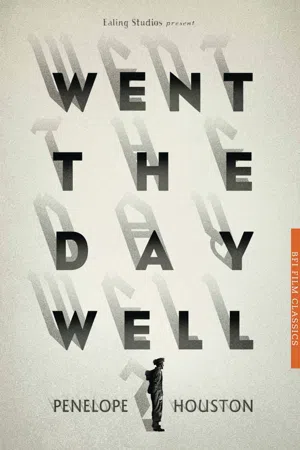
Went the Day Well? is one of the most unusual pictures Ealing Studios produced,
a distinctly unsentimental war film made in the darkest days of World War II,
and nothing like the loveable comedies that later became the Ealing trademark.
Its clear-eyed view of the potential for violence lurking just below the surface
in a quiet English village possibly owes something to the Graham Greene story
on which it is based, though, as Penelope Houston shows, there remains a
mystery about the extent to which Greene was actually involved in the scripting.
Or perhaps the direction by the Brazilian born Cavalcanti, a maverick within the
Ealing coterie, is the chief reason why Went the Day Well? avoids the cosy feel of
later, more familiar, Ealing films.
In his foreword to this special edition, published to celebrate the 20th
anniversary of the BFI Film Classics series, Geoff Brown pays homage to
Penelope Houston's astute study, and places the book in the context of Went the
Day Well?'s changing critical reception. Brown discusses the non-English
qualities of the film's narrative, and the extent to which Cavalcanti brought a
foreign sensibility to its very English setting.
- 72 pages
- English
- ePUB (mobile friendly)
- Available on iOS & Android
eBook - ePub
Went the Day Well?
About this book
Trusted by 375,005 students
Access to over 1 million titles for a fair monthly price.
Study more efficiently using our study tools.
Information
1 Storylines
Went the Day Well? opens in a quiet English country churchyard. ‘Come to have a look at Bramley End, have you?’ asks the verger, waiting to waylay us with all the determination of an inveterate storyteller. We’re there, he tells us, because of the German names recorded on a little war memorial. ‘They wanted England, these Jerries did, and this is the only bit they got.’ Immediately, he dives into reminiscence: ‘It was Saturday morning when those army lorries came rumbling along the road from Upton. We’d have laughed at you if you’d told us we’d got a real live German right under our very noses and we’d have thought you was a bit weak in the upper storey if you’d said the chaps in those lorries was anything else but ordinary British tommies. Pretty soon we learned better ...’ Before he has finished speaking, the camera moves away from the churchyard to pick up the small convoy advancing along the road into Bramley End.

‘A quiet English country churchyard’
The war is over, the verger (Mervyn Johns) has told us. Bramley End has long since returned to its tranquil self. A film which went into production during the dark days of early 1942, weeks after the fall of Singapore, months before El Alamein, had the assurance, even cheek, to look so confidently to the future, soothing its audience before getting down to the business of unsettling them. I had sometimes wondered whether this prologue was actually an afterthought, perhaps tacked on to the picture after the rest had been shot, by which time optimism could have been more justified. But it’s there already in the shooting script, dated 28 March 1942.
The flashback action tells of a village under enemy occupation for two days, the Whitsun weekend of 1942. The men who arrive in the lorries are German parachutists, sixty of them, passing themselves off as Royal Engineers and demanding billets in the village while they carry out an exercise in the area. The villagers may be deceived by the friendly uniforms, but there is no attempt to bamboozle the audience. Ortler (Basil Sydney), the German C.O., almost immediately makes contact with Oliver Wilsford (Leslie Banks), a respectable resident who is also the ‘real live German under our very noses’, no mere Nazi sympathiser or fifth columnist but an agent taking his orders from Berlin. Ortler’s task is to jam the British radio-location over a three hundred mile area and to protect the equipment. If necessary, he and his men are to hold the village for forty-eight hours.
The Germans settle into their billets, but rather carelessly manage to arouse a few suspicions. The vicar’s daughter, Nora (Valerie Taylor), in particular wonders why Royal Engineers should be writing their sevens in the continental way and how a slab of Austrian chocolate has found its way into the kit of ‘Major Hammond’ (Ortler). Wilsford heads her off, but alerts Ortler to put ‘Plan B’ into operation. The lanes are barricaded and walkers and cyclists ‘turned away. Those villagers not already in church are herded there (‘But we’re chapel,’ objects one perplexed local). The vicar is shot when he tries to ring the church bells as a warning. Later, four men cycling back after a Home Guard exercise are ambushed and mown down.

(left to right) Valerie Taylor, C.V. France, Leslie Banks, Basil Sydney
Given half a chance, the villagers do their unavailing best to send messages to the outside world. At night, however, there are two successful escape attempts. George (Harry Fowler), a resourceful young evacuee billeted at the manor house, shins down a drainpipe and makes contact in the woods with his friend Bill Purvis (Edward Rigby), the local poacher. Purvis kills one German but is shot while staging a diversion. George, with a bullet wound in his leg, staggers to the next village to alert the Home Guard: ‘Jerries at Bramley’. Meanwhile, Tom Sturry (Frank Lawton), son of the village publican and on leave from the navy for his wedding, leads a break-out from the church, recaptures the post office and telephones for help. Sturry and his small force head for the manor house, to rescue the children held hostage there and to hold it until the army arrives. Wilsford, still unsuspected by everyone except Nora and the lady of the manor, is shot dead by Nora as he is pulling down the barricades to let the Germans into the manor. The villagers hold out; the army and the Home Guard arrive in strength; the Battle of Bramley End is over.
Went the Day Well? (or, as it was then called, They Came in Khaki) went into production on 26 March 1942 on Stage 2 at Ealing: ‘INT. VICARAGE DINING ROOM AND HALL’. Twenty-one months earlier, on 29 June 1940, a story by Graham Greene called The Lieutenant Died Last had been published in the American magazine Collier’s, ‘the national weekly’. The film is ‘based on’ this story, although a good many things happened to it along the way.
Graham Greene’s village has none of the cooking apple cosiness of Bramley End (Bramley Green in the shooting script and also, oddly, in some of the first reviews). He gives it the uncompromisingly dismal name of Potter and locates it precisely: ‘One of those tiny isolated villages you still find dumped down in deserted corners of what we call in England “Metroland” – the district where commuters live in tidy villas within easy distances of the railway, on the edge of scrubby commons full of clay pits and gorse and rather withered trees.’ To get there, ‘You take a turning marked “No Through Road” and bump heavily towards what looks like a farm gate stuck a mile or more over the shaggy common. Through the gate is nothing but Potter ...’
Potter is not pretty; its church is not thirteenth-century but tin-roofed twentieth-century; its inhabitants are a grumbling, fractious lot. But it is within miles of the main-line railway, and when the German parachutists arrive (only about ten, rather than the sixty the film allows to tumble unobserved from the sky), their purpose is to sabotage the railway. They are wearing their own uniforms, which ensures them prisoner of war status if captured, and they behave in a rather more businesslike way than Ortler and his troop.
The villagers are rounded up in the pub. ‘The post office is closed,’ says its guardian, when the German officer turns up on her doorstep. ‘She didn’t think he looked like a shop customer,’ even though he calls her ‘madam’. The telephone wires have prudently been cut. There is hardly any deliberate violence, and the one village casualty is a boy who tries to make a run for it. ‘They had fired, humanely, at his legs; but he was crippled for life.’
Out in the woods, the poacher, Bill Purves (sic), has been going about his own affairs and actually seen the parachutists coming down. ‘ “It didn’t seem right,” he said afterwards; he meant that it didn’t seem fair, people peeking at you like that out of the sky.’ He is none too clear about just what war is going on: ‘“The bloody Bojers,” Purves said aloud, the old brain creaking rustily back forty years to South Africa and an ambush on the veldt.’ But he stalks the Germans, catches them on the railway line, finds the hunt ‘more fun than rabbit shooting’. He gets several of the Germans, before one of his shots sets off the explosives they are planting and does for the rest. Purves feels a bit sickened: it was ‘like dynamiting fish’. The German lieutenant, fatally injured, appeals to Purves to finish him off, which he does, as he would any wounded animal. And he takes from the lieutenant’s pocket a photograph of a baby.
Purves is not particularly thanked by anyone for his rather spectacular role in checking the invasion; merely let off with a caution when caught with the rabbits in his poacher’s pocket. ‘One souvenir he never showed to anyone – the photograph of the baby on the mat. Sometimes he took it out of a drawer and looked at it himself uneasily. It made him – for no reason that he could understand – feel bad.’
Graham Greene’s story is very short: a mere half-dozen magazine columns. It’s an odd, sardonic little tale, very exact in its description, elusive in its attitudes. It might even have been subjected to some of that ruthless American style-editing: ‘feel bad’ doesn’t sound quite right, for an elderly English poacher in 1940, and the dashes that break out like a rash over the story’s last three sentences don’t look right. The interesting questions, however, are how The Lieutenant Died Last came to be published where it did, and what happened to it before Ealing signed a contract for making a film based on the story, which they did not do until February 1942.
Anthony Aldgate, it seems to me, has answered the first question as satisfactorily as anyone is likely to do, in his interesting chapter on Went the Day Well? in Britain Can Take It. Although Graham Greene’s war service at the Ministry of Information was brief, he was certainly there in April 1940, Aldgate points out, ‘as one of the two specialists in Branch II (Literature)’. I came across an MoI minute which seems to indicate that he was still there in August 1940, when according to the dates given to Aldgate by Greene’s agent, Gerald Pollinger, he should have been well away. In the summer of 1940, as Aldgate says, the Ministry’s Policy Committee ‘was greatly exercised with thoughts and ideas on how best to project Britain’s cause and case in America.’ The Collier’s connection would appear to have been launched with publication of the Greene story, a tasty enough morsel to dangle before an editor. It was strengthened later in 1940, when Quentin Reynolds, the magazine’s London correspondent, wrote and narrated the commentary for London Can Take It! (1940), the blitz documentary which did so much for Britain’s ‘cause and case’ in America.
There seem solid grounds for backing Aldgate’s theory: The Lieutenant Died Last probably landed in Collier’s because the Ministry of Information managed to place it there. Aldgate tucks away in a footnote an assurance from Gerald Pollinger that ‘the story was not written under any kind of official pressure as propaganda’ and that ‘Graham Greene says he has never written any fiction under official guidance, and this applies to this story.’
It remains quite possible, however, that the story could have been published as propaganda, with Greene’s approval, but actually written with no such intention. If Graham Greene had set out to write something calculated to persuade Collier’s middle-American readership of Britain’s worth, it’s hard to believe that he (or, indeed, almost anyone) could not have done a little better than The Lieutenant Died Last. Admittedly, a semi-senile village reprobate gets the better of a German platoon; and one can make a case, as Aldgate does, for the telling effects of ‘English understatement’ and the like. But what would American readers have made of Potter, that sulky little place where they are so befuddled by ARP and AFS uniforms that they can’t recognise a German one, where there appear to be no warning or defence systems, and where the villagers, meek though surly, fit compliantly into the German scheme of things? Any support for a Britain made up of Potters, they might well have felt, would be support wasted.
It is unlikely that Collier’s would have been widely read in Britain, and Greene’s story was not picked up by any British paper or magazine. Ealing, for its part, was not a studio with a large story department, acquiring and stockpiling material. The initiative to buy a story would come, as a general practice, from the creative people. So how did the studio get to hear of The Lieutenant Died Last, of which they were to keep so little in the film? (The notion of parachutists taking over an English village; the character of the old poacher, with his role considerably changed but his name, rather touchingly, left virtually intact.)
Here the cat has been thrown somewhat among the pigeons by Michael Balcon. His autobiography, A Lifetime of Films, allows only one short paragraph to Went the Day Well? and that paragraph contains only one factual statement. Cavalcanti’s film ...
Table of contents
- Cover
- Title Page
- Contents
- Foreword Geoff Brown
- Acknowledgments
- Introduction
- 1. Storylines
- 2. Germans in the back garden
- 3. Actuality and Technique
- 4. They Came in Khaki
- 5. A Little Talent and Taste
- Credits
- Bibliography
- eCopyright
Frequently asked questions
Yes, you can cancel anytime from the Subscription tab in your account settings on the Perlego website. Your subscription will stay active until the end of your current billing period. Learn how to cancel your subscription
No, books cannot be downloaded as external files, such as PDFs, for use outside of Perlego. However, you can download books within the Perlego app for offline reading on mobile or tablet. Learn how to download books offline
Perlego offers two plans: Essential and Complete
- Essential is ideal for learners and professionals who enjoy exploring a wide range of subjects. Access the Essential Library with 800,000+ trusted titles and best-sellers across business, personal growth, and the humanities. Includes unlimited reading time and Standard Read Aloud voice.
- Complete: Perfect for advanced learners and researchers needing full, unrestricted access. Unlock 1.4M+ books across hundreds of subjects, including academic and specialized titles. The Complete Plan also includes advanced features like Premium Read Aloud and Research Assistant.
We are an online textbook subscription service, where you can get access to an entire online library for less than the price of a single book per month. With over 1 million books across 990+ topics, we’ve got you covered! Learn about our mission
Look out for the read-aloud symbol on your next book to see if you can listen to it. The read-aloud tool reads text aloud for you, highlighting the text as it is being read. You can pause it, speed it up and slow it down. Learn more about Read Aloud
Yes! You can use the Perlego app on both iOS and Android devices to read anytime, anywhere — even offline. Perfect for commutes or when you’re on the go.
Please note we cannot support devices running on iOS 13 and Android 7 or earlier. Learn more about using the app
Please note we cannot support devices running on iOS 13 and Android 7 or earlier. Learn more about using the app
Yes, you can access Went the Day Well? by Penelope Houston in PDF and/or ePUB format, as well as other popular books in Media & Performing Arts & Film History & Criticism. We have over one million books available in our catalogue for you to explore.