eBook - ePub
Titanic
About this book
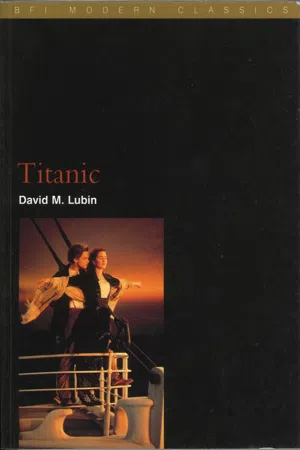
This text looks at 'Titanic', the first film to earn over a billion dollars at the global box-office. This epic film reimagines one of the defining events of the 20th century through the lens of American romanticism.
Trusted by 375,005 students
Access to over 1.5 million titles for a fair monthly price.
Study more efficiently using our study tools.
Information
Titanic
Who’s Seen It, Why?
For a movie that sold more tickets in its first year of release than any other motion picture in history, a movie that was the first ever to gross one billion dollars in worldwide sales, Titanic has been seen by few people I know. When I began telling my friends, colleagues and students that I was writing a detailed analysis of the blockbuster, I was surprised at how few of them had seen it – or at least were willing to admit they had. Eventually this response proved so predictable that I eventually switched gears – or, to use a metaphor from the film – reversed engines and now have come to be surprised when someone I know actually says, ‘Oh, yes, I’ve seen that film.’ The greatest surprise of all is when he or she adds, ‘And I loved it.’
As the French sociologist Pierre Bourdieu details in Distinction, the consumption or non-consumption of popular culture artefacts is a means by which individuals in a society define for themselves and others their social position, their status.1 To consume an artefact that most everyone else in your peer group has been consuming, and to relish it along with them, is to strengthen your affiliation. To make a choice not to consume an artefact that you perceive to be distasteful to your own class faction is likewise a means of affirming your legitimate place within that faction. Consuming or not consuming the artefact in question can even be a tactic for dissociating yourself from your present peer group in order to associate yourself with another.
Something of this sort goes on all the time as we make decisions, first, what movies to see or not see and, second, whether to be enthralled by them or instead turn up our noses and loudly protest having wasted our time. I think it has something to do with why so few of my acquaintances in the professional managerial middle class made a point of viewing Titanic and why, in fact, so many of them made it a point of pride to stay away from a film that was hyped almost beyond belief in the first months of its release. Refusing to see Titanic, or, if seeing it, refusing to be taken in by it (in a key phrase from the film dialogue, ‘to let it in’), became a way of asserting one’s independence from all the journalistic gush surrounding James Cameron’s film and all the highly suspect emotional manipulation within it.

True love or true hype?
This is not to say that critics of Titanic are unjustified in finding it a crude, tawdry, manipulative example of cinematic art. There are, indeed, sound aesthetic reasons for considering the film closer in kinship and kitsch to Ship of Fools, The Poseidon Adventure and even The Love Boat than to Battleship Potempkin. But, still, the critical backlash against Titanic in some of the popular and trade press was so excessive that one can only wonder if the bombardment against Cameron’s ‘ship of dreams’ wasn’t really aimed at a larger target than the particular film in question.
Leading the onslaught was the influential senior film reviewer for the Los Angeles Times, Kenneth Turan, who availed himself of every opportunity to pepper Titanic with grapeshot from the moment of its US première in late December 1997 to its film-industry apotheosis the following March when at the Academy Awards ceremony it tied the illustrious record set in 1959 by Ben-Hur for the most Oscars (11) ever won by a single film.2When irate readers defended Titanic from Turan’s ridicule by proclaiming that ‘proof [of the film’s capacity for moving viewers] is in the box-office’, Turan replied, ‘Film critics, general opinion notwithstanding, are not intended to be applause meters. After all, restaurant critics don’t send [consumers] straight to McDonald’s on the “everybody goes there, it must be the best” theory.’ Quite to the contrary, the role of critics ‘must be to point out the existence and importance of other criteria for judgment besides popularity’.3
The enemy here appears to be contemporary popular taste, mass culture, the McDonaldization of sensibility with regard to hamburgers and blockbusters alike. Not that Turan assigns the blame for this degradation of standards to the masses themselves, but rather to the culture industry that has seduced or otherwise commandeered their attention: ‘Titanic’s ability to attract a crowd,’ he continues, ‘shows how desperate the mainstream audience – alienated by studio reliance on the kind of mindless violence that can be counted on to sell overseas – has become for anything even resembling old-fashioned entertainment.… Deadened by exposure to nonstop trash… audiences have been sadly eager to embrace a film that, putting the best face on it, is a witless counterfeit of Hollywood’s Golden Age, a compendium of clichés that add up to a reasonable facsimile of a film.’
Film studies professor José Arroyo concurs not only with Turan’s assessment of Titanic’s flaws but his conviction that these flaws are endemic to the current state of market-driven film-making: ‘It is because of its lack of story-telling skills and its execrable character delineation that Titanic is emblematic of contemporary Hollywood action / spectacle – it is also because of this that it is not a good film.’4 Critic Laura Miller is less measured in tone: ‘That everything about Titanic – from its stereotyped characters to its bright, even lighting – feels ersatz and obvious may only trouble the kind of people who dislike the immaculate, synthetic recreations of real places in Disney theme parks.’ Alas, most people are not Disney-proof: ‘The movie works as a simple-minded entertainment that provides a setting for spectacular visual effects, and many audiences will find it adequately enjoyable,’ Miller concedes with a sigh.5
Adequately enjoyable? Is that all? As is by now well known, audiences across the planet found Titanic something more than merely adequate in the pleasure – and, indeed, pain – it stimulated. In an effort to make sense of the film’s staggeringly unexpected audience appeal, a Newsweek story in February 1998 told of an 18-year-old US college student named Gina Latta who wears blue nail polish, has her ears triple pierced, favours David Lynch movies, and even regards the dialogue in Titanic as ‘incredibly cheesy’. Nonetheless, in the two months since the film’s US première, Latta had seen it four times: ‘The first time I saw it, I got out of the theater and I was having a cigarette with a friend and we couldn’t stop crying. I was so overwhelmed at how sad it was.’6
The Newsweek piece drew upon a variety of media producers and pundits to suggest that the movie was tapping into widespread public desires to move beyond, in Camille Paglia’s words, ‘shallow postmodernist irony and cynicism’ toward a cynicism-free product that celebrates themes of selflessness, self-sacrifice and cross-class bonding. Feminist author Mary Pipher (Reviving Orphelia) contended that the movie was ‘really about [Jack] helping [Rose] become an authentic whole person’, while 29-year-old male Japanese magazine editor Naoshi Kayashima valued it as an examination of male cowardice and courage (‘a movie about how men choose their endings’), and 63-year-old theatre director André Gregory explained that, for him, ‘the movie was really about that old woman. I was moved that she could fight her way out of a life that was imposed on her by her family, and by society.’7
The thrust of the Newsweek coverage was to designate Titanic as a women’s film with crossover appeal to men who want more from a movie than simply colossal effects and brutal physical action. Yet despite Newsweek’s acknowledgment of the film’s emotional appeal to male as well as female filmgoers, it characterized Titanic’s typical viewer – particularly its repeat viewer – as a female under the age of 25. Polls cited by the article found that 60 per cent of Titanic’s audiences were female, 63 per cent of its viewers were under 25, and 45 per cent of all women under 25 who had seen the movie had seen it at least twice. No surprise then that press accounts of the movie’s unprecedented box-office success took it upon themselves to explain it as the revenge of the ‘chick flick’ against the more typical ‘dick flick’ that Cameron and other high-testosterone action directors had previously turned into box-office megahits. A cartoon in Time drolly advanced this point of view by depicting a city block with two queues of consumers: the all-female queue stands in front of a cinema with the name Titanic blazoned across its marquee; the all-male queue lines up before a pharmacy with a sign in the window announcing ‘Viagra Now Available’.8
Throughout the spring of 1998, reports of Titanic hysteria seemed determined to resurrect the old cultural stereotype of tear-streaked, weak-kneed female idolators constitutionally incapable of withstanding the obsessive impulses programmed into them by the merchants of shlock. Elvis, the early Beatles, and now Titanic. In March the Associated Press carried an item about a 12-year-old Italian girl who had devotedly attended the movie every single day since December. In May the teen magazine Sugar told of a 14-year-old English girl and her mum who had sat through a total of 84 screenings of the epic since its UK release at the end of January.9 In June an Associated Press news brief reported that an unidentified Norwegian woman, mid- to late thirties in age, had plunged to her death from the bow railing of a Scandinavian cruise ship, where she had positioned herself at sunset in imitation of Rose’s ‘flying’ scene. A rash of similar, if non-fatal, incidents on other cruise ships in other seas led transportation safety boards to issue stern warnings that passengers must not be permitted to climb onto ship railings.10

The commerce of sexual politics. ©Jack Ziegler from cartoonbank.com. All rights reserved
It’s my contention, though, that the appeal of Cameron’s film extends well beyond female moviegoers looking for a good cry, stolid males hoping to provide a manly shoulder to cry on, and untold legions of ‘Titaniacs’ who have long constituted a guaranteed audience for any movie or book (possibly even this book) that takes the doomed ocean liner as its topic. What the following analysis suggests is that Titanic offers its audiences a way to think about relevant modern issues of culture and class. While not by any means an intellectual film (and far less an intellectual’s film), Titanic nevertheless prompts viewers to pose to themselves questions about our society’s divide between rich and poor, the nature of love, the meaning of sacrifice, and modernity’s faith in, even obsession with, technological prowess and mastery over nature.
Indeed, these same questions were raised in the minds of the general public from the very first reports of Titanic’s collision with the iceberg on the night of 14 April 1912.11 In the immediate aftermath of the sinking, Joseph Conrad used it as an occasion to blame the steamship lines for fetishizing size, speed and profits, while Thomas Hardy, in a poem penned for a memorial service one month after the disaster, expressed anew his naturalist creed that fate rules human destiny and, in this instance, ordained for the great ship and the even greater iceberg an unavoidable ‘Convergence of the Twain...
Table of contents
- Cover Page
- Title Page
- Contents
- Titanic
- Notes
- Credits
- eCopyright
Frequently asked questions
Yes, you can cancel anytime from the Subscription tab in your account settings on the Perlego website. Your subscription will stay active until the end of your current billing period. Learn how to cancel your subscription
No, books cannot be downloaded as external files, such as PDFs, for use outside of Perlego. However, you can download books within the Perlego app for offline reading on mobile or tablet. Learn how to download books offline
Perlego offers two plans: Essential and Complete
- Essential is ideal for learners and professionals who enjoy exploring a wide range of subjects. Access the Essential Library with 800,000+ trusted titles and best-sellers across business, personal growth, and the humanities. Includes unlimited reading time and Standard Read Aloud voice.
- Complete: Perfect for advanced learners and researchers needing full, unrestricted access. Unlock 1.5M+ books across hundreds of subjects, including academic and specialized titles. The Complete Plan also includes advanced features like Premium Read Aloud and Research Assistant.
We are an online textbook subscription service, where you can get access to an entire online library for less than the price of a single book per month. With over 1.5 million books across 990+ topics, we’ve got you covered! Learn about our mission
Look out for the read-aloud symbol on your next book to see if you can listen to it. The read-aloud tool reads text aloud for you, highlighting the text as it is being read. You can pause it, speed it up and slow it down. Learn more about Read Aloud
Yes! You can use the Perlego app on both iOS and Android devices to read anytime, anywhere — even offline. Perfect for commutes or when you’re on the go.
Please note we cannot support devices running on iOS 13 and Android 7 or earlier. Learn more about using the app
Please note we cannot support devices running on iOS 13 and Android 7 or earlier. Learn more about using the app
Yes, you can access Titanic by David M. Lubin in PDF and/or ePUB format, as well as other popular books in Media & Performing Arts & Film History & Criticism. We have over 1.5 million books available in our catalogue for you to explore.