What makes a home for you?
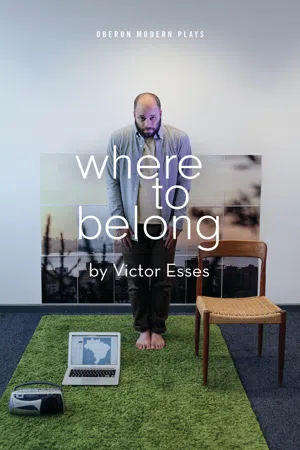
Victor Esses is Jewish-Lebanese, Brazilian, and gay. In 1975, Victor's mother flees Lebanon as a refugee of the Civil War. In 2017, Victor visits Lebanon for the first time. In 2018, amidst the elections that will see Brazil choose a far-right president, he travels from London to São Paulo to show his partner the city of his childhood.
Where to Belong is the tender, moving story of these journeys – an exploration of how to find your place in a rich and complex world of identities.
- 64 pages
- English
- ePUB (mobile friendly)
- Available on iOS & Android
eBook - ePub
Where to Belong
About this book
Trusted by 375,005 students
Access to over 1 million titles for a fair monthly price.
Study more efficiently using our study tools.
Information
Prologue
VICTOR:
How do I place my body in this space?
My white body.
My Jewish body.
Which then, does it mean it’s not white?
My non-black body.
My body that is not English,
yet it could be. Could it?
It could be.
What does my body say to you?
My gay body. My fat body. My sexual body.
My body and its story…
Where does it belong?
This privileged, middle-class body.
This upright, erect, able, thinking body.
Is it presentable?
It is me who stands here in front of you.
Me, whoever that may be.
In a body I don’t feel comfortable in.
A body that belongs here, but only
when I force myself to stand here.
He walks to a different spot.
Or here.
He walks upstage left, by the back wall.
Or here. To question.
*


An image of the Beirut skyline from a distance is projected onto the upstage wall.
‘Nehna Wel Amar Jiran’ by Fairuz plays.
VICTOR turns, straightens the chair, and drags it behind himself upstage, across the image, as if it were a suitcase. As he reaches stage right, he takes the chair centre stage.
He removes the smaller box that is covering the bigger one and helium balloons fly out. He places it on the back of the chair, facing the audience. He uncovers the lens of the mini-projector that faces it. An image is projected onto the piece of cardboard that stands on the visible wooden feet of the chair. Together they become an old television.
VICTOR:
Years ago, long before I moved to the UK, back in São Paulo, Brazil, we used to drive to the beach town of Guarujá often, on weekends. That’s where the Sephardic Jews used to go. And my dad used to insert a cassette into the cassette player, in the car on the way from São Paulo to Guarujá. And the song he often played was called ‘Allo Beirut’. Or ‘Hello Beirut’. I never knew what it said at the time apart from ‘hello, hello, hello Beirut’. He, my dad, would often sing it himself when anyone mentioned Beirut. His hometown. The one he left when he was thirteen.
Later I discovered that the song came out in 1966. One year before my dad left for Brazil. It was sung by Sabah, one of the big divas of the Arabic chanson. And it spoke dearly of a place that was then living a golden era: the Paris of the Middle East. In those days people thought it was cool to be compared to Paris.
Less than a decade after that, a civil war broke out between Maronites and Shiites and anyone and everyone in-between. That’s when my mother left, in 1975. The song ‘Allo Beirut’, I found out later, speaks of someone asking the operator to connect them to the radio station, where they seem to have lost their heart, and their babe. And really their babe here is Beirut as the song mentions many of the neighbourhoods in the city in a very romantic way.
After 1975 ‘Allo Beirut’ became a song of memory, of those glory days. Allo (clears throat) allo (tries again) allo… (Starts singing with his eyes closed.)
He sings ‘Allo Beirut’.
Sabah was a real star. She starred in over ninety films throughout her life – according to Wikipedia. She used to wear these outrageous dresses and hairpieces. She actually reminds me of my great-aunt Marcelle, whom I met much later. She left her Jewish roots behind, and from Lebanon moved to Italy. To Rome. And converted to Catholicism. For a man, a diplomat. Sabah and Marcelle were completely similar. They weren’t completely similar, but the way they liked to dress up and the big personalities were definitely a thing.
(Two and a half years ago) I went to Beirut for the first time and I saw a city that is partly still in ruins. You can feel the tension in the air. The remnants of a divided country, of a civil war that lasted for the best part of fifteen years. A people who love to party hard to forget and pretend. Streets where you never know if someone is watching you. Empty spaces left by bombs and bullets. And a place where some rich Kh...
Table of contents
- Front Cover
- Half-Title Page
- Title Page
- Copyright Page
- Contents
- Introduction
- Dedication
- Prologue
- Epilogue
Frequently asked questions
Yes, you can cancel anytime from the Subscription tab in your account settings on the Perlego website. Your subscription will stay active until the end of your current billing period. Learn how to cancel your subscription
No, books cannot be downloaded as external files, such as PDFs, for use outside of Perlego. However, you can download books within the Perlego app for offline reading on mobile or tablet. Learn how to download books offline
Perlego offers two plans: Essential and Complete
- Essential is ideal for learners and professionals who enjoy exploring a wide range of subjects. Access the Essential Library with 800,000+ trusted titles and best-sellers across business, personal growth, and the humanities. Includes unlimited reading time and Standard Read Aloud voice.
- Complete: Perfect for advanced learners and researchers needing full, unrestricted access. Unlock 1.4M+ books across hundreds of subjects, including academic and specialized titles. The Complete Plan also includes advanced features like Premium Read Aloud and Research Assistant.
We are an online textbook subscription service, where you can get access to an entire online library for less than the price of a single book per month. With over 1 million books across 990+ topics, we’ve got you covered! Learn about our mission
Look out for the read-aloud symbol on your next book to see if you can listen to it. The read-aloud tool reads text aloud for you, highlighting the text as it is being read. You can pause it, speed it up and slow it down. Learn more about Read Aloud
Yes! You can use the Perlego app on both iOS and Android devices to read anytime, anywhere — even offline. Perfect for commutes or when you’re on the go.
Please note we cannot support devices running on iOS 13 and Android 7 or earlier. Learn more about using the app
Please note we cannot support devices running on iOS 13 and Android 7 or earlier. Learn more about using the app
Yes, you can access Where to Belong by Victor Esses in PDF and/or ePUB format, as well as other popular books in Social Sciences & British Drama. We have over one million books available in our catalogue for you to explore.