
- 536 pages
- English
- ePUB (mobile friendly)
- Available on iOS & Android
eBook - ePub
Fluid-Solid Reactions
About this book
Fluid-Solid Reactions, Second Edition takes a detailed and thorough look at the scope of fluid-solid reaction systems, focusing on the four phenomena: external mass transfer, pore diffusion, chemical reaction, and adsorption/desorption. This completely revised new edition builds on the classic original edition through the introduction of cutting-edge new theories and applications, including the formulation and application of a new and convenient law that governs fluid-solid reaction kinetics. This book will be of primary interest to practicing engineers engaged in process research, development, and design in the many fields where fluid-solid reactions are critical to workflow and research.
Fluid-solid reactions play a major role in the technology of most industrialized nations. These reactions encompass a very broad field, including the extraction of metals from their ores, the combustion of solid fuels, coal gasification, and the incineration of solid refuse.
- Features 50% new and revised content, arming researchers with the latest developments in the field
- Details a new unified approach to modeling the rates of fluid-solid reaction systems
- Authored by one of the world's foremost experts on fluid-solid reactions and their applications in the field
Trusted by 375,005 students
Access to over 1.5 million titles for a fair monthly price.
Study more efficiently using our study tools.
Information
Chapter 1
Introduction
Abstract
This chapter introduces the subject matters, their importance in research and industrial applications, major components in the theoretical analysis of fluid-solid reactions, and how the book is organized with a brief summary of each chapter.
Keywords
fluid–solid reactions; blast furnace; fluidized bed roaster; flash smelting furnace; classification; theoretical development; intermediate steps; chapter organization
Fluid-solid reactions, both gas-solid and liquid-solid types, play a major role in most industrial technologies. They encompass a very broad field, including the extraction of metals from their ores (ironmaking in blast furnaces, the roasting of sulfide ores, flash smelting, leaching of minerals from ores, etc.), the combustion of solid fuels, coal gasification, cement manufacture, dissolution of solids in liquids, and crystallization to name a few examples (Sohn and Wadsworth, 1979; Szekely et al., 1976). They are also critical in a wide range of other fields from environment-related systems such as carbon dioxide sequestration (Liu and Mostaghimi, 2017; Menke et al., 2015; Chen et al., 2014) to several aspects of semiconductor processing (Chiang et al., 2017; Dodge and Shadman, 2014). Equipment used for effecting fluid-solid reactions is also diverse, as seen from Figs. 1.1 to 1.3.

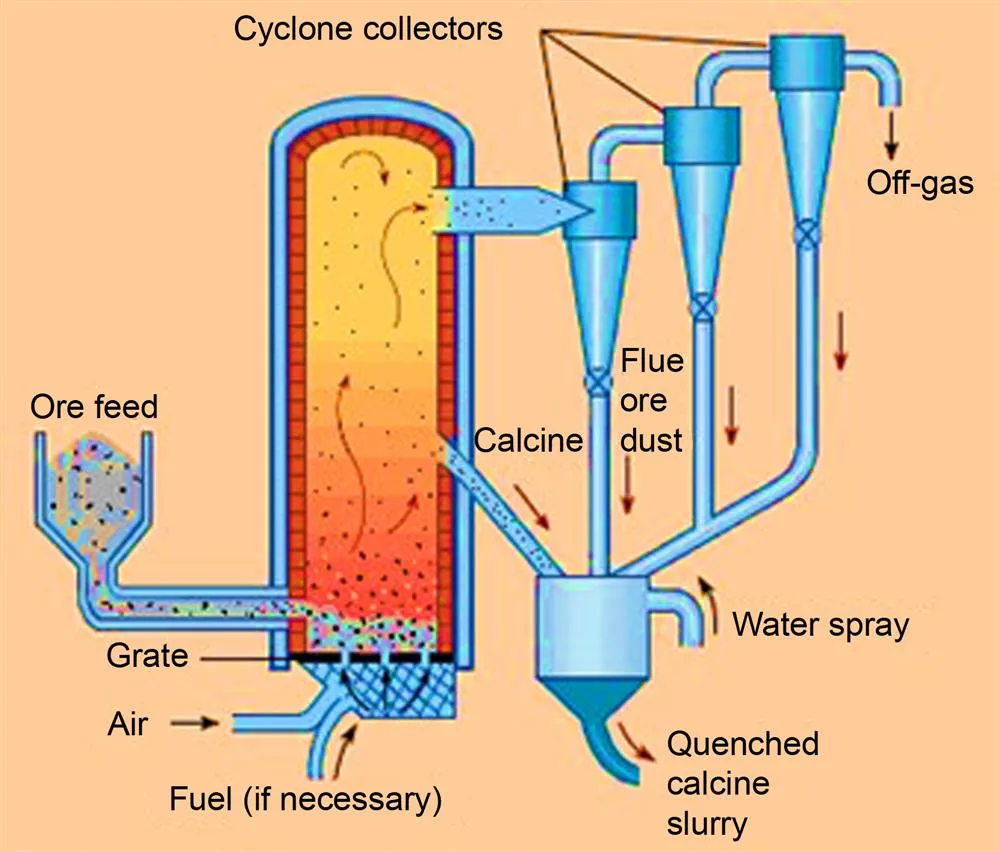

Fig. 1.1 is a schematic line diagram of a typical iron blast furnace in which iron ore is reduced and molten hot metal is the product. A large iron blast furnace may have an internal volume of 6000 m3 and produce almost 6 million tonnes of iron per year, enough to produce 6 million passenger cars yearly (e-metallicus, 2017). The blast furnace is fed with ore, pellets, or sinter, which may range in size from 1 to 10 cm.
Fig. 1.2 is a schematic diagram of a fluidized bed roaster for sulfide ores. The solid reactant supplied to such a system is carefully sized and may be of the order of 0.01–0.2 cm.
Fig. 1.3 is a schematic diagram of a copper flash smelting furnace, in which a copper concentrate of particle size <100 µm is reacted with an oxygen-containing process gas to produce a copper matte in the typical first step of coppermaking.
Fluid-solid reactions may be grouped into the following general types:
- A. Solid→Fluid
- B. Solid 1→Fluid+Solid 2
- C. Fluid+Solid→Fluid
- D. Fluid+Solid 1→Fluid+Solid 2
- E. Fluid+Solid 1→Solid 2
- F. Solid 1+Solid 2→Fluid+Solid 3
- G. Solid 1+Solid 2→Solid 3+Solid 4 (if proceeding through fluid intermediates)
- H. Fluid→Fluid+Solid
- I. Fluid→Solid
Each aforementioned phase may consist of more than one compound. A fluid phase may contain an inert fluid component, the presence of which may significantly affect mass transfer.
Although some of the aforementioned reactions are the reverses of others, for example, Types A and I, their mechanisms and rate expressions are usually very different, that is, those for one cannot be applied to the other. This is because the mechanisms and kinetics of fluid-solid reactions depend critically on the structure of the solid. Thus fluid-solid reactions cannot in general be termed “reversible” in the sense of reversible homogeneous reactions. Fluid-solid reactions with finite equilibrium constants should be termed “equilibrium-limited” reactions, because the same rate equation does not apply to the reverse reaction simply with a change of the sign on the concentration driving force. The fluid product concentration in this case just reduces the concentration driving force for the forward reaction, and a different rate expression must be applied when the product concentration exceeds the equilibrium value, that is, the reverse reaction must be considered as a different type of fluid-solid reaction.
Of the aforementioned groups, Type D is arguably most widely encountered in chemical and metallurgical processes, and thus will receive the greatest attention in this book, followed by Types C and F.
Some real examples of fluid-solid reactions are (ΔH° values at 25°C)
- 1.

- 2.

- 3.

- 4.

- 5.

- 6.

- 7. 4CuFeS2 (s)+17O2 (dissolved in liq.)+4H+ (in liq.)=4Cu2+ ()+4Fe3+ (
 )+(
)+( )+2H2O ()
Of these reactions, the oxidation (combustion) of carbon and the oxidation (roasting) of pyrite are both highly exothermic, while the reduction of iron oxide with hydrogen is slightly endothermic. Both the reaction of carbon dioxide with carbon and the reaction of ferrous oxide with carbon are strongly endothermic. It is perhaps of interest to make some comments on the characteristics of the reactions listed.
Systems 1 and 5 involve reaction between a fluid and a solid wher...
Table of contents
- Cover image
- Title page
- Table of Contents
- Copyright
- Dedication
- Preface
- Acknowledgments
- Chapter 1. Introduction
- Chapter 2. Constitutive elements of fluid-solid reactions
- Chapter 3. Reaction kinetics of fine particles
- Chapter 4. General approach to fluid-solid reaction analysis and modeling
- Chapter 5. Reactions of single nonporous solids
- Chapter 6. Reactions of single porous solids
- Chapter 7. Sohn’s law of fluid-solid reaction rates
- Chapter 8. Extension of basic analysis to complex systems
- Chapter 9. Reactions between solids proceeding through gaseous intermediates
- Chapter 10. Design of multiparticle fluid-solid reactors
- Chapter 11. Experimental techniques in fluid-solid reactions
- Index
Frequently asked questions
Yes, you can cancel anytime from the Subscription tab in your account settings on the Perlego website. Your subscription will stay active until the end of your current billing period. Learn how to cancel your subscription
No, books cannot be downloaded as external files, such as PDFs, for use outside of Perlego. However, you can download books within the Perlego app for offline reading on mobile or tablet. Learn how to download books offline
Perlego offers two plans: Essential and Complete
- Essential is ideal for learners and professionals who enjoy exploring a wide range of subjects. Access the Essential Library with 800,000+ trusted titles and best-sellers across business, personal growth, and the humanities. Includes unlimited reading time and Standard Read Aloud voice.
- Complete: Perfect for advanced learners and researchers needing full, unrestricted access. Unlock 1.5M+ books across hundreds of subjects, including academic and specialized titles. The Complete Plan also includes advanced features like Premium Read Aloud and Research Assistant.
We are an online textbook subscription service, where you can get access to an entire online library for less than the price of a single book per month. With over 1.5 million books across 990+ topics, we’ve got you covered! Learn about our mission
Look out for the read-aloud symbol on your next book to see if you can listen to it. The read-aloud tool reads text aloud for you, highlighting the text as it is being read. You can pause it, speed it up and slow it down. Learn more about Read Aloud
Yes! You can use the Perlego app on both iOS and Android devices to read anytime, anywhere — even offline. Perfect for commutes or when you’re on the go.
Please note we cannot support devices running on iOS 13 and Android 7 or earlier. Learn more about using the app
Please note we cannot support devices running on iOS 13 and Android 7 or earlier. Learn more about using the app
Yes, you can access Fluid-Solid Reactions by H. Y. Sohn in PDF and/or ePUB format, as well as other popular books in Physical Sciences & Organic Chemistry. We have over 1.5 million books available in our catalogue for you to explore.