eBook - ePub
The Hidden Link Between Earth's Magnetic Field and Climate
- 228 pages
- English
- ePUB (mobile friendly)
- Available on iOS & Android
eBook - ePub
The Hidden Link Between Earth's Magnetic Field and Climate
About this book
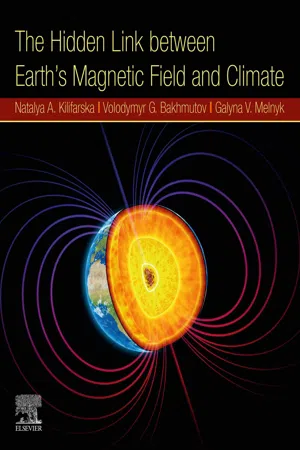
The Hidden Link Between Earth's Magnetic Field and Climate offers a new framework of understanding and interpretation for both well-known and less known relations between different geophysical and meteorological variables which can improve the quality of climate modeling. The book reviews the most current research on both current and paleo data to introduce a causal chain of interactions between the geomagnetic field, energetic particles which bombard the Earth's atmosphere, ozone and humidity near the tropopause, and surface temperature.
The impacts of these complicated interactions is not uniformly distributed over the globe, thus contributing to our understanding of regional differences in climatic changes and the asymmetrical ozone distribution over the globe.
- Covers the newly discovered autocatalytic cycle for ozone production in the lower stratosphere, providing a better understanding of the heterogeneous distribution of ozone globally
- Outlines a mechanism for the lower stratospheric ozone influence on the temperature and humidity of the upper troposphere
- Provides a single resource on research in energetic particles' modulation by heterogeneous geomagnetic fields, mechanisms of the influence of particles on the atmospheric ozone, and the influence of ozone on climate
Trusted by 375,005 students
Access to over 1.5 million titles for a fair monthly price.
Study more efficiently using our study tools.
Information
Topic
Physical SciencesSubtopic
Meteorology & ClimatologyChapter 1
Geomagnetic field—Origin, spatial-temporal structure, and variability
Abstract
This chapter provides introductory information about Earth's magnetic field, necessary for understanding the following chapters of this book. The structure and methods for data collection of contemporary geomagnetic field are briefly described. More attention is paid to the methods for accurate determination of the intensity, and the precise dating of the ancient geomagnetic field. The chapter offers information about some widely used concepts like secular variations, westward drift of a nondipole part of geomagnetic field, geomagnetic reversals, and the origin of Earth's magnetic field. The secular variations during the 20th century are analysed in more detail. The reader will also find the most recent state of knowledge regarding the field generation and factors determining its external and internal variability. Finally, useful information about the recently available empirical models of geomagnetic field is presented.
Keywords
Dipole and nondipole component of geomagnetic field; Externally and internally generated geomagnetic variations; Westward drift; Geomagnetic reversals; Geomagnetic field origin
Earth's magnetic field plays an important role in many aspects of Earth sciences. It is one of the key components of the complex integrated system of our planet, because it interacts with all Earth's shells—the atmosphere, the biosphere, Earth's crust, mantle and core—shielding the life on the planet from the harmful effects of cosmic radiation. Therefore, the magnetic field ‘contains’ information about both the state of near-Earth outer space and the internal structure of the deep Earth's interior. This chapter considers the structure, properties, nature, and methods for investigation of Earth's magnetic field.
1.1 Geomagnetic field structure—Dipole and nondipole components; temporal variability
The observed geomagnetic field on Earth's surface is a vector sum of the magnetic fields of several sources (Fig. 1.1) located in different areas inside the planet and in near-planetary space (Parkinson, 1983; Yanovsky, 1978; etc.):

where F0 is the dipolar component of geomagnetic field, Fm is the field of world anomalies associated with the heterogeneity of the deep Earth's interior (nondipole field), Fa is the remanent magnetization of the rocks within the upper part of Earth's crust (anomalous field), Fe is the field of external sources, and δF is the field of variation, also associated with external causes (Fig. 1.1). The sum of the dipole and nondipole fields is sometimes called the main magnetic field of the Earth, i.e. F = F0 + Fn.

The geomagnetic field can be described on Earth's surface by its three orthogonal components: X (pointing to the geographic north direction), Y (pointing eastward), and Z (pointing downward in the Northern Hemisphere). The two horizontal components X and Y can be combined, yielding the horizontal component H, which is aligned in the direction of the compass needle:

The sum of all three components defines the total field intensity, directed towards the centre of the planet:

The declination D is defined as the angle between H and geographic north, while the inclination I is the angle between the horizontal plane and the vector of total field intensity F. In the international SI system, the measurable units of geomagnetic field strength are Tesla (T) and its subunits: μT = 10− 6 T and nT = 10− 9 T.
The spatial-temporal variability of Earth's magnetic field is one of its most characteristic features. The available information has a different physical basis, accuracy, and resolution, and covers different time ranges. To obtain the most complete information about Earth's magnetic field, data from all sources are used (refer to Table 1.1).
Table 1.1
| № | Geomagnetic variations | Period (1 < n < 10) | Amplitude (1 < n < 10) | Measurement accuracy | Data acquisition methodsa |
|---|---|---|---|---|---|
| 1 | Steady and irregular pulsations | Minutes | ~ n × 10− 1 (nT) | 0.1–1.0 (nT) | О, S |
| 2 | Disturbed and undisturbed variations | Hours | ~ n × 10 (nT) | 1.0–5.0 (nT) | О, S |
| 3 | Magnetic storms | Hours-days | n × 10–n × 102 (nT) | 10 (nT) | О, S |
| 4 | Secular variations | n × 10–n × 103 years | More than (n × 102n × 103) (nT) | 1–3 degrees | О, H, А, P |
| 5 | Episodes and excursions | n × 102–n × 104 years | > 50 degrees (excursions) | ~ 10 degrees | P |
| 6 | Reversals | n × 103–n × 104 years | – | ~ 10 degrees | P |
| 7 | Intervals between reversals | n × 105–n × 106 years | – | ~ 10–20 degrees | P |

aA, archaeomagnetic; H, historical; O, ground-based observations; P, palaeomagnetic methods; S, satellite measurements.
From Bakhmutov, V.G., 2006. Paleosecular Variations of Geomagnetic Field, Kiev. Naukova Dumka, p. 9 (in Russian).
Temporal variations of geomagnetic field cover a broad range of timescales (Table 1.1). Short-term changes (e.g. variations with Nos. 1–3) are caused by the external sources—i.e. the electromagnetic currents in the magnetosphere and ionosphere, which are studied by the use of direct (instrumental) observations. Long-period changes (Nos. 4–6 in Table 1.1) are caused by the internal sources in Earth's core and are studied by using both—direct observations and the results of indirect (i.e. archaeomagnetic and palaeomagnetic) methods. Geomagnetic pulsations (No. 1 in Table 1.1) are very short-lasting oscillations of geomagnetic field. The origin of these fluctuations is ultra-low-frequency hydromagnetic waves, which are excited in solar wind and Earth's magnetosphere. They are divided into two classes: irregular pulsations Pi (individual bursts lasting several minutes), and more stable continuous pulsations Pc (lasting several hours with a quasisinusoidal shape). Among all Pcs, Pc1 pulsations are distinguished with a period of 0.2–5 s (also called ‘pearls’) and duration of the series from half an hour to several hours. The maximum of their occurrence is observed in the early morning local time hours. In the Pi1 range, several types of pulsations are observed, in particular Intervals of Pulsations with Diminishing Period (IPDPs) associated with the development of the magnetospheric substorm. IPDPs are most often observed in the afternoon and evening sectors in the form of a series of separate wave packets, similar to Pc1 oscillations, but with a gradually decreasing period, i.e. increasing frequency.
The perturbed and unperturbed geomagnetic variations (Nos. 2–3 in Table 1.1) are changes in the Earth's magnetic field over time under the influence of various factors. Unperturbed are the small amplitude (~ tens of nT) annual variations of the monthly average values of Earth's magnetic field, and diurnal variations, which are associated with changes in solar activity and the moon phase. They have a maximum during the...
Table of contents
- Cover image
- Title page
- Table of Contents
- Copyright
- List of abbreviations
- Chapter 1: Geomagnetic field—Origin, spatial-temporal structure, and variability
- Chapter 2: Variations and covariation in palaeoclimate and palaeomagnetic field
- Chapter 3: Current understanding about the factors driving climate variability
- Chapter 4: Contemporary evidence for existing relation between geomagnetic and climatic parameters
- Chapter 5: Galactic cosmic rays and solar particles in Earth's atmosphere
- Chapter 6: Energetic particles’ impact on the near tropopause ozone and water vapour
- Chapter 7: Mechanisms of geomagnetic influence on climate
- Chapter 8: Geomagnetic field and internal climate modes
- Index
Frequently asked questions
Yes, you can cancel anytime from the Subscription tab in your account settings on the Perlego website. Your subscription will stay active until the end of your current billing period. Learn how to cancel your subscription
No, books cannot be downloaded as external files, such as PDFs, for use outside of Perlego. However, you can download books within the Perlego app for offline reading on mobile or tablet. Learn how to download books offline
Perlego offers two plans: Essential and Complete
- Essential is ideal for learners and professionals who enjoy exploring a wide range of subjects. Access the Essential Library with 800,000+ trusted titles and best-sellers across business, personal growth, and the humanities. Includes unlimited reading time and Standard Read Aloud voice.
- Complete: Perfect for advanced learners and researchers needing full, unrestricted access. Unlock 1.5M+ books across hundreds of subjects, including academic and specialized titles. The Complete Plan also includes advanced features like Premium Read Aloud and Research Assistant.
We are an online textbook subscription service, where you can get access to an entire online library for less than the price of a single book per month. With over 1.5 million books across 990+ topics, we’ve got you covered! Learn about our mission
Look out for the read-aloud symbol on your next book to see if you can listen to it. The read-aloud tool reads text aloud for you, highlighting the text as it is being read. You can pause it, speed it up and slow it down. Learn more about Read Aloud
Yes! You can use the Perlego app on both iOS and Android devices to read anytime, anywhere — even offline. Perfect for commutes or when you’re on the go.
Please note we cannot support devices running on iOS 13 and Android 7 or earlier. Learn more about using the app
Please note we cannot support devices running on iOS 13 and Android 7 or earlier. Learn more about using the app
Yes, you can access The Hidden Link Between Earth's Magnetic Field and Climate by Kilifarska N.A.,Bakmutov V.G.,Melnyk G.V. in PDF and/or ePUB format, as well as other popular books in Physical Sciences & Meteorology & Climatology. We have over 1.5 million books available in our catalogue for you to explore.