eBook - ePub
An Evidence-Based Approach to the Management of Nasopharyngeal Cancer
From Basic Science to Clinical Presentation and Treatment
- 330 pages
- English
- ePUB (mobile friendly)
- Available on iOS & Android
eBook - ePub
An Evidence-Based Approach to the Management of Nasopharyngeal Cancer
From Basic Science to Clinical Presentation and Treatment
About this book
An Evidence-Based Approach to the Management of Nasopharyngeal Cancer: From Basic Science to Clinical Presentation and Treatment provides a comprehensive overview with updated management procedures for nasopharyngeal carcinoma. Written by experts on the subject, it is organized in a simple yet comprehensive manner to aid in the understanding of this complex condition. The book discusses several topics related to NPC, including epidemiology, pathophysiology, risk factors and treatment (surgical and non-surgical). Additionally, it discusses key features of clinical presentation of NPC, recent advances and promising new therapies.
This will be a valuable source for clinicians, graduate students, oncologists and several members of the biomedical field who are interested in understanding nasopharyngeal cancer in a practical and applicable way.
- Discusses current trends in surgery, including the use of endoscopy and robotic and navigation technology in the management of NPC
- Presents a summary with diagrams and workflows at the end of every chapter as a quick reference guide
- Encompasses colorful figures of pathology, clinical cases, endoscopic findings, surgical approaches, resection of tumors, brachytherapy and robotic and navigation technology so readers fully comprehend content
Trusted by 375,005 students
Access to over 1.5 million titles for a fair monthly price.
Study more efficiently using our study tools.
Information
1
Introduction
William Ignace Wei1 and Raymond K. Tsang2, 1Department of Surgery, Hong Kong Sanitorium and Hospital, Happy Valley, Hong Kong SAR, China, 2Department of Surgery, The University of Hong Kong, Pokfulam, Hong Kong SAR, China
Abstract
Nasopharyngeal carcinoma (NPC) is a unique cancer in every aspect. Its incidence varies drastically worldwide, with endemic areas having an incidence more than ten times greater than nonendemic areas. First described in the late 1800s in Western medical literature, NPC was considered incurable at that time. Advances in every area of Western medicine, including diagnostic techniques, radiotherapy, chemotherapy, and surgery have made NPC one of the more curable head and neck cancers with cure rates of over 80% in cases diagnosed during early stages. Endemic NPC is associated with Epstein–Barr virus and is one of the first described virus associated cancers. This virus association is now exploited as a tumor marker and a model for studying virus-induced carcinogenesis. This book is aimed to present the latest knowledge in all the aspects of NPC with reference to the latest evidence presented in the medical literature.
Keywords
Nasopharyngeal carcinoma; Epstein–Barr virus; head and neck cancer; cancer epidemiology; radiation therapy
Nasopharyngeal carcinoma (NPC) is a unique cancer in every aspect, including its epidemiology, pathogenesis, and the evolution of its treatment. It is also a cancer for which modern medicine can be proud of the progress made in combatting it. From the first description of NPC in the late 19th century, to introduction of the first curative therapy via radiation in the first half of the 20th century, to modern diagnosis and treatment in the 21st century, we have come a long way in understanding this cancer and are now able to offer curative treatment for the majority of the patients. Yet this cancer is still not fully understood. The precise cause of differences in distribution by race is still an enigma and we have not elucidated the exact role of the Epstein–Barr virus (EBV) in carcinogenesis. Much more research, both basic and clinical, is still required in order to eradicate this disease. Reviewing the history of how modern medicine learned to understand this cancer is a synopsis of how modern medicine came to understand and treat many cancers in the last one and a half centuries.
Historical aspect
As NPC is relatively rare in Europe, there is no record of the disease until the 19th century. Early reports of suspected cases of NPC might be confused with other cancers like paranasal sinus cancers, which probably involved the nasopharynx and adjacent structures in their late stage. Muir in 1960 summarized the reports of the suspected cases of NPC in the non-English literature (Muir, 1983). Bosworth was the first to write about the disease in English in his textbook Diseases of the Nose and Throat and devoted a chapter to describe the disease (Bosworth, 1892). Bosworth considered the disease incurable and advised for palliative treatment only. The famous endoscopist Chevalier Jackson wrote about the disease in 1901 and also agreed that radical curative surgeries did not offer a cure and only increased the suffering of the patient (Jackson, 1901).
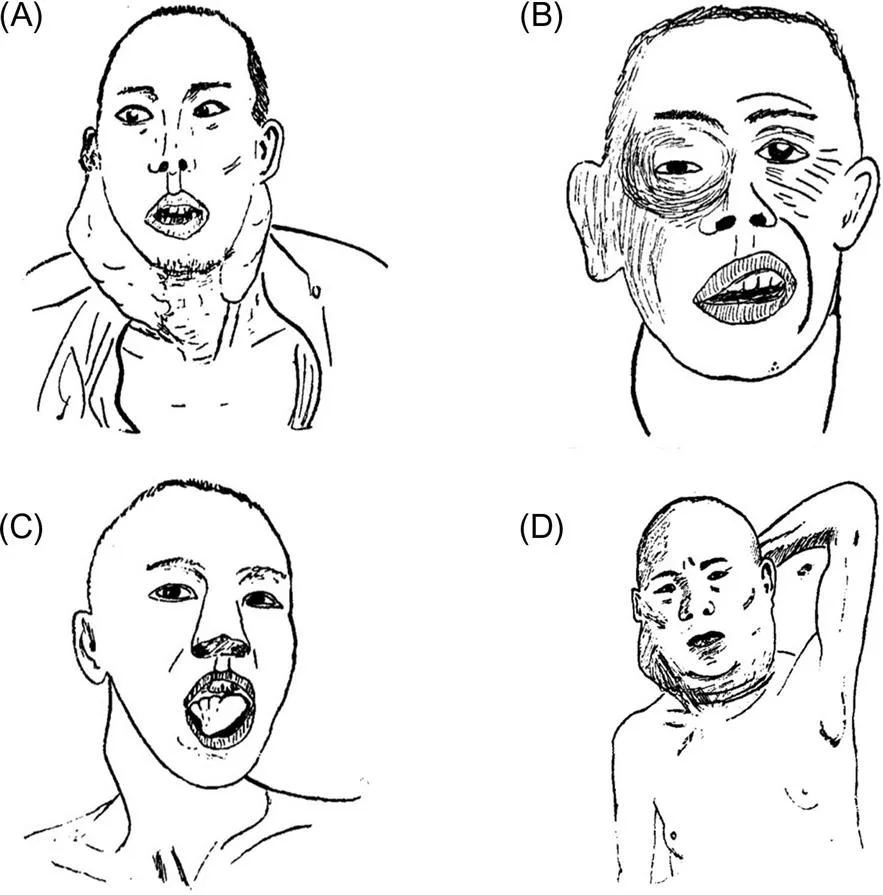
While the disease was relatively rare in the West, Western medical practitioners working in the Far East recognized the common occurrence of the disease and wrote about the presentation of the cancer. While practicing medicine in Guangzhou, Todd wrote about cancers in the posterior nares metastasizing to the cervical glands (Todd, 1921). K.H. Digby, Professor of Surgery in the University of Hong Kong, wrote in detail regarding the different presentations of the disease, including the various cranial neuropathies, for the benefit of the medical students and young doctors (Digby, Thomas, & Tse, 1930). A sample of his drawings can be seen in Fig. 1.1.
Despite the rarity of NPC in the West, it received attention from the media and medical community when the famous baseball player Babe Ruth suffered from the disease and received an early form of radiotherapy and chemotherapy in 1946 and 1947 (Bikhazi, Kramer, Spiegel, & Singer, 1998). Babe Ruth’s disease was initially controlled with teropterin, a folic acid analog, which resulted in regression of the cancer. The cancer ultimately became nonresponsive to teropterin and Babe Ruth succumbed to the disease. Teropterin later was developed into amethopterin, now known as methotrexate. Babe Ruth’s treatment was one of the earliest uses of chemotherapeutic agents in a solid organ cancer.
Geographical distribution and familial clustering
NPC is a peculiar cancer that has a ten-fold difference in incidence in endemic areas versus nonendemic areas. As mentioned above, Western physicians working in South China in the early 20th century noted the remarkably high incidence of NPC among the local population in South China, especially in Guangdong province. By 1950–60, the disparity in the incidence of the disease worldwide was well recognized. Increased incidence of the disease was noted in the overseas Chinese communities both in South East Asia and the West. Hayes Martin from Memorial Sloan Kettering Hospital in New York City described his case series of 358 cases of NPC and noted a disproportionally high percentage (10%, 37 patients) of Chinese individuals suffering from the disease (Martin & Quan, 1951). The stark difference in the incidence among the local population and the immigrant Chinese population had already led to a speculation on the genetic basis of the disease. Fig. 1.2 shows the difference in incidence of the cancer among different countries in 2012.

The disease has the highest incidence in Southern China, whereas in Northern China the incidence is lower and comparable to that of the West. Even within Guangdong province, the area with highest incidence in China, there was a difference in the incidence among population groups speaking different dialects. The population that spoke Cantonese had a higher incidence compared with the population that spoke Hakka. Further, among the Cantonese speaking population, fisherman that lived in boats had a two-fold increased risk compared to the population living on land (Li, Yu, & Henderson, 1985). Here both genetic and environmental factors cause the disparity in the incidence. Compared to the land living counterparts, Cantonese fishermen consumed large amounts of preserved salted fish, which has been shown to increase the risk of developing NPC.
In areas of the West with high incidence of NPC like New York City and San Francisco, invariably there are high concentrations of immigrants from China, mostly from arriving from Guangdong province since the late- 19th century. Other areas in South East Asia like Singapore, Malaysia, Thailand, and Indonesia also have significant numbers of Chinese immigrants and relatively high incidence of the disease.
Apart from the high incidence in Southern Chinese communities, indigenous populations from Malaysia and Indonesia also have moderate incidence of NPC, though not as high as Southern Chinese. Another population with moderate incidence are people of Middle East and North African origin. Inuit people residing in the Artic circle of North America and Greenland also have moderate incidence of the disease (Torre et al., 2015). On the other hand, Northern Chinese, Koreans, and Japanese populations have a low incidence of the disease similar to the incidence in Caucasians (Forman et al., 2014).
Apart from the wide difference in incidence among different population, the phenomenon of familial clustering of NPC has long been observed in both high incidence and low incidence populations (Albeck et al., 1993; Gajwani, Devereaux, & Beg, 1980; Jia et al., 2004). The cause of familial clustering can be inheritance of a susceptibility gene or common exposure to the environmental carcinogen in the family. A complex segregation analysis done in Southern China on more than 1900 Cantonese patients showed that the inheritance was multifactorial and no single gene was responsible for susceptibility to the cancer (Jia et al., 2005).
With the presence of familial clustering, family members of NPC patients have increased risk of developing the disease. The risk was estimated to be increased 4–10 fold in individuals with a first degree relative suffering from the disease (Chang & Adami, 2006). Therefore it is logical to o...
Table of contents
- Cover image
- Title page
- Table of Contents
- Copyright
- Dedication
- List of Contributors
- About the editors
- Acknowledgment
- 1. Introduction
- 2. Risk factors and etiopathogenesis of nasopharyngeal carcinoma
- 3. Genetics of nasopharyngeal carcinoma and molecular signaling pathways
- 4. Surgical anatomy of the nasopharynx
- 5. Pathology classification of nasopharyngeal carcinoma
- 6. Clinical presentation of nasopharyngeal carcinoma
- 7. Assessment and staging of nasopharyngeal carcinoma
- 8. Laboratory investigation for nasopharyngeal carcinoma diagnosis
- 9. Open surgical salvage procedures for nasopharyngeal carcinoma
- 10. Radiation therapy and chemotherapy in early and advanced nasopharyngeal cancer
- 11. Role of endoscopic endonasal surgery in recurrent nasopharyngeal carcinoma: endoscopic endonasal transpterygoid nasopharyngectomy
- 12. Nasopharyngeal carcinoma screening and prevention programs
- 13. Survival rates and quality of life of nasopharyngeal carcinoma patients
- 14. New developments in nasopharyngeal cancer
- Index
Frequently asked questions
Yes, you can cancel anytime from the Subscription tab in your account settings on the Perlego website. Your subscription will stay active until the end of your current billing period. Learn how to cancel your subscription
No, books cannot be downloaded as external files, such as PDFs, for use outside of Perlego. However, you can download books within the Perlego app for offline reading on mobile or tablet. Learn how to download books offline
Perlego offers two plans: Essential and Complete
- Essential is ideal for learners and professionals who enjoy exploring a wide range of subjects. Access the Essential Library with 800,000+ trusted titles and best-sellers across business, personal growth, and the humanities. Includes unlimited reading time and Standard Read Aloud voice.
- Complete: Perfect for advanced learners and researchers needing full, unrestricted access. Unlock 1.5M+ books across hundreds of subjects, including academic and specialized titles. The Complete Plan also includes advanced features like Premium Read Aloud and Research Assistant.
We are an online textbook subscription service, where you can get access to an entire online library for less than the price of a single book per month. With over 1.5 million books across 990+ topics, we’ve got you covered! Learn about our mission
Look out for the read-aloud symbol on your next book to see if you can listen to it. The read-aloud tool reads text aloud for you, highlighting the text as it is being read. You can pause it, speed it up and slow it down. Learn more about Read Aloud
Yes! You can use the Perlego app on both iOS and Android devices to read anytime, anywhere — even offline. Perfect for commutes or when you’re on the go.
Please note we cannot support devices running on iOS 13 and Android 7 or earlier. Learn more about using the app
Please note we cannot support devices running on iOS 13 and Android 7 or earlier. Learn more about using the app
Yes, you can access An Evidence-Based Approach to the Management of Nasopharyngeal Cancer by Baharudin Abdullah,Anusha Balasubramanian,Norhafiza Mat Lazim in PDF and/or ePUB format, as well as other popular books in Medicina & Industria farmacéutica, biotecnológica y sanitaria. We have over 1.5 million books available in our catalogue for you to explore.