eBook - ePub
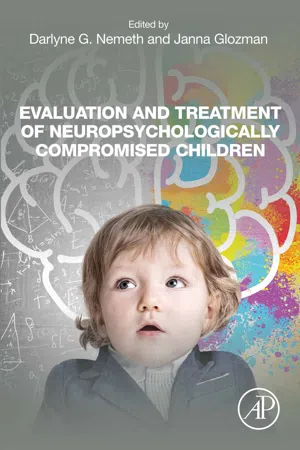
Evaluation and Treatment of Neuropsychologically Compromised Children
- 356 pages
- English
- ePUB (mobile friendly)
- Available on iOS & Android
eBook - ePub
Evaluation and Treatment of Neuropsychologically Compromised Children
About this book
Evaluation and Treatment of Neuropsychologically Compromised Children: Understanding Clinical Applications Post Luria and Reitan defines what executive functions are, discusses differences in executive functioning between normative children and those with special education needs, identifies how best to perform neuropsychological assessments of executive function using both qualitative and quantitative measures, and presents the best treatment interventions for improvement. The book makes special note of the contributions of A.R. Luria, from Russia, and Ralph M. Reitan, from the US as the "fathers" of modern neuropsychology to help readers understand current advances in theory and clinical applications relating to executive function.
- Describes executive functioning in normative and special needs children
- Outlines the contributions of Luria and Reitan, relating them to current developments in executive function
- Integrates qualitative and quantitative assessment measures
- Covers ADHD and executive functioning
- Includes children of all ages through teens
Trusted by 375,005 students
Access to over 1.5 million titles for a fair monthly price.
Study more efficiently using our study tools.
Information
Chapter 1
The contributions of Luria and Reitan to developmental neuropsychology and to the understanding of neuropsychologically compromised children
Janna Glozmana; Darlyne G. Nemethb a M. V. Lomonosov Moscow State University, Moscow, Russia
b The Neuropsychology Center of Louisiana, LLC, Baton Rouge, LA, United States
b The Neuropsychology Center of Louisiana, LLC, Baton Rouge, LA, United States
Abstract
This chapter discusses why Luria and Reitan are both considered to be the fathers of international developmental neuropsychology. The similarities and differences in their development as neuropsychologists and their converging and differing approaches to neuropsychological assessment will be highlighted. Special attention will be paid to the practice of the scientific methods used to advance the field and to better understand brain-behavior relationships. This chapter reviews the theoretical foundations of neuropsychological assessment and intervention that have created the field of developmental neuropsychology in Russia and in America. This chapter also analyzes the specific features of neuropsychological evaluation of children, and their differences from the assessment of adults. Diagnostic case examples of neuropsychologically compromised children are offered.
Keywords
Neuropsychology; Batteries for assessment; Fathers of neuropsychology; Developmental neuropsychology; Neuropsychologically compromised children
The contributions of Luria to developmental neuropsychology
The theoretical basis of developmental neuropsychology in Russia as well as of general neuropsychology has been based on three principles, proposed by L.S. Vygotsky and A.R. Luria: (1) the principle of social genesis of higher mental functions (HMFs); (2) the principle of system organization of HMFs; and (3) the principles of dynamic organization and localization of HMFs (Luria, 1958, 1959). These principles derived from the cultural-historical approach to the analysis of development of HMFs and of their difficulties. The focus was on orientation, not at the disease or the defect level but at the developmental level, looking at the history of culture for the reasons of mental phenomena and for the means of their remediation. Vygotsky concluded that a defect interferes with the child’s cultural development, but that culture helps the child to overcome the defect. By this, the cultural-historical approach has become and still is a methodological basis for remediating education.
One of the first studies based upon this approach was a comparative exploration of mental functions in urban, rural, and homeless children. This study confirmed the influence of social and cultural factors on child cognitive development (Luria, 1928, 1930).
Developmental neuropsychology in Russia
A review of Russian developmental neuropsychology highlighted the importance of the psychogenic studies in the 20th century in the Eugenics Office of the Academy of Sciences in St. Petersburg, created in 1921, and in the Laboratory of Heredity and Human Constitution at the Moscow Medico-biological Institute, created in 1928. The first institution used the genealogical method while the second used a more informative (as was proved later) twins method (Ravich-Scherbo & Sigal, 2003). The last compared the input of genetic and environmental factors in the individual variability of child psychological and neurophysiological features.
Luria began his work at the Medico-biological Institute in 1932. By this time, Lebedinsky’s paper, “The problem of heredity in psychology and twins method,” had already been published. This paper analyzed the method as well as the results of the assessment of different mental features (reasoning, mediation capacities, temper) in twins at different ages. It revealed both the greater genetic similarity of most features in monozygotic twins (genetically similar) as compared with dizygotic twins (genetically different), and also a dependence of similarity on the age of the twins and the function assessed. From 1932 until 1937 (when the Medico-biological Institute was closed as the genetic studies were prohibited), Luria directed studies of genotype/environment relations through cultural-historical theory (Fig. 1).

The group included Lebedinsky, Mironova, Morozova, and Yudovich. They were the first in Russia to use the “twins model” in experimental studies of genetic mechanisms of mind. The difference with similar studies in occidental countries consists of special tests, addressing predominantly the “natural” (genetic) or “cultural” (environmental) factors instead of standardized batteries measuring IQ. For instance, in nonverbal tasks, which better reveal “natural” factors, the results were more similar in monozygotic twins than in dizygotic ones.
Their program for the study of genotype/environment relations was based upon Vygotsky-Luria’s theory of mental development. This research revealed changes in the relative input of heredity and environment due to modifications in mental functioning in answer to different educative procedures and to the role of speech acquisition in mental development (Lebedinsky, 1932; Luria, 1936, 1948, 1963, 2002; Mironova & Kolbanovsky, 1934; Ravich-Scherbo & Sigal, 2003). A study of 130 twin pairs, ages 6–11, revealed, for instance, that the elementary memory is determined by genetic features in all age groups while mediated remembering using pictograms was revealed dependent from genetic features only in preschoolers. To generalize, the influence of natural factors on a child’s cognitive functions decreases with age, but the influence of cultural factors increases. This evidence indicates that, during ontogenic development, not only the psychological structure of the mental processes but also their internal nature dramatically changes (Luria, Symernitskaya, & Tybulevich, 1973, p. 112).
The research work in the Medico-biological Institute allowed Luria to develop the main ideas of developmental neuropsychology: “mental development in childhood is first of all a modification in his forms of activit...
Table of contents
- Cover image
- Title page
- Table of Contents
- Copyright
- Contributors
- About the authors
- About the editors
- Foreword
- Acknowledgments
- Prologue
- Chapter 1: The contributions of Luria and Reitan to developmental neuropsychology and to the understanding of neuropsychologically compromised children
- Chapter 2: Heritage of Reitan and Luria to 21st century developmental neuropsychology
- Chapter 3: Integrating quantitative and qualitative measures with neuropsychological assessment and intervention
- Chapter 4: Combining qualitative and quantitative measures in the evaluation of executive functions in ADHD
- Chapter 5: Ralph M. Reitan and the clinical interpretation of neuropsychological test data
- Chapter 6: Executive functions defined
- Chapter 7: Understanding “hot and cold” executive functions in children and adolescents
- Chapter 8: Preparing children to learn through early intervention
- Chapter 9: The role of family in speech rehabilitation of children with learning disabilities: Clinical observations by Luria and Reitan
- Chapter 10: Formation of higher mental functions in children with special educational needs via social interaction
- Chapter 11: Laying the framework for developing executive functions in tweens with learning disabilities
- Chapter 12: Rebuilding executive functions in environmentally traumatized children and adolescents
- Chapter 13: Neuropsychological evaluation of children with complex medical concerns
- Chapter 14: When medication may be helpful
- Chapter 15: Implications for the future
- Epilogue
- Index
Frequently asked questions
Yes, you can cancel anytime from the Subscription tab in your account settings on the Perlego website. Your subscription will stay active until the end of your current billing period. Learn how to cancel your subscription
No, books cannot be downloaded as external files, such as PDFs, for use outside of Perlego. However, you can download books within the Perlego app for offline reading on mobile or tablet. Learn how to download books offline
Perlego offers two plans: Essential and Complete
- Essential is ideal for learners and professionals who enjoy exploring a wide range of subjects. Access the Essential Library with 800,000+ trusted titles and best-sellers across business, personal growth, and the humanities. Includes unlimited reading time and Standard Read Aloud voice.
- Complete: Perfect for advanced learners and researchers needing full, unrestricted access. Unlock 1.5M+ books across hundreds of subjects, including academic and specialized titles. The Complete Plan also includes advanced features like Premium Read Aloud and Research Assistant.
We are an online textbook subscription service, where you can get access to an entire online library for less than the price of a single book per month. With over 1.5 million books across 990+ topics, we’ve got you covered! Learn about our mission
Look out for the read-aloud symbol on your next book to see if you can listen to it. The read-aloud tool reads text aloud for you, highlighting the text as it is being read. You can pause it, speed it up and slow it down. Learn more about Read Aloud
Yes! You can use the Perlego app on both iOS and Android devices to read anytime, anywhere — even offline. Perfect for commutes or when you’re on the go.
Please note we cannot support devices running on iOS 13 and Android 7 or earlier. Learn more about using the app
Please note we cannot support devices running on iOS 13 and Android 7 or earlier. Learn more about using the app
Yes, you can access Evaluation and Treatment of Neuropsychologically Compromised Children by Darlyne G. Nemeth,Janna Glozman in PDF and/or ePUB format, as well as other popular books in Psychology & Educational Psychology. We have over 1.5 million books available in our catalogue for you to explore.