eBook - ePub
Wheat and Barley Grain Biofortification
- 364 pages
- English
- ePUB (mobile friendly)
- Available on iOS & Android
eBook - ePub
Wheat and Barley Grain Biofortification
About this book
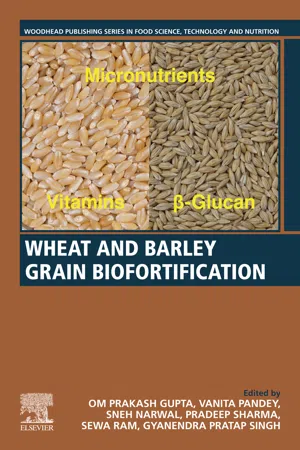
Wheat and Barley Grain Biofortification addresses topics associated with the alleviation of malnutrition in globally diverse populations via wheat and barley biofortification. The book synthesizes the current trends of malnutrition across the globe, the need for wheat and barley nutritional enhancement and how agronomic, microbial and molecular understanding of biofortification can help in devising significant approaches and strategies. In addition, it includes discussions on potential genetic variability available and their efficient utilization in wheat and barley for molecular breeding for nutrients, challenges and opportunities for bioavailability, and technical advancement for analysis of bioavailability.
- Addresses the need for wheat and barley biofortification to address global nutrition demands
- Places emphasis on the current agronomic and molecular understanding of biofortification
- Discusses the potential utilization of genetic variability
- Highlights the economics of biofortification over fortification technology
Information
Subtopic
Biochimie1
The unacceptable status quo: malnutrition challenges of the developed and developing world
Jaya Jumrani*
Vikalp N. Rai ICAR-National Institute of Agricultural Economics and Policy Research, New Delhi, India
Abstract
Malnutrition has huge costs associated with it and the global economic costs range from USD 2 to USD 3 trillion annually. Non-economic costs involved are real but are not estimable. Globally, malnutrition is responsible for one in every five deaths. Different forms of malnutrition affect almost all the countries, irrespective of their economic status, geographic location, levels of food security, and population growth. As high as 11% of the global population is undernourished and most of them live in South Asia and Sub-Saharan Africa. The developed world is mainly grappling with overnutrition burden. On the other hand, many developing nations are dealing with the triple burden of malnutrition. Addressing all of these challenges across regions requires a multi-pronged strategy that should span across disciplines and sectors. It calls for innovations and interventions across agriculture, health, educational and environmental domains besides encouraging behavioral changes among the vulnerable populations.
Keywords
malnutrition
undernutrition
overnutrition
DALYs
micronutrient deficiencies
India
Charting the trends in malnutrition across the globe
Nutrition is one of the potentially strongest amendable factors in the well-being and health of an individual at any stage of his/her life. It is responsible for both the prevention and cure of major causes of morbidity and mortality among all populations. In the recent times, diverse modern food environments have put complex demands on each individual to enjoy optimal nutrition and remain healthy (Vorster, 2009). Malnutrition is a complex health as well as socioeconomic concern having multiple forms. It is often accompanied with both communicable and non-communicable disease (NCD) burdens. Different forms of malnutrition affect almost all the countries irrespective of their economic status, geographic location, levels of food security and population growth. All these factors exert respective independent influences on an individual’s as well as a nation’s nutritional situation (Guldan, 2019).
Hunger and malnutrition (which includes both overnutrition and undernutrition) still affect billions of people globally despite the existence of all-time record high levels of food production. Nutritional inequalities are quite evident in both the developed and developing worlds. These, however, are often witnessed more in case of people residing in the developing countries. These inequities depict the double burden of malnutrition (DBM), which is the ironic coexistence of undernutrition and overnutrition. Both of these can manifest either at personal, household or demographic levels (Perez-Escamilla et al., 2018). Hunger and malnutrition have traditionally been considered equivalent to a lack of food. It has now been recognized that these can also emerge due to low-quality diets. The key nutrient needs of a human body can be met by high-quality diets consisting of nutrient-rich foods.
Dietary balance and optimal nu...
Table of contents
- Cover
- Title page
- Table of Contents
- Copyright
- Contributors
- Editors biography
- Foreword
- Preface
- 1: The unacceptable status quo: malnutrition challenges of the developed and developing world
- 2: Role of molecular approaches in improving genetic variability of micronutrients and their utilization in breeding programs
- 3: Getting more micronutrients from wheat and barley through agronomic biofortification
- 4: Anti-nutritional factors and bioavailability: approaches, challenges, and opportunities
- 5: A decade of progress on genetic enhancement of grain zinc and iron in CIMMYT wheat germplasm
- 6: Biofortification of wheat through wide hybridization and molecular breeding
- 7: Exploring genetic variability for developing celiac disease safe wheat
- 8: Prospecting plant–microbe interactions for enhancing nutrient availability and grain biofortification
- 9: Effect of storage and processing conditions on nutrient composition of wheat and barley
- 10: Advantage of biofortification over fortification technologies
- 11: Barley biofortification: present status and future prospects
- 12: Barley grain beta glucan enrichment: status and opportunities
- 13: Biofortification for enhancing nutritional outcomes and policy imperatives
- Index
Trusted by 375,005 students
Access to over 1.5 million titles for a fair monthly price.
Study more efficiently using our study tools.
Frequently asked questions
Yes, you can cancel anytime from the Subscription tab in your account settings on the Perlego website. Your subscription will stay active until the end of your current billing period. Learn how to cancel your subscription
No, books cannot be downloaded as external files, such as PDFs, for use outside of Perlego. However, you can download books within the Perlego app for offline reading on mobile or tablet. Learn how to download books offline
Perlego offers two plans: Essential and Complete
- Essential is ideal for learners and professionals who enjoy exploring a wide range of subjects. Access the Essential Library with 800,000+ trusted titles and best-sellers across business, personal growth, and the humanities. Includes unlimited reading time and Standard Read Aloud voice.
- Complete: Perfect for advanced learners and researchers needing full, unrestricted access. Unlock 1.5M+ books across hundreds of subjects, including academic and specialized titles. The Complete Plan also includes advanced features like Premium Read Aloud and Research Assistant.
We are an online textbook subscription service, where you can get access to an entire online library for less than the price of a single book per month. With over 1.5 million books across 990+ topics, we’ve got you covered! Learn about our mission
Look out for the read-aloud symbol on your next book to see if you can listen to it. The read-aloud tool reads text aloud for you, highlighting the text as it is being read. You can pause it, speed it up and slow it down. Learn more about Read Aloud
Yes! You can use the Perlego app on both iOS and Android devices to read anytime, anywhere — even offline. Perfect for commutes or when you’re on the go.
Please note we cannot support devices running on iOS 13 and Android 7 or earlier. Learn more about using the app
Please note we cannot support devices running on iOS 13 and Android 7 or earlier. Learn more about using the app
Yes, you can access Wheat and Barley Grain Biofortification by Om Prakash Gupta,Vanita Pandey,Sneh Narwal,Pradeep Sharma,Sewa Ram,Gyanendra Pratap Singh in PDF and/or ePUB format, as well as other popular books in Technologie et ingénierie & Biochimie. We have over 1.5 million books available in our catalogue for you to explore.