eBook - ePub
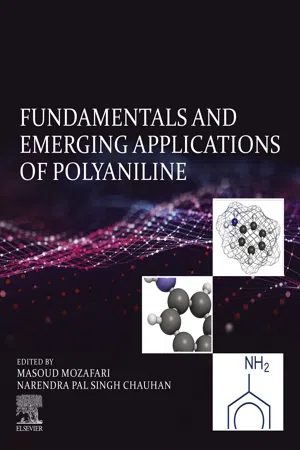
Fundamentals and Emerging Applications of Polyaniline
- 308 pages
- English
- ePUB (mobile friendly)
- Available on iOS & Android
eBook - ePub
Fundamentals and Emerging Applications of Polyaniline
About this book
Fundamentals and Emerging Applications of Polyaniline presents in-depth coverage of synthetic routes, characterization tools, experimental procedures, and the preparation of PANI-based materials for advanced applications. Sections examine the various synthetic routes available for the polymerization of aniline, covering both conventional methods and new approaches, specific PANI-based materials, and their potential applications. Users will be able to understand how to use these methods in areas such as electromagnetic interference shielding, rechargeable batteries, light emitting diodes, super capacitors, anti-static packaging and coatings, photonics, biomedical applications, chemical and biochemical sensors.
This is a highly valuable source of information for researchers, scientists and graduate students in polymer science, polymer composites, polymer chemistry, nanotechnology, physics and materials science.
- Covers the latest synthetic approaches, such as ultrasound-assisted polymerization, irradiation path and electrochemical polymerization
- Offers detailed information on PANI-based composites, including graphene, CNT and functionalized polyaniline
- Explains how different PANI-based materials can be geared for specific cutting-edge applications across a range of fields
Trusted by 375,005 students
Access to over 1.5 million titles for a fair monthly price.
Study more efficiently using our study tools.
Information
Chapter 1
Polyaniline: An introduction and overview
Narendra Pal Singh Chauhana; Masoud Mozafarib,c,d a Department of Chemistry, Faculty of Science, Bhupal Nobles’ University, Udaipur, India
b Bioengineering Research Group, Nanotechnology and Advanced Materials Department, Materials and Energy Research Center (MERC), Tehran, Iran
c Cellular and Molecular Research Center, Iran University of Medical Sciences, Tehran, Iran
d Department of Tissue Engineering & Regenerative Medicine, Faculty of Advanced Technologies in Medicine, Iran University of Medical Sciences (IUMS), Tehran, Iran
b Bioengineering Research Group, Nanotechnology and Advanced Materials Department, Materials and Energy Research Center (MERC), Tehran, Iran
c Cellular and Molecular Research Center, Iran University of Medical Sciences, Tehran, Iran
d Department of Tissue Engineering & Regenerative Medicine, Faculty of Advanced Technologies in Medicine, Iran University of Medical Sciences (IUMS), Tehran, Iran
Abstract
Polyaniline (PANI) is a conductive polymer that is used in many applications due to its unique characteristics. Although it has been almost 150 years since this class of polymers was discovered, it has recently attracted heightened attention from the scientific community working in different fields of study, largely due to the discovery of the high electrical conductivity of PANI. Different synthesis strategies and modification techniques can be used for the optimization of PANI for specific applications. It is expected that this class of polymers play a more critical role in the future in many different fields, ranging from electronics to medicine, due to its ease of synthesis, environmental stability, and simple doping/dedoping chemistry.
Keywords
Polyaniline; PANI; Conductive polymer; Polymer synthesis
1 Introduction
In 1977, Shirakawa and coworkers [1] fabricated intrinsically conducting polymers (ICPs), trans“polyacetylene”, (CH)x, with unique properties that made them excellent candidates for a range of emerging applications. Although this class of polymers had many advantages over other conventional polymers, there were also some drawbacks in their development, the main issues with them being their processing and poor mechanical properties. Therefore many other ICPs were proposed, including polyaniline (PANI), polythiophene (PTh), polypyrrole (Ppy), and their derivatives.
Among the various conducting polymers, PANI has attracted attention since it has nitrogen and hydrogen bonds on either side of a phenylene ring, which is highly reactive. Hence, it has immense potential for many applications due to its unique characteristics, such as [2–9] easy preparation, eco-friendliness, stability, cost effectiveness, and wide spectrum of applications. It is also a very important tool in chemistry and physics, as it undergoes protonation and deprotonation. Furthermore, it undergoes adsorption via a nitrogen, having a lone pair of electrons. But PANI has also shown some drawbacks, such as its insolublility in common solvents, its poor mechanical properties, and infusible nature (i.e., it decomposes before melting). Different techniques, namely grafting [10], blending, composites, fictionalization, etc., have been applied to provide enhanced electrochromic, sensor, catalytic, redox, processability, mechanical, and other physical properties [11–15]. The characteristic peaks for PANI using the Fourier transform infrared (FTIR) spectroscopy technique are tabulated in Table 1.
Table 1
| Type of bonds | Frequency (cm− 1) | References |
|---|---|---|
N | 3460 | [16–18] |
| N | 3230 | |
C | ~ 1560 and 1498 | |
| C | 1298 | |
| degree of electron delocalization | 1128 |

2 Synthesis methods of PANI
2.1 Chemical synthesis
Chemical synthesis involves various methods, including in situ oxidation polymerization, counterion-induced processability, emulsion polymerization, inversion emulsion process, dispersion polymerization blending method, solution blending, dry blending, interfacial polymerization, melt processing, and the flux method.
2.1.1 In situ chemical polymerization
Various modified PANIs have been prepared using in situ chemical polymerization, such as PANI/bacterial cellulose nanocomposite [19–21], PANI@cellulose nanowhiskers [22, 23], PANI and iota-carrageenan biocomposites [24], and others, and these have shown excellent conductivity, tensile strength, thermal stability, decreased percolation thresholds, and oxidation reduction transition. In one study, Zhang et al. [25] prepared PANI on cellulose nanocrystals via in situ polymerization in which lyotropic chiral nematic liquid crystals were utilized as an asymmetric reaction field. The lyotropic chiral nematic liquid crystals of cellulose nanocrystals were fabricated by using a simple hydrolysis method. The content of cellulose nanocrystals influences the size of the PANI nanoparticles.
2.1.2 Bulk and slurry oxidative polymerization
This is another method for the synthesis of PANI. In one study, a bulk and slurry oxidative polymerization method was used by Alves Marins [26] for the synthesis of fiber-based nanocomposites of PANI attached with sepiolite, which could be used for electrorheological fluid applications.
2.1.3 Chemical oxidative polymerization
The performance of cellulose-PANI composites prepared by chemical oxidative polymerization depends on the acids used in the process. Mo et al. [27] reported that dibasic acid could show higher conductivity compared to that of monobasic acid. In this method, the product depends on the acidity conditions [28]. Sarauli et al. [29] chemically prepared copolymers by using methoxyaniline-5-sulfonic acid monomers and aniline monomer with different ratios and another copolymer with 3-amino-benzoic acid and aniline. They also studied the interactions of redox protein cytochrome c (cyt c) and the enzyme sulfite oxidase (SO) with electrodes made of these materials. The addition of cellulose triacetate (CTA) increased the solubility of PANI in organic solvents, with an improvement in biodegrability and flexibility [30]. The (PANI)-kaolinite nanoc...
Table of contents
- Cover image
- Title page
- Table of Contents
- Copyright
- Contributors
- About the editors
- Preface
- Chapter 1: Polyaniline: An introduction and overview
- Chapter 2: Synthetic route of polyaniline (I): Conventional oxidative polymerization
- Chapter 3: Synthetic route of PANI (II): Enzymatic method
- Chapter 4: Synthetic route of PANI (III): Ultrasound-assisted polymerization
- Chapter 5: Synthetic route of polyaniline (IV): Irradiation path
- Chapter 6: Synthetic route of PANI (V): Electrochemical polymerization
- Chapter 7: PANI-based nanostructures
- Chapter 8: Polyaniline/metal oxides nanocomposites
- Chapter 9: PANI-CNT nanocomposites
- Chapter 10: Polyaniline/graphene-based nanocomposites
- Chapter 11: Functionalized polyaniline and composites
- Chapter 12: Advanced characterization tools for PANI and PANI-clay nanocomposites
- Chapter 13: Experimental procedures for assessing electrical and thermal conductivity of polyaniline
- Chapter 14: Application of polyaniline and its derivatives
- Chapter 15: Polyaniline: Future perspectives
- Index
Frequently asked questions
Yes, you can cancel anytime from the Subscription tab in your account settings on the Perlego website. Your subscription will stay active until the end of your current billing period. Learn how to cancel your subscription
No, books cannot be downloaded as external files, such as PDFs, for use outside of Perlego. However, you can download books within the Perlego app for offline reading on mobile or tablet. Learn how to download books offline
Perlego offers two plans: Essential and Complete
- Essential is ideal for learners and professionals who enjoy exploring a wide range of subjects. Access the Essential Library with 800,000+ trusted titles and best-sellers across business, personal growth, and the humanities. Includes unlimited reading time and Standard Read Aloud voice.
- Complete: Perfect for advanced learners and researchers needing full, unrestricted access. Unlock 1.5M+ books across hundreds of subjects, including academic and specialized titles. The Complete Plan also includes advanced features like Premium Read Aloud and Research Assistant.
We are an online textbook subscription service, where you can get access to an entire online library for less than the price of a single book per month. With over 1.5 million books across 990+ topics, we’ve got you covered! Learn about our mission
Look out for the read-aloud symbol on your next book to see if you can listen to it. The read-aloud tool reads text aloud for you, highlighting the text as it is being read. You can pause it, speed it up and slow it down. Learn more about Read Aloud
Yes! You can use the Perlego app on both iOS and Android devices to read anytime, anywhere — even offline. Perfect for commutes or when you’re on the go.
Please note we cannot support devices running on iOS 13 and Android 7 or earlier. Learn more about using the app
Please note we cannot support devices running on iOS 13 and Android 7 or earlier. Learn more about using the app
Yes, you can access Fundamentals and Emerging Applications of Polyaniline by Masoud Mozafari,Narendra Pal Singh Chauhan in PDF and/or ePUB format, as well as other popular books in Technology & Engineering & Industrial & Technical Chemistry. We have over 1.5 million books available in our catalogue for you to explore.