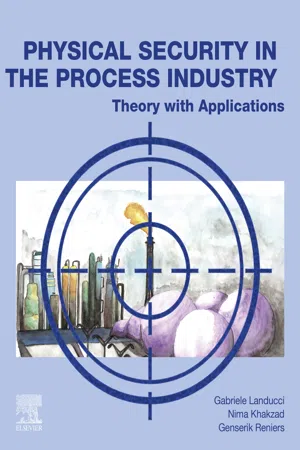
eBook - ePub
Physical Security in the Process Industry
Theory with Applications
- 252 pages
- English
- ePUB (mobile friendly)
- Available on iOS & Android
eBook - ePub
Physical Security in the Process Industry
Theory with Applications
About this book
Physical Security in the Process Industry: Theory with Applications deals with physical security in the field of critical infrastructures where hazardous materials are a factor, along with the state-of-the-art thinking and modeling methods for enhancing physical security. The book offers approaches based on scientific insights, mainly addressing terrorist attacks. Moreover, the use of innovative techniques is explained, including Bayesian networks, game-theory and petri-networks. Dealing with economic parameters and constraints and calculating the costs and benefits of security measures are also included. The book will be of interest to security (and safety) scientists, security managers and the public at large.
- Discusses how to achieve inherent physical security using a scientific approach
- Explores how to take adequate add-on physical security measures
- Covers risk assessment tools and applications for practical use in the industry
- Demonstrates how to optimize security decisions using security models and approaches
- Considers economic aspects of security decisions
Trusted by 375,005 students
Access to over 1.5 million titles for a fair monthly price.
Study more efficiently using our study tools.
Information
1
An introduction to physical security
Abstract
This chapter introduces basic concepts related to risk, safety, and security in order to provide a sound theoretical framework. In particular, a specific focus is given to physical security, discussing how it should be seen in relation to safety and discussing what safety models and principles can be employed to manage the security aspects of physical threats. Next, the concepts of risk and engineering risk management are explained. Quantitative security risk evaluation is briefly explained, introducing the relevant physical security risk components, such as threat, attractiveness, vulnerability, and consequences. Security risks are then classified in order to provide a specific type of management strategy mainly based on the standard ISO framework. The chapter ends with some historical perspectives on safety and security science evolution.
Keywords
Chemical and process industry; Risk; Risk assessment; Risk management; Safety models; Security in relation to safety
1.1. Security as a part of safety
If one thinks about it, security has a very long and rich history. In Ancient Egypt or old Persia for instance, there were already soldiers and personal guards. But also even earlier, in the ancient China, security was very important. As an example of the importance of security in those ancient times, the terracotta army depicting the armies of Qin Shi Huang, the first Emperor of China, can be mentioned, found in the city of Xi'an in the province Shaanxi in China. Actually, it is possible to go as far back in time as desired: while humans were settling in communities for agricultural reasons, there were undoubtedly security issues and problems such as theft, manslaughter, and murder. In fact, where humans are, or have ever been, there was or is need for security. In that sense, the “security officer” is arguably the oldest profession in the world.
We now can ask about the definition of security and what it in fact contains and entails. What is it that makes a certain topic, situation, or issue belong to the security field, or to another domain, for example, safety? The answer is surprisingly simple, and at the same time somewhat complex, and may be traced back to the understanding of one concept: human intention. However, the clear distinction between safety and security in terms of intention only seems easy, but in fact it is not.
Let us first discuss the concept of “safety” more in depth before defining, describing, and discussing the concept of security. What is safety? Here the difficulty starts: there is no single and widely accepted definition of “safety” by safety scientists. Definitions such as “freedom from danger,” “a dynamic non-event,” or “the result of conditions for which the likelihood of non-intentional negative consequences is low,” all try to be as clear or as general as possible, but none of them represents a generally accepted definition. These varying definitions indicate that it is difficult to find an acceptable, useable, and understandable definition for safety. The main problem consists of the fact that the meaning of safety varies according to the perspective of the person looking at the concept. A specific situation might seem safe for one person, while the same situation may seem very unsafe for another person.
Safety can actually be seen as a state (perception or real) of a person, a machine, etc., at a certain moment in time. Many possible safety substates can be conceived at one certain moment in time, but individually these substates do not reveal anything on the potential consequences of unsafety, about the likelihood that a certain state (aggregated from the substates) turns out bad or good, about what kind of safety measures can be taken for each substate, etc. Moreover, the substates change continuously and thus the aggregated safety state in reality is extremely dynamic and changes all the time (Fig. 1.1.1).
In brief, safety can be defined as “the avoidance and/or decrease of losses due to all types of causes (related to safety sub-states), and taking into account all possible sub-states at a certain moment in time.”
The concept of “safety sub-state” is usually characterized by being nonintentional or nondeliberate. This is not necessarily the case: looking at safety from a broad perspective, it is clear that the concept is actually linked to avoiding losses of all kind, hence also intentional, that is, deliberately human-caused, losses. If we consider security into the “Safety” definition, we can describe safety as “the avoidance and/or decrease of losses due to all types of causes (related to safety sub-states), and taking into account all possible (non-intentional as well as deliberate) sub-states at a certain moment in time.”
One important problem arises: the description of the substates or the aggregated safety state does not allow us to quantify. The substates are rather theoretical and hypothetical by nature, and in principle, an infinite number of substates exists. Hence, at this moment for us the “safety state” is an abstract concept. Based on an abstract concept, it is impossible to rationally take safety measures to lower unsafety and to increase safety. For this exact reason, the concept of “risk” is introduced.

1.2. Risk sandglass and security risk trias
Dealing with security risks is actually a part of managing operational risks, and thus, security management can be situated within the field of “engineering risk management.” Obviously, other risks such as financial risks, quality risks, environmental risks, ethical risks, and health risks are all risks that need to be ...
Table of contents
- Cover image
- Title page
- Table of Contents
- Copyright
- 1. An introduction to physical security
- 2. History of terrorist attacks to critical infrastructures involving hazardous materials
- 3. Principles and concepts for security risk assessment
- 4. Physical security risk assessment tools and applications
- 5. Security culture and security management models
- 6. Advanced design of physical security systems
- 7. Economic aspects of security decisions
- 8. Conclusions
- Index
Frequently asked questions
Yes, you can cancel anytime from the Subscription tab in your account settings on the Perlego website. Your subscription will stay active until the end of your current billing period. Learn how to cancel your subscription
No, books cannot be downloaded as external files, such as PDFs, for use outside of Perlego. However, you can download books within the Perlego app for offline reading on mobile or tablet. Learn how to download books offline
Perlego offers two plans: Essential and Complete
- Essential is ideal for learners and professionals who enjoy exploring a wide range of subjects. Access the Essential Library with 800,000+ trusted titles and best-sellers across business, personal growth, and the humanities. Includes unlimited reading time and Standard Read Aloud voice.
- Complete: Perfect for advanced learners and researchers needing full, unrestricted access. Unlock 1.5M+ books across hundreds of subjects, including academic and specialized titles. The Complete Plan also includes advanced features like Premium Read Aloud and Research Assistant.
We are an online textbook subscription service, where you can get access to an entire online library for less than the price of a single book per month. With over 1.5 million books across 990+ topics, we’ve got you covered! Learn about our mission
Look out for the read-aloud symbol on your next book to see if you can listen to it. The read-aloud tool reads text aloud for you, highlighting the text as it is being read. You can pause it, speed it up and slow it down. Learn more about Read Aloud
Yes! You can use the Perlego app on both iOS and Android devices to read anytime, anywhere — even offline. Perfect for commutes or when you’re on the go.
Please note we cannot support devices running on iOS 13 and Android 7 or earlier. Learn more about using the app
Please note we cannot support devices running on iOS 13 and Android 7 or earlier. Learn more about using the app
Yes, you can access Physical Security in the Process Industry by Gabriele Landucci,Nima Khakzad,Genserik Reniers in PDF and/or ePUB format, as well as other popular books in Technology & Engineering & Chemical & Biochemical Engineering. We have over 1.5 million books available in our catalogue for you to explore.