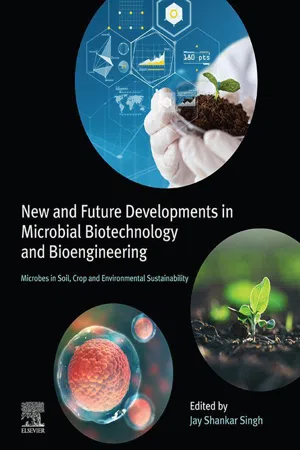
eBook - ePub
New and Future Developments in Microbial Biotechnology and Bioengineering
Microbes in Soil, Crop and Environmental Sustainability
- 386 pages
- English
- ePUB (mobile friendly)
- Available on iOS & Android
eBook - ePub
New and Future Developments in Microbial Biotechnology and Bioengineering
Microbes in Soil, Crop and Environmental Sustainability
About this book
New and Future Developments in Microbial Biotechnology and Bioengineering: Microbes in Soil, Crop and Environmental Sustainability reviews the exploitation of microbial biodiversity in soil with respect to nutrient-use efficiency, also discussing the improvement and maintenance of certain physical and chemical conditions in soil that can provide economic and environmental benefits toward agricultural sustainability. The utilization of microbes ranges from applications in biotechnology, marginal land restoration, the formulation of microbial inoculants, the enhancement of crop productivity, and the mitigation of global warming gases. Finally, various uses for microbial resources in crop disease management, bioenergy production, and income based on microbial cultivation are explored.
- Highlights the developments and achievements of microbial resources and their role in the sustainable management of soil fertility and agriculture productivity
- Outlines the role of microbial resource and biotechnology in sustainability to industry, agriculture, forest and management of environment
- Provides up-to-date information on the application of microbial resources and the role of biotechnology to meet the ever increasing demand of food, soil and plant productivity management
- Outlines enhancement in productivity through interventions of microbial bio-agents and eco-friendly technology
Information
Table of contents
- Cover image
- Title page
- Table of Contents
- Copyright
- List of Contributors
- Preface
- Chapter 1. Bacterial fertilizers for soybean plants: current status and future prospects
- Chapter 2. Plant–bacterial interactions in management of plant growth under abiotic stresses
- Chapter 3. Environmental applications of microalgae/cyanobacteria
- Chapter 4. Plant–microbe associations for enhancement of agricultural productivity
- Chapter 5. Microbial resources in management of C sequestration, greenhouse gases, and bioremediation processes
- Chapter 6. Microbial secondary metabolites and plant–microbe communications in the rhizosphere
- Chapter 7. Mycorrhizal symbiosis: an effective tool for metal bioremediation
- Chapter 8. Microalgae: potential agents for CO2 mitigation and bioremediation of wastewaters
- Chapter 9. Sustainable approaches for biological control of mycotoxigenic fungi and mycotoxins in cereals
- Chapter 10. Plant growth promoting microbes: a future trend for environmental sustainability
- Chapter 11. Harnessing the soil microbial wealth for enhancement of plant secondary metabolites in medicinal and aromatic plants
- Chapter 12. Role of plant-associated bacteria in phytoremediation of trace metals in contaminated soils
- Chapter 13. Use of microbial biofertilizers technology in agro-environmental sustainability
- Chapter 14. Microbe-mediated management of degraded and marginal lands
- Chapter 15. Trichoderma—a new strategy in combating agriculture problems
- Chapter 16. Phycoremediation of industrial effluents contaminated soils
- Chapter 17. Microbial services in agro-environmental management
- Chapter 18. Rhizosphere microbiome and plant probiotics
- Chapter 19. Microbial resources mediated bioremediation of persistent organic pollutants
- Chapter 20. Microbial approaches in management and restoration of marginal lands
- Chapter 21. Host–endophytes cross-talk: an essential prerequisite for plant ecosystem functioning
- Chapter 22. Tapping soil biodiversity for enhancing resource use efficiency
- Chapter 23. Application of plant growth promoting rhizobacteria in remediation of pesticides contaminated stressed soil
- Index
Trusted by 375,005 students
Access to over 1.5 million titles for a fair monthly price.
Study more efficiently using our study tools.
Frequently asked questions
Yes, you can cancel anytime from the Subscription tab in your account settings on the Perlego website. Your subscription will stay active until the end of your current billing period. Learn how to cancel your subscription
No, books cannot be downloaded as external files, such as PDFs, for use outside of Perlego. However, you can download books within the Perlego app for offline reading on mobile or tablet. Learn how to download books offline
Perlego offers two plans: Essential and Complete
- Essential is ideal for learners and professionals who enjoy exploring a wide range of subjects. Access the Essential Library with 800,000+ trusted titles and best-sellers across business, personal growth, and the humanities. Includes unlimited reading time and Standard Read Aloud voice.
- Complete: Perfect for advanced learners and researchers needing full, unrestricted access. Unlock 1.5M+ books across hundreds of subjects, including academic and specialized titles. The Complete Plan also includes advanced features like Premium Read Aloud and Research Assistant.
We are an online textbook subscription service, where you can get access to an entire online library for less than the price of a single book per month. With over 1.5 million books across 990+ topics, we’ve got you covered! Learn about our mission
Look out for the read-aloud symbol on your next book to see if you can listen to it. The read-aloud tool reads text aloud for you, highlighting the text as it is being read. You can pause it, speed it up and slow it down. Learn more about Read Aloud
Yes! You can use the Perlego app on both iOS and Android devices to read anytime, anywhere — even offline. Perfect for commutes or when you’re on the go.
Please note we cannot support devices running on iOS 13 and Android 7 or earlier. Learn more about using the app
Please note we cannot support devices running on iOS 13 and Android 7 or earlier. Learn more about using the app
Yes, you can access New and Future Developments in Microbial Biotechnology and Bioengineering by Jay Shankar Singh in PDF and/or ePUB format, as well as other popular books in Technology & Engineering & Chemical & Biochemical Engineering. We have over 1.5 million books available in our catalogue for you to explore.