- 586 pages
- English
- ePUB (mobile friendly)
- Available on iOS & Android
eBook - ePub
Nuclear Safety
About this book
The second edition of Nuclear Safety provides the most up to date methods and data needed to evaluate the safety of nuclear facilities and related processes using risk-informed safety analysis, and provides readers with new techniques to assess the consequences of radioactive releases. Gianni Petrangeli provides applies his wealth of experience to expertly guide the reader through an analysis of nuclear safety aspects, and applications of various well-known cases. Since the first edition was published in 2006, the Fukishima 2011 inundation and accident has brought a big change in nuclear safety experience and perception. This new edition addresses lessons learned from the 2011 Fukishima accident, provides further examples of nuclear safety application and includes consideration of the most recent operational events and data.
This thoroughly updated resource will be particularly valuable to industry technical managers and operators and the experts involved in plant safety evaluation and controls. This book will satisfy generalists with an ample spectrum of competences, specialists within the nuclear industry, and all those seeking for simple plant modelling and evaluation methods.
New to this edition:
- Up to date analysis on recent events within the field, particularly events at Fukushima
- Further examples of application on safety analysis
- New ways to use the book through calculated examples
- Covers all plant components and potential sources of risk, including human, technical and natural factors
- Brings together, in a single source, information on nuclear safety normally only found in many different sources
- Provides up-to date international design and safety criteria and an overview of regulatory regimes
Trusted by 375,005 students
Access to over 1.5 million titles for a fair monthly price.
Study more efficiently using our study tools.
Information
Chapter 1
Introduction
Abstract
The objectives of nuclear safety consist in ensuring the siting and the plant conditions need to comply with adequate principles, such as the internationally accepted health, safety, and radioprotection principles. In particular, the plant at the chosen site shall guarantee that the health of the population and of the workers does not suffer adverse radiation consequences more severe than the established limits and that such effects be the lowest reasonably obtainable [the ALARA (as low as reasonably achievable) Principle] in all operational conditions and in case of accidents.
Keywords
Nuclear safety; plant site; operational conditions; health; radiation; accidents
1.1 Objectives
The objectives of nuclear safety consist in ensuring the siting and the plant conditions need to comply with adequate principles, such as the internationally accepted health, safety, and radioprotection principles. In particular, the plant at the chosen site shall guarantee that the health of the population and of the workers does not suffer adverse radiation consequences more severe than the established limits and that such effects be the lowest reasonably obtainable [the ALARA (as low as reasonably achievable) Principle] in all operational conditions and in case of accidents.
These objectives are frequently subdivided into a general objective, a radiation protection objective, and a technical objective, for example, in the International Atomic Energy Agency (IAEA) criteria (see www.iaea.org).
The general nuclear safety objective (IAEA Fundamental Safety Principles SF-1, 2006) is to protect individuals, society, and the environment from harm by establishing and maintaining effective defences against radiological hazards in nuclear installations.
The radiation protection objective is to ensure that in all operational states radiation exposure within the installation or due to any planned release of radioactive material from the installation is kept below prescribed limits and ALARA, and to ensure mitigation of the radiological consequences of any accidents.
The technical safety objective is to take all reasonably practicable measures to prevent accidents in nuclear installations and to mitigate their consequences should they occur; to ensure with a high level of confidence that, for all possible accidents taken into account in the design of the installation, including those of very low probability, any radiological consequences would be minor and below prescribed limits; and to ensure that the likelihood of accidents with serious radiological consequences is extremely low.
The target for existing power plants consistent with the technical safety objective has been defined by the International Nuclear Safety Advisory Group (advisor to the IAEA Director General) as a likelihood of occurrence of severe core damage that is below about 10−4 events per plant operating year. Implementation of all safety principles at future plants should lead to the achievement of an improved goal of not more than about l0−5 such events per plant operating year. Severe accident management and mitigation measures should reduce the probability of large offsite releases requiring short-term offsite response by a factor of at least 10.
It has to be observed that these principles, while indicating the need for strict control of radiation sources, do not preclude the external release of limited amounts of radioactive products nor the limited exposure of people to radiation. Similarly, the objectives require to decrease the likelihood and the severity of accidents, but they recognize that some accidents can happen. Measures have to be taken for the mitigation of their consequences. Such measures include onsite accident management systems (procedures, equipment, operators) and offsite intervention measures. The greater the potential hazard of a release, the lower must be its likelihood.
The chapters of this book, except the few of them not concerned with the safety of nuclear installations, deal with the ways for practically achieving these objectives.
1.2 A Short History of Nuclear Safety Technology
1.2.1 The Early Years
The first reactor, the “Fermi pile” CP1 (or Chicago Pile 1, built in 1942) was provided with rudimentary safety systems in line with the sense of confidence inspired by the charismatic figure of Enrico Fermi and his opinion concerning the absence of any danger from unforeseen phenomena. The safety systems (Fig. 1.1) are as follows:
- • Gravity-driven fast shutdown rods (one was operated by cutting a retaining rope with an axe).
- • A secondary shutdown system made of buckets containing a cadmium sulfate solution, which is a good neutron absorber. The buckets were located at the top of the pile and could be emptied onto it should the need arise.
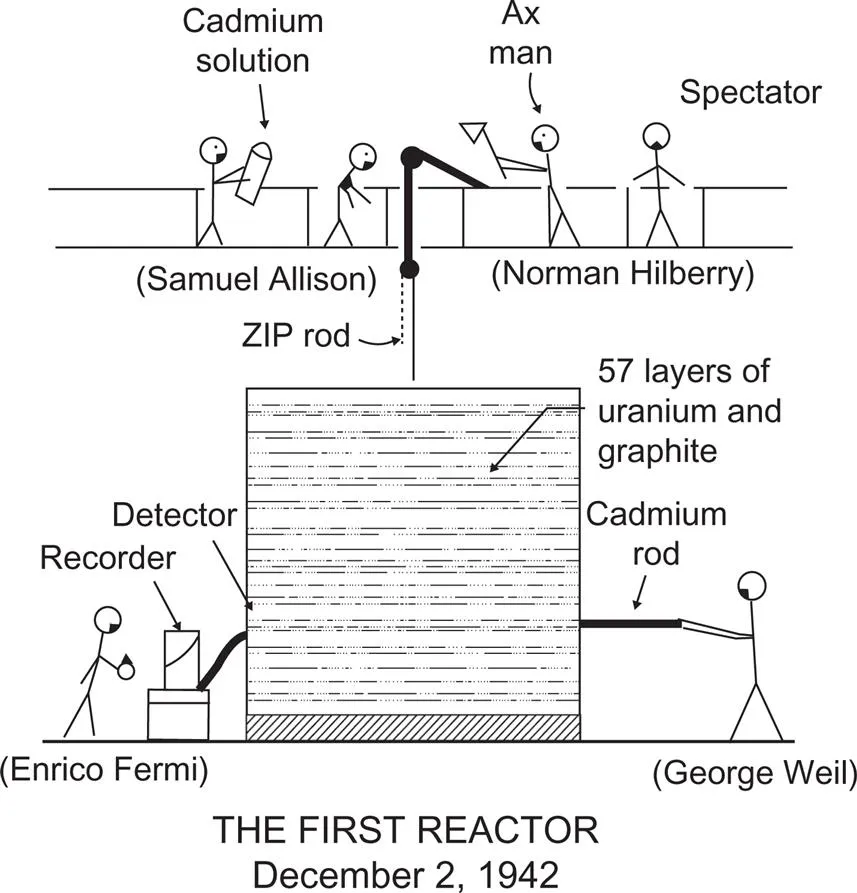

Compared with the set of safety systems subsequently considered essential, an emergency cooling system was missing as decay heat was practically absent after shut down, and there was no containment system (except for a curtain!) provided as the amount of fission products was not significant.
Other reactors were soon built, for both military and civil purposes, and since they were constructed on remote sites (e.g., Hanford, Washington); they did not need containment systems.
In the light of subsequent approaches used in reactor safety, probably, in this first period, not all the necessary precautions were taken; however, it is necessary to consider the specific time and circumstances present (a world war in progress or just finished, status of radiation protection knowledge not yet sufficiently advanced, etc.).1
In the 1980s and 1990s, a revision of the “simplified” approach used for these first reactors (mainly devoted to plutonium production) was made. They were, as a consequence, either shut down or modified. In particular, the following characteristics or problems were removed or solved:
- • the open cycle cooling of the reactors and nonpressure-resistant containments;
- • the disposal of radioactive waste using unreliable methods, such as the location of radioactive liquids in simple underground metallic tanks which were subject to the risk of corrosion and of consequent leaks; and
- • the storage of spent fuel elements in leaking pools of water.
1.2.2 From the Late 1950s to the Three Mile Island Accident
Since the early 1960s and even before, in the West, the criterion of locating power reactors in a leakproof and pressure-resistant containment vessel was established and consolidated. In those cases where a significant release of radioactive products could be possible, the design pressure of the containment was chosen on the assumption that all the primary (and part of the secondary) hot water (for a water reactor) was released from the cooling systems.
Indeed, since the 1950s, the US “Reactor Safeguards Committee,” set up by the Atomic Energy Commission (AEC) with the task of defining the guidelines for nuclear safety, had indicated that for a noncontained reactor, a low population zone should be provided. This distance, R, had to be equal, at least to that given by Eq. (1.1).

where Pth is the thermal power of the reactor in kilowatts.
For a 3000 MW reactor (the usual size today), this exclusion distance is equal to approximately 30 km, which is equal to the distance evacuated after the Chernobyl accident (Bourgeois et al., 1996). Evidently, the reference doses for the short-term evacuation were roughly the same for the two cases. An exclusion distance of this magnitude poses excessive problems to siting, even in a country endowed with abundant land such as the United States; therefore the decision of adopting a containment is practically a compulsory one.
The first reactor with leakproof and pressure-resistant containment was the SR1 reactor (West Milton, New York, built in the 1950s). Built to perform tests for the development of reactors for military ship propulsion; this reactor was cooled by sodium and the containment was designed for the pressure corresponding to the combustion of the sodium escaping from a hypothetical leak in the cooling circuit.
In Western countries, moreover, it was required that the whole refrigeration primary circuit should be located completely inside the containment, so that, even in the case of a complete rupture of the largest primary system pipe, all the escaped fluid would be confined in the containment envelope. The design pressure of the containment for water reactors (starting with the Shippingport, Pa, reactor, moderated and cooled by pressurized water) was derived on the basis of the assumption of the complete release of the primary water.
In Eastern Europe, these criteria were applied to a lesser degree, as it was accepted that the pressure vessel alone would be located within the containment (the rupture of large pipes was considered sufficiently unlikely to justify this assumption) and that the leakproof containment characteristic need not be very stringent. Thus at the second Atoms for Peace conference in Geneva in 1964, the Western visitors were impressed but surprised by the model of the Novovoronezh reactor, which showed only one small containment enclosure around the reactor pressure vessel and was located in a building that from the outside resembled a big public office building. Still many years afterward, the Russian reactors of the VVER 230 series, although provided with complete “Western-style” containment, had a leakage rate from the containment of the order of 25% each day (to be compared with figures of the order of 0.2% each day from typical Western containments).2
Apart from differences of approach between world regions, in this period of time and in all the countries with nuclear reactors, the systems installed in the plants according to the requirements of the safety bodies and having the sole purpose of accident mitigation, were frequently the subject of heated debates; in particular, the emergency core cooling systems and the containment systems were often discussed.
More precisely, the opinions on the accident assumptions evolved in the West were divided. The reference situations for the reasonably conceivable accidents were chosen by the judgment of expert committees. These situations included the worst “credible” events (such as the complete severance of the largest primary pipe). The assumptions concerning the initiating event were accompanied by simultaneous conservative assumptions concerning malfunctions in safety systems, such as a “single failure” consisting in the failure, simultaneous with the initiating event (pipe failure and so on), of one active component of one of the safety systems devoted to emergency safety functions during the accident (water injection system, reactor shutdown system, and so on).3
On one side, the more cautious experts, generally members of public safety control bodies, many scholars and members of nongovernmental organizations for the defence of public rights, supported the need for keeping these conservative assumptions; on the other side, more optimistic people (members of manufacturing industries and of electric utilities) maintained that the above-mentioned accident assumptions entailed a true waste of resources (those necessary to provide nuclear plants with huge containment buildings and powerful safety systems). It has to be noted that the “optimists” were by no means imprudent or reckless: a sincere conviction existed in the industry that the current accident assumptions were not well founded.4
The contrast between the optimists and the pessimists was exacerbated by the foreseeable circumstance that not all of the logical consequences of the initially adopted accident assumptions were from the start clear to technical people. As an example, as far as the effectiveness of emergency core cooling systems is concerned, it was not understood from the start that Zircaloy fuel cladding (stainless steel behaves in a similar way) could react with water in an autocatalytic way at relatively low temperatures and could release large quantities of hydrogen. Neither was it understood from the start that the same cladding could swell before rupturing and could occupy the space between fuel rods, preventing the flow of cooling water. The existence of these phenomena was demonstrated by studies and by tests performed by the AEC on the Semiscale facility at the US National Laboratory of Idaho Falls toward the end of the 1960s, when many US reactors had already been ordered and were being designed or built.
Similarly, at the beginning of the 1970s, the possibility was demonstrated that the break of a pipe could damage other nearby pipes or other plant components, starting a chain ...
Table of contents
- Cover image
- Title page
- Table of Contents
- Copyright
- Preface
- Chapter 1. Introduction
- Chapter 2. Inventory and Localization of Radioactive Products in the Plant
- Chapter 3. Safety Systems and Their Functions
- Chapter 4. The Classification of Accidents and a Discussion of Some Examples
- Chapter 5. Severe Accidents
- Chapter 6. The Dispersion of Radioactivity Releases
- Chapter 7. Health Consequences of Releases
- Chapter 8. The General Approach to the Safety of the Plant–Site Complex
- Chapter 9. Defence in Depth
- Chapter 10. Quality Assurance
- Chapter 11. Safety Analysis
- Chapter 12. Safety Analysis Review
- Chapter 13. Classification of Plant Components
- Chapter 14. Notes on Some Plant Components
- Chapter 15. Earthquake Resistance
- Chapter 16. Tornado Resistance
- Chapter 17. Resistance to External Impact
- Chapter 18. Nuclear Safety Criteria
- Chapter 19. Nuclear Safety Research
- Chapter 20. Operating Experience
- Chapter 21. Underground Location of Nuclear Power Plants
- Chapter 22. The Effects of Nuclear Explosions
- Chapter 23. Radioactive Waste
- Chapter 24. Fusion Safety
- Chapter 25. Safety of Specific Plants and of Other Activities
- Chapter 26. Nuclear Facilities on Satellites
- Chapter 27. Erroneous Beliefs About Nuclear Safety
- Chapter 28. When Can We Say That a Particular Plant Is Safe?
- Chapter 29. The Limits of Nuclear Safety: The Residual Risk
- Additional References
- Appendix 1. The Chernobyl Accident
- Appendix 2. Calculation of the Accident Pressure in a Containment
- Appendix 3. Table of Safety Criteria
- Appendix 4. Dose Calculations
- Appendix 5. Simplified Thermal Analysis of an Insufficiently Refrigerated Core
- Appendix 6. European Requirements Revision E, 2016
- Appendix 7. Notes on Fracture Mechanics
- Appendix 8. US General Design Criteria
- Appendix 9. IAEA Criteria
- Appendix 10. Primary Depressurization Systems
- Appendix 11. Thermal-Hydraulic Transients of the Primary System
- Appendix 12. The Atmospheric Dispersion of Releases
- Appendix 13. Regulatory Framework and Safety Documents
- Appendix 14. USNRC Regulatory Guides and Standard Review Plan
- Appendix 15. Safety Cage
- Appendix 16. Criteria for the Site Chart (Italy)
- Appendix 17. The Three Mile Island Accident
- Appendix 18. Other Examples of Practical Use of This Book
- Websites
- Index
Frequently asked questions
Yes, you can cancel anytime from the Subscription tab in your account settings on the Perlego website. Your subscription will stay active until the end of your current billing period. Learn how to cancel your subscription
No, books cannot be downloaded as external files, such as PDFs, for use outside of Perlego. However, you can download books within the Perlego app for offline reading on mobile or tablet. Learn how to download books offline
We are an online textbook subscription service, where you can get access to an entire online library for less than the price of a single book per month. With over 1.5 million books across 990+ topics, we’ve got you covered! Learn about our mission
Look out for the read-aloud symbol on your next book to see if you can listen to it. The read-aloud tool reads text aloud for you, highlighting the text as it is being read. You can pause it, speed it up and slow it down. Learn more about Read Aloud
Yes! You can use the Perlego app on both iOS and Android devices to read anytime, anywhere — even offline. Perfect for commutes or when you’re on the go.
Please note we cannot support devices running on iOS 13 and Android 7 or earlier. Learn more about using the app
Please note we cannot support devices running on iOS 13 and Android 7 or earlier. Learn more about using the app
Yes, you can access Nuclear Safety by Gianni Petrangeli in PDF and/or ePUB format, as well as other popular books in Technology & Engineering & Environmental Management. We have over 1.5 million books available in our catalogue for you to explore.