eBook - ePub
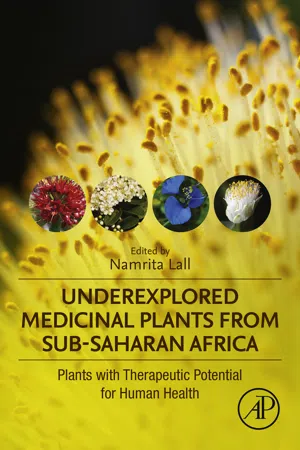
Underexplored Medicinal Plants from Sub-Saharan Africa
Plants with Therapeutic Potential for Human Health
- 358 pages
- English
- ePUB (mobile friendly)
- Available on iOS & Android
eBook - ePub
Underexplored Medicinal Plants from Sub-Saharan Africa
Plants with Therapeutic Potential for Human Health
About this book
Underexplored Medicinal Plants from Sub-Saharan Africa: Plants with Therapeutic Potential for Human Health examines a comprehensive selection of rarely explored plants that have been underestimated for their therapeutic value. The book contains monographs of medicinal plants, outlining their botanical description, geographical distribution, ethnobotanical usage, chemical constituents, sample and standard preparations and methods, and pharmacological properties. With expert contributors from South Africa, Mauritius, Seychelles, Cameroon and Nigeria, and the compilation of ethnobotanical, taxonomic and pharmacologic information for each species, this book is a valuable resource for researchers, academics in pharmacology, ethnopharmacology, medicinal plant sciences, and more.
- Explores the therapeutic potential of a comprehensive selection of underexplored and underutilized medicinal plants in sub-Sahara Africa
- Provides a summary table of structures of any known natural products, including details of plant source (chapter) and observed activity (e.g. anticancer, antibacterial)
- Includes contributions from experts from South African, Mauritius, Seychelles, Cameroon and Nigeria
Trusted by 375,005 students
Access to over 1.5 million titles for a fair monthly price.
Study more efficiently using our study tools.
Information
Topic
MedicineChapter 1
Acalypha integrifolia Willd
Nawraj Rummun 1 , 2 , Cláudia Baider 3 , Theeshan Bahorun 1 , and Vidushi S. Neergheen-Bhujun 1 , 2 1 ANDI Centre of Excellence for Biomedical and Biomaterials Research, University of Mauritius, Réduit, Republic of Mauritius 2 Department of Health Sciences, Faculty of Science, University of Mauritius, Réduit, Republic of Mauritius 3 The Mauritius Herbarium, Agricultural Services, Ministry of Agro-Industry and Food Security, Réduit, Republic of Mauritius
Abstract
Acalypha integrifolia Willd (Euphorbiaceae) is a monoecious shrub. The species is endemic to the Mascarenes, and this subspecies is endemic to the Mascarenes islands of Réunion and Mauritius. The leaves are used as part of alternative medicine on both islands. Herbalists recommend a decoction of the leaf for their anthelmintic and depurative properties but also for various dermatological pathologies. However, although the leaf is commonly administered orally, scientific evaluation of its efficacy, phytochemical, and safety profile for human consumption is scarce. The reported biological activity has focused on the in vitro antibacterial and antifungal properties. This chapter presents a general view of the botanical description, ethnomedicinal uses, and antimicrobial properties of the Indian Ocean A. integrifolia subspecies.
Keywords
Anthelmintic; Antibacterial; Antifungal; Astringent; Purgative; Skin infections

1. General description
1.1. Botanical nomenclature
Acalypha integrifolia Willd.
1.2. Botanical family
Euphorbiaceae
1.3. Vernacular names
Mauritius: Bois queue de rat
Réunion: Bois de crève coeur, Bois de Charles
2. Botanical description
Shrub up to 2 m tall. Branches erect; young branchlets usually glabrous, sometimes with tiny appressed hairs. Stipules 1–9 mm, triangular. Leaves variable, alternated or whorled, 4–13(−18) × 1–4.5(−6.5) cm; blade elliptical-ovate, elliptical, elliptical-obovate or oblong; base truncated or cordated; tip acute or rounded; glabrous, sometimes with hairs along the veins when young; coriaceous or papyraceous; secondary veins sometimes indistinguishable, green both sides, green with red margin or green above, red or purple below. Male inflorescence axillary, up to 20 cm long, many flowered, flowers in groups, axis hairy; female inflorescence axillary or at the base of male inflorescence, 2–5 cm long, 1–5 flowered. Flowers unisexual, more or less sessile; male flowers with small bracts; female flowers with large bract, styles 3, ovary covered with spines. Fruit 3–4 mm long. Seed, 2.5–3 mm long, pale brown. (Adapted from Coode, 1982).
3. Distribution
Acalypha integrifolia Willd is a species found in the Mascarenes only (Montero Muñoz et al., 2018) and do not occur in Madagascar as previously thought (WCSP, 2018; Tropicos, 2018). On Mauritius, the species is found at Le Pouce, Perrier and Magenta, among other sites (Coode 1982).
4. Ethnobotanical usage
The leaf is traditionally used for their astringent and purgative effect. The leaf decoction is ingested orally for their anthelmintic activity against intestinal worms. Moreover, the decoction is also applied topically to treat skin infections (Gurib-Fakim and Guého, 1996; Mahomoodally and Aumeeruddy, 2017; Rouillard and Guého, 1999; Seebaluck et al., 2015 ).
5. Phytochemical constituents
No isolated phytochemical has been reported from this species. The leaf, stem, and root have been reported to contain saponins, tannins, sterols, terpenes, and traces of alkaloids (Gurib-Fakim and Guého, 1996). The leaf decoction contained terpenes, tannins, coumarins, sesquiterpene lactones, and cardiac glycosides. In addition, the methanolic leaf extract also contained flavonoids (Seebaluck-Sandoram et al., 2018).
6. TLC fingerprinting of plant extracts
The air-dried leaves were exhaustively extracted with aqueous methanol (80%, v/v) and partitioned with dichloromethane. The aqueous phase was lyophilized and 5 mg of the powdered extract was dissolved in 1 mL of aqueous methanol (80%, v/v). For the reference standards, Quercitrin, quercetin, rutin, hyperoside, and chlorogenic...
Table of contents
- Cover image
- Title page
- Table of Contents
- Copyright
- Disclaimer
- Contributors
- About the editor
- Foreword
- Introduction
- Chapter 1. Acalypha integrifolia Willd
- Chapter 2. Aloe lomatophylloides
- Chapter 3. Aloe macra
- Chapter 4. Aloe purpurea
- Chapter 5. Aloe spicata
- Chapter 6. Aloe tormentorii
- Chapter 7. Bauhinia galpinii
- Chapter 8. Bruguiera gymnorhiza
- Chapter 9. Buddleja saligna
- Chapter 10. Combretum molle
- Chapter 11. Commelina benghalensis
- Chapter 12. Elaeodendron transvaalense
- Chapter 13. Equisetum ramosissimum
- Chapter 14. Eriosema kraussianum
- Chapter 15. Erythrophleum lasianthum
- Chapter 16. Euclea natalensis
- Chapter 17. Eugenia crassipetala
- Chapter 18. Eugenia tinifolia
- Chapter 19. Ficus glumosa
- Chapter 20. Ficus lutea
- Chapter 21. Ficus sur
- Chapter 22. Greyia radlkoferi
- Chapter 23. Haemanthus albiflos
- Chapter 24. Heteropyxis canescens
- Chapter 25. Heteropyxis dehniae
- Chapter 26. Hypericum revolutum subsp. revolutum
- Chapter 27. Juncus effusus
- Chapter 28. Lannea schweinfurthii
- Chapter 29. Lippia scaberrima
- Chapter 30. Newtonia buchananii
- Chapter 31. Nymphaea caerulea
- Chapter 32. Ocimum labiatum
- Chapter 33. Phyllanthus phillyreifolius
- Chapter 34. Plantago longissima
- Chapter 35. Plectranthus ecklonii
- Chapter 36. Plectranthus neochilus
- Chapter 37. Rapanea melanophloeos
- Chapter 38. Ravenala madagascariensis
- Chapter 39. Searsia lancea
- Chapter 40. Siphonochilus aethiopicus
- Chapter 41. Stillingia lineata subsp. lineata
- Chapter 42. Terminalia bentzoe subsp. bentzoe
- Chapter 43. Terminalia prunioides
- Chapter 44. Vigna unguiculata
- Chapter 45. Wikstroemia indica
- Chapter 46. Zantedeschia aethiopica
- Index
Frequently asked questions
Yes, you can cancel anytime from the Subscription tab in your account settings on the Perlego website. Your subscription will stay active until the end of your current billing period. Learn how to cancel your subscription
No, books cannot be downloaded as external files, such as PDFs, for use outside of Perlego. However, you can download books within the Perlego app for offline reading on mobile or tablet. Learn how to download books offline
We are an online textbook subscription service, where you can get access to an entire online library for less than the price of a single book per month. With over 1.5 million books across 990+ topics, we’ve got you covered! Learn about our mission
Look out for the read-aloud symbol on your next book to see if you can listen to it. The read-aloud tool reads text aloud for you, highlighting the text as it is being read. You can pause it, speed it up and slow it down. Learn more about Read Aloud
Yes! You can use the Perlego app on both iOS and Android devices to read anytime, anywhere — even offline. Perfect for commutes or when you’re on the go.
Please note we cannot support devices running on iOS 13 and Android 7 or earlier. Learn more about using the app
Please note we cannot support devices running on iOS 13 and Android 7 or earlier. Learn more about using the app
Yes, you can access Underexplored Medicinal Plants from Sub-Saharan Africa by Namrita Lall in PDF and/or ePUB format, as well as other popular books in Medicine & Alternative & Complementary Medicine. We have over 1.5 million books available in our catalogue for you to explore.