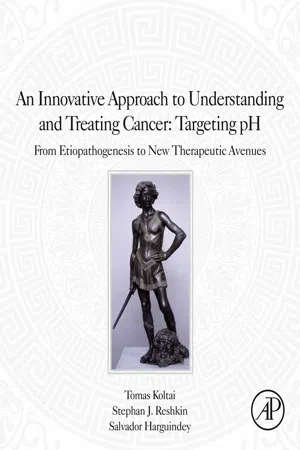
eBook - ePub
An Innovative Approach to Understanding and Treating Cancer: Targeting pH
From Etiopathogenesis to New Therapeutic Avenues
- 574 pages
- English
- ePUB (mobile friendly)
- Available on iOS & Android
eBook - ePub
An Innovative Approach to Understanding and Treating Cancer: Targeting pH
From Etiopathogenesis to New Therapeutic Avenues
About this book
An Innovative Approach to Studying and Treating Cancer: Targeting pH describes one of the few characteristics of cancer that is not shared by normal tissues: the reversal or inversion of the pH gradient when intracellular pH becomes alkaline and extracellular pH becomes acid. This is now recognized as one of the most selective and differential hallmarks of all cancer cells and tissues, being the opposite of the condition found in normal tissues and a potential target in order to achieve either a stable disease or even regression with no toxicity.
The book discusses topics such as lactic acid and its transport system in the pH paradigm, mechanisms to decrease extra cellular pH and increase intracellular pH, NHE-1 activity in cancer, carbonic anhydrases, vacuolar ATPase proton pump, and the sodium-bicarbonate cotransporter system. Additionally, it discusses complementary pharmacological interventions, cellular acidification and extracellular alkalinization as a new and integral approach to cancer treatment.
- Analyzes the mechanisms that lead to the inversion of pH gradient in cancer tissues
- Summarizes almost 100 years of research on pH inversion in cancer in one single source, discussing the most relevant and updated researches in the field
- Proposes new efficient treatments against cancer using pH inversion mechanisms, either with new drugs like proton transport inhibitors and proton pump inhibitors (PTIs and PPIs) or with repurposed drugs
Information
Part I
Metabolism and pH physiopathology of cancer
Chapter 1
Introduction
Abstract
Nearly a 100 years have elapsed since Otto Warburg's first publications on cancer metabolism. Today we know much more about this issue than in his days. However, this knowledge has not had a major impact on cancer treatment. We believe that we are at the gates of substantial changes in cancer treatment, and that the metabolic and pH approach will have an important role. In this book we shall try to show not only the importance of pH in cancer but also the mechanisms of how pH works from the very beginning of the malignant process, its progression and evolution and eventually in the apoptotic process. And most important of all, we shall also describe the multiple ways in which the therapeutic manipulation of pH may stop or at least slow down the malignant process and decrease the metastatic risk.
Keywords
pH; pH centered approach; Warburg; Intracellular pH; Extracellular pH
Introductory words
Here in this book, we shall climb the cancer mountain. And we are going to do it from the metabolic side. But, we will have to use an innovative instrument for this climb: the pH-centered approach. The pH-centered approach enables us to understand that the striking findings of acid-base alterations in cancer are not collateral damage of the disease. From Warburg and up to the late fifties, the metabolic approach led to the idea that cancer was a “mitochondrial disease”. However, the explosive development of molecular biology showed that the mitochondrial origin of cancer was a flawed concept. The new culprit was the gene. And a gene-centered approach era started. We are living now in this “genetic era”. Cancer is the product of a change in one or many genes, whether mutations, epigenetic silencing, translocations, etc. While there is no doubt that the gene (gene-centered approach) is the root of the malignant process; something is missing for a real understanding of the reasons that lead to cancer development. Genes “speak”, but they do not do things by themselves. Genes have a code that they express through proteins. These proteins are the real instruments that make things happen. Different tumors make things happen in different ways. Malignant tumors have different phenotypes and genotypes. A mesothelioma has very little to do with a chronic myeloid leukemia. Both are malignant tumors, both grow, and both may eventually kill their host, and yet, they are both cancers. And of course, their genotypes and phenotypes are strikingly different. This has led scientists to say that cancer is not a disease but a multiplicity of diseases. Melanoma seems to be one disease. For example, when we penetrate into the intricate world of melanoma, we find that melanomas with certain mutations, such as the V600 mutation, behave differently than melanomas with a different kind of mutation. Thus the concept that cancer is many diseases seems appropriate. Furthermore, it is known that the same tumor is genetically and phenotypically heterogeneous. This would mean that one tumor is many diseases. As we said at the beginning, something is still missing in the quest for an integrated vision of cancer. This is the point where the pH-centered approach comes to our aid. All different tumors, no matter their genotype or phenotype or driving pathway, share one feature: an inverted pH gradient in which as the cell increases its alkalinity the surrounding matrix becomes acid while in normal cells it is the opposite. When analyzed in depth, this abnormality leads to the conclusion that the unifying characteristic of all malignant tumors is this pH alteration. It does not matter if it is a glioblastoma, a renal cell carcinoma, or a lymphoma. They all invert their pH gradient.
This pH inversion could seem to be a collateral development of the many metabolic changes that take place in cancer. Is it so?
For an answer based on sheer logic let us analyze a few facts:
- (1) The pH inversion occurs very early in the transformation process, even before the metabolic changes ensue (metabolic switch).
- (2) Inhibiting the pH inversion in the early stage of transformation, aborts the malignization.
- (3) Reversing the pH inversion slows down cancer proliferation and growth.
- (4) There are no cancers without the inverted pH gradient.
- (5) The most active parts of a tumor (where invasion is going on) show a more pronounced inversion of the pH gradient.
- (6) Metastatic cells may be genetically different from the primary tumor, but the pH inversion is equally present.
- (7) When cells are under hypoxic conditions (that induce a pH inversion) transformation may develop.
- (8) Once transformation starts in these hypoxic cells, the restoration of normal oxygen levels does not restore normality.
- (9) pH inversion creates a very harsh environment that jeopardizes the survival of normal cells, and in spite of this, malignant cells thrive and grow in it.
Many diseases but one common pathway: inversion of the pH gradient. Cells, whether normal or malignant do not have a thinking apparatus. But for a few seconds let's suppose the contrary. Then:
- (1) Why would a cell invert its pH gradient if this would create an “impossible” environment?
- (2) Why would a cell that is transforming invert its pH as the first step towards cancer?
- (3) Why would the inhibition of the pH abnormality impede carcinogenesis at that early stage?
- (4) Why do all malignancies have an inverted pH?
Researchers have slowly but steadily found answers to these intriguing questions. These answers are the fundamentals of the pH-centered approach to cancer.
We believe that pH inversion is not a collateral consequence of malignization. It is center stage. And the emerging view is that the genetic alterations that give way to cancer are strongly associated with the pH inversion, which is probably the first step in malignization.
...Table of contents
- Cover image
- Title page
- Table of Contents
- Copyright
- Contributors
- Preface
- Part I: Metabolism and pH physiopathology of cancer
- Part II: Therapeutics
- Abbreviations
- Index
Trusted by 375,005 students
Access to over 1.5 million titles for a fair monthly price.
Study more efficiently using our study tools.
Frequently asked questions
Yes, you can cancel anytime from the Subscription tab in your account settings on the Perlego website. Your subscription will stay active until the end of your current billing period. Learn how to cancel your subscription
No, books cannot be downloaded as external files, such as PDFs, for use outside of Perlego. However, you can download books within the Perlego app for offline reading on mobile or tablet. Learn how to download books offline
Perlego offers two plans: Essential and Complete
- Essential is ideal for learners and professionals who enjoy exploring a wide range of subjects. Access the Essential Library with 800,000+ trusted titles and best-sellers across business, personal growth, and the humanities. Includes unlimited reading time and Standard Read Aloud voice.
- Complete: Perfect for advanced learners and researchers needing full, unrestricted access. Unlock 1.5M+ books across hundreds of subjects, including academic and specialized titles. The Complete Plan also includes advanced features like Premium Read Aloud and Research Assistant.
We are an online textbook subscription service, where you can get access to an entire online library for less than the price of a single book per month. With over 1.5 million books across 990+ topics, we’ve got you covered! Learn about our mission
Look out for the read-aloud symbol on your next book to see if you can listen to it. The read-aloud tool reads text aloud for you, highlighting the text as it is being read. You can pause it, speed it up and slow it down. Learn more about Read Aloud
Yes! You can use the Perlego app on both iOS and Android devices to read anytime, anywhere — even offline. Perfect for commutes or when you’re on the go.
Please note we cannot support devices running on iOS 13 and Android 7 or earlier. Learn more about using the app
Please note we cannot support devices running on iOS 13 and Android 7 or earlier. Learn more about using the app
Yes, you can access An Innovative Approach to Understanding and Treating Cancer: Targeting pH by Tomas Koltai,Stephan J. Reshkin,Salvador Harguindey in PDF and/or ePUB format, as well as other popular books in Biological Sciences & Biology. We have over 1.5 million books available in our catalogue for you to explore.