- 1,246 pages
- English
- ePUB (mobile friendly)
- Available on iOS & Android
eBook - ePub
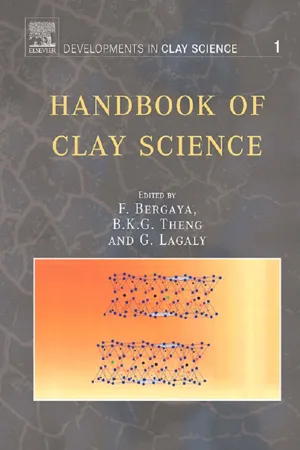
Handbook of Clay Science
About this book
The first general texts on clay mineralogy and the practical applications of clay, written by R.E. Grim, were published some 40-50 years ago. Since then, a vast literature has accumulated but this information is scattered and not always accessible. The Handbook of Clay Science aims at assembling the scattered literature on the varied and diverse aspects that make up the discipline of clay science. The topics covered range from the fundamental structures (including textures) and properties of clays and clay minerals, through their environmental, health and industrial applications, to their analysis and characterization by modern instrumental techniques. Also included are the clay-microbe interaction, layered double hydroxides, zeolites, cement hydrates, genesis of clay minerals as well as the history and teaching of clay science. No modern book in the English language is available that is as comprehensive and wide-ranging in coverage as the Handbook of Clay Science.In providing a critical and up-to-date assessment of the accumulated information, this will serve as the first point of entry into the literature for both newcomers and graduate students, while for research scientists, university teachers, industrial chemists, and environmental engineers the book will become a standard reference text.* Presents contributions from 66 authors from 18 different countries who have come together to produce the most comprehensive modern handbook on clay science* Provides up-to-date concepts, properties, and reactivity of clays and clay minerals in a one-stop source of information* Covers classical and new environmental, industrial, and health applications of clays, as well as the instrumental techniques for clay mineral analysis* Combines geology, mineralogy, crystallography with physics, geotechnology, and soil mechanics together with inorganic, organic, physical, and colloid chemistry for a truly multidisciplinary approach
Information
Topic
Physical SciencesSubtopic
Geology & Earth SciencesTable of contents
- Cover image
- Title page
- Table of Contents
- List of Contributors by Country of Residence
- Acknowledgements
- Contributing Authors
- Foreword
- Chapter 1 General Introduction: Clays, Clay Minerals, and Clay Science
- Chapter 2 Structures and Mineralogy of Clay Minerals
- Chapter 3 Surface and Interface Chemistry of Clay Minerals
- Chapter 4 Synthetic Clay Minerals and Purification of Natural Clays
- Chapter 5 Colloid Clay Science
- Chapter 6 Mechanical Properties of Clays and Clay Minerals
- Chapter 7 Modified Clays and Clay Minerals
- Chapter 7.1 Acid Activation of Clay Minerals
- Chapter 7.2 Thermally Modified Clay Minerals
- Chapter 7.3 Clay Mineral Organic Interactions
- Chapter 7.4 Clay Minerals and the Origin of Life
- Chapter 7.5 Pillared Clays and Clay Minerals
- Chapter 8 Properties and Behaviour of Iron in Clay Minerals
- Chapter 9 Clays, Microorganisms, and Biomineralization
- Chapter 10 Clays in Industry
- Chapter 10.1 Conventional Applications
- Chapter 10.2 Clay Minerals as Catalysts
- Chapter 10.3 Clay Mineral– and Organoclay–Polymer Nanocomposite
- Chapter 11 Clays, Environment and Health
- Chapter 11.1 Clays and Clay Minerals for Pollution Control
- Chapter 11.2 Clays and Pesticides
- Chapter 11.3 Clay Liners and Waste Disposal
- Chapter 11.4 Clays and Nuclear Waste Management
- Chapter 11.5 Clays and Human Health
- Chapter 11.6 Clays and Clay Minerals as Drugs
- Chapter 12 Critical Assessment of Some Analytical Techniques
- Chapter 12.1 Mössbauer spectroscopy of clays and clay minerals
- Chapter 12.2 Identification and Quantitative Analysis of Clay Minerals
- Chapter 12.3 X-ray Absorption Spectroscopy
- Chapter 12.4 X-ray Photoelectron Spectroscopy
- Chapter 12.5 Small-Angle Scattering Techniques
- Chapter 12.6 Fourier Transform Infrared Spectroscopy
- Chapter 12.7 Nuclear Magnetic Resonance Spectroscopy
- Chapter 12.8 Transmission Electron Microscopy
- Chapter 12.9 Surface Area and Porosity
- Chapter 12.10 Cation and Anion Exchange
- Chapter 12.11 Thermal Analysis
- Chapter 13 Some Other Materials Related to Clays
- Chapter 13.1 Layered Double Hydroxides
- Chapter 13.2 Parallels and Distinctions between Clay Minerals and Zeolites
- Chapter 13.3 Cement Hydrates
- Chapter 14 Genesis of Clay Minerals
- Chapter 15 History of clay science: a young discipline
- Chapter 16 Teaching Clay Science: A Great Perspective
- Subject Index
Trusted by 375,005 students
Access to over 1.5 million titles for a fair monthly price.
Study more efficiently using our study tools.
Frequently asked questions
Yes, you can cancel anytime from the Subscription tab in your account settings on the Perlego website. Your subscription will stay active until the end of your current billing period. Learn how to cancel your subscription
No, books cannot be downloaded as external files, such as PDFs, for use outside of Perlego. However, you can download books within the Perlego app for offline reading on mobile or tablet. Learn how to download books offline
Perlego offers two plans: Essential and Complete
- Essential is ideal for learners and professionals who enjoy exploring a wide range of subjects. Access the Essential Library with 800,000+ trusted titles and best-sellers across business, personal growth, and the humanities. Includes unlimited reading time and Standard Read Aloud voice.
- Complete: Perfect for advanced learners and researchers needing full, unrestricted access. Unlock 1.5M+ books across hundreds of subjects, including academic and specialized titles. The Complete Plan also includes advanced features like Premium Read Aloud and Research Assistant.
We are an online textbook subscription service, where you can get access to an entire online library for less than the price of a single book per month. With over 1.5 million books across 990+ topics, we’ve got you covered! Learn about our mission
Look out for the read-aloud symbol on your next book to see if you can listen to it. The read-aloud tool reads text aloud for you, highlighting the text as it is being read. You can pause it, speed it up and slow it down. Learn more about Read Aloud
Yes! You can use the Perlego app on both iOS and Android devices to read anytime, anywhere — even offline. Perfect for commutes or when you’re on the go.
Please note we cannot support devices running on iOS 13 and Android 7 or earlier. Learn more about using the app
Please note we cannot support devices running on iOS 13 and Android 7 or earlier. Learn more about using the app
Yes, you can access Handbook of Clay Science by Faïza Bergaya,B.K.G. Theng,G. Lagaly in PDF and/or ePUB format, as well as other popular books in Physical Sciences & Geology & Earth Sciences. We have over 1.5 million books available in our catalogue for you to explore.