
- 430 pages
- English
- ePUB (mobile friendly)
- Available on iOS & Android
eBook - ePub
Shale Gas and Tight Oil Reservoir Simulation
About this book
Shale Gas and Tight Oil Reservoir Simulation delivers the latest research and applications used to better manage and interpret simulating production from shale gas and tight oil reservoirs. Starting with basic fundamentals, the book then includes real field data that will not only generate reliable reserve estimation, but also predict the effective range of reservoir and fracture properties through multiple history matching solutions. Also included are new insights into the numerical modelling of CO2 injection for enhanced oil recovery in tight oil reservoirs. This information is critical for a better understanding of the impacts of key reservoir properties and complex fractures.
- Models the well performance of shale gas and tight oil reservoirs with complex fracture geometries
- Teaches how to perform sensitivity studies, history matching, production forecasts, and economic optimization for shale-gas and tight-oil reservoirs
- Helps readers investigate data mining techniques, including the introduction of nonparametric smoothing models
Trusted by 375,005 students
Access to over 1.5 million titles for a fair monthly price.
Study more efficiently using our study tools.
Information
Topic
Physical SciencesSubtopic
EnergyChapter 1
Introduction of Shale Gas and Tight Oil Reservoirs
Abstract
This chapter provides an overview of the importance of unconventional resources such as shale gas and tight oil in the world. Horizontal drilling and multistage fracturing are needed to economically develop such unconventional reservoirs due to ultralow permeability and low porosity. The unique fluid and fracture properties of shale gas and tight oil reservoirs make it challenging to accurately simulate well performance using traditional reservoir simulation method. In addition, the importance of sensitivity study, history matching, production forecasting, economic optimization, CO2 injection for enhanced oil recovery in shale reservoirs is discussed.
Keywords
Shale gas; Tight oil; Horizontal drilling; Multi-stage fracturing; Complex fracture networks
1.1 Introduction
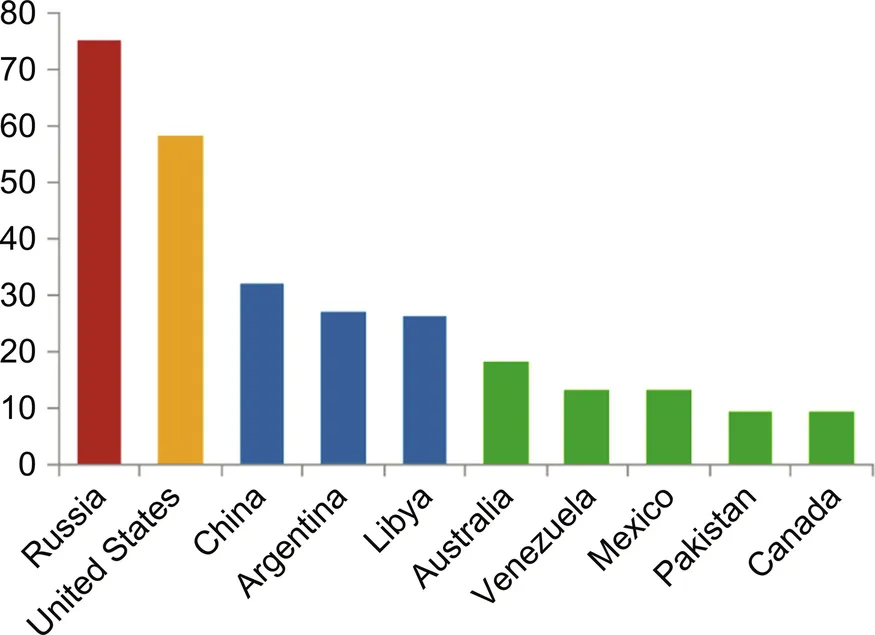
Unconventional resources, such as shale gas and tight oil, are making a major contribution to the world energy. U.S. Energy Information Administration (EIA, 2013a) reported that the technically recoverable world shale oil resources are 345 billion barrels and world shale gas resources are 7299 trillion cubic feet (TCF). Fig. 1.1 shows the top reserve holders of shale gas resources throughout the world. As shown, the United States has 24.4 trillion cubic meters gas estimation, China has 36.1 trillion cubic meters gas estimation, and Argentina has 21.9 trillion cubic meters gas estimation. Fig. 1.2 shows U.S. shale gas and oil plays in the Lower 48 States. It is predicted that shale gas production will increase from 40% of total U.S. dry gas production in 2012 to 53% in 2040 (EIA, 2014). Fig. 1.3 shows the top 10 holders of tight oil resources throughout the world. Based on the early release overview of U.S. Energy Information Administration in 2013, onshore tight oil production will increase from 33% of total lower 48 onshore oil production to 51% in 2040 (EIA, 2013b).


Gas shales are typically characterized by ultralow permeability and low porosity and have a significant amount of total organic content (TOC). The permeability in shale gas reservoirs is around nano-Darcy.
In order to economically develop shale gas and tight oil reservoirs, two key technologies such as horizontal drilling and multistage fracturing are required, as shown in Fig. 1.4. The actual fracture stimulation process involves pumping large volume of fluids, which can create the complex fractures, and large amount of proppants, which can prevent the fractures closure. During hydraulic fracturing treatments, complex fracture networks are often generated and the interaction of hydraulic and natural fractures significantly impacts the complexity (Daniels et al., 2007; Maxwell et al., 2013). The complex fracture networks can create a huge contact area between the formation and horizontal wellbore (Cipolla and Wallace, 2014). The effectiveness of fracturing stimulation treatment plays an important role in economic production of the unconventional reservoirs (Weng, 2014). Three to six perforation clusters per fracturing stage are typically used in most horizontal wells (Cipolla et al., 2010). EIA (2015) reported that four countries including the United States, Canada, China, and Argentina are currently producing commercial volumes of shale gas and tight oil and the United States is the dominant producer (Fig. 1.5).


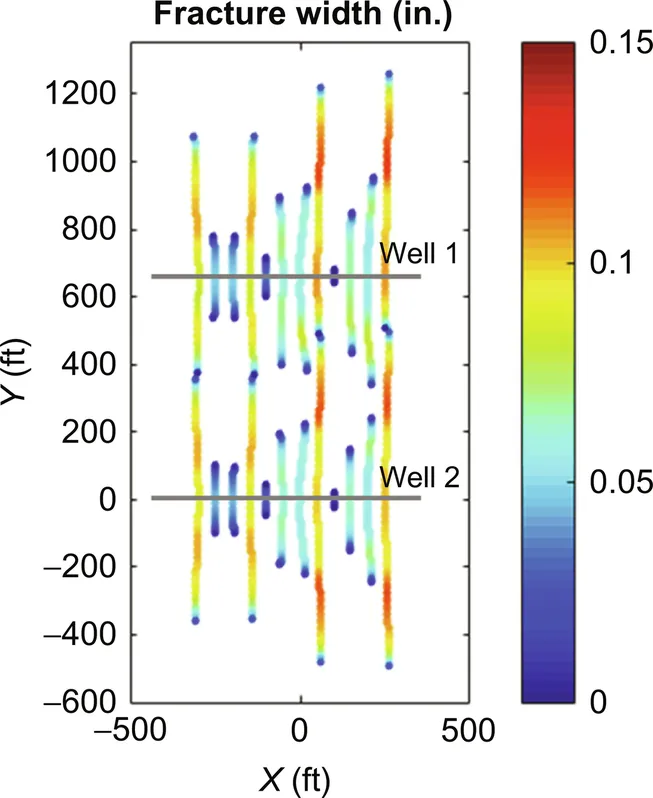
Modeling complex hydraulic fracture propagation is important to understand fracture geometry. An acceptable fracture modeling should capture four critical physical processes, including (1) fracture deformation induced by internal pressure in the fracture; (2) fluid flow in the fracture; (3) fluid leak-off into the formation, and (4) fracture propagation (Veatch, 1986; Adachi et al., 2007). The most popular numerical method used for fracture modeling is boundary element method, which can efficiently simulate multiple fracture propagation (Wu et al., 2012; Wu and Olson, 2015a, 2016). In addition, a simplified three-dimensional displacement discontinuity method was proposed by Wu and Olson (2015b) to effectively simulate fracture opening and shearing. The complex fracture propagation model developed by Wu and Olson (2015a,b) couples rock deformation and fluid flow in the fractures and horizontal wellbore. The model fully captures the key physical mechanisms such as the stress shadow effects, flow rate distribution among multiple fractures, and interaction of hydraulic and natural fractures. It can simulate multiple fracture propagation in single well and multiple wells, as shown in Figs. 1.6 and 1.7, respectively. Hence, it is very important to develop reservoir models to perform production simulation considering the complex fracture geometries.

The actual hydraulic fracturing process often generates complex nonplanar hydraulic fractures. The fracture width and fracture permeability change along fracture length. In general, some ideal fracture geometries such as biwing fractures and orthogonal fracture networks are used to represent the complex nonplanar fractures. Although there are numerical models to handle the complex fracture geometry, most of them are computationally more expensive. Also, there is the big challenge of gridding issue for modeling fractures. More importantly, the effects of varying fracture width and permeability along the fracture length are not considered by the existing models. Hence, an efficient model to simulate production from the complex nonplanar fractures is still lacking in the petroleum industry. In addition, there are very few work that have combined the realistic fracture geometry modeling as well as production simulation using such fracture geometries to analyze field well performance. Accordingly, it is significant to combine them together to evaluate well performance from shale gas and tight oil reservoirs.
Simulation of production from complex fracture geometries in shale reservoirs is challenging. We present an efficient semianalytical model by dividing fractures into segments to approximately represent the complex nonplanar fractures. It combines an analytical solution for the diffusivity equation about fluid flow in shale and a numerical solution for fluid flow in fractures. In addition, we present conventional numerical model to handle planar fractures and orthogonal fracture networks using local grid refinement (LGR). Moreover, we introduce an embedded discrete fracture model (EDFM) to efficiently deal with the complex fractures by dividing the fractures into segments using matrix cell boundaries and creating non-neighboring connections (NNCs). Fractures can have any strike and dip angels and variable width along fracture length. In addition, an EDFM preprocessor is introduced, which can be utiliz...
Table of contents
- Cover image
- Title page
- Table of Contents
- Copyright
- Dedication
- Preface
- Chapter 1: Introduction of Shale Gas and Tight Oil Reservoirs
- Chapter 2: Numerical Model for Shale Gas and Tight Oil Simulation
- Chapter 3: Semianalytical Model for Shale Gas and Tight Oil Simulation
- Chapter 4: Modeling Gas Adsorption in Marcellus Shale Using Langmuir and BET Isotherms
- Chapter 5: Embedded Discrete Fracture Model (EDFM) for Complex Fracture Geometry
- Chapter 6: An Integrated Framework for Sensitivity Analysis and Economic Optimization in Shale Reservoirs
- Chapter 7: An Assisted History-Matching Workflow Using a Proxy-Based Approach for Shale Reservoirs
- Chapter 8: CO2 Injection for Enhanced Oil Recovery in Tight Oil Reservoirs
- Chapter 9: Phase Behavior Modeling by Considering Nanopore Confinement
- Index
Frequently asked questions
Yes, you can cancel anytime from the Subscription tab in your account settings on the Perlego website. Your subscription will stay active until the end of your current billing period. Learn how to cancel your subscription
No, books cannot be downloaded as external files, such as PDFs, for use outside of Perlego. However, you can download books within the Perlego app for offline reading on mobile or tablet. Learn how to download books offline
Perlego offers two plans: Essential and Complete
- Essential is ideal for learners and professionals who enjoy exploring a wide range of subjects. Access the Essential Library with 800,000+ trusted titles and best-sellers across business, personal growth, and the humanities. Includes unlimited reading time and Standard Read Aloud voice.
- Complete: Perfect for advanced learners and researchers needing full, unrestricted access. Unlock 1.5M+ books across hundreds of subjects, including academic and specialized titles. The Complete Plan also includes advanced features like Premium Read Aloud and Research Assistant.
We are an online textbook subscription service, where you can get access to an entire online library for less than the price of a single book per month. With over 1.5 million books across 990+ topics, we’ve got you covered! Learn about our mission
Look out for the read-aloud symbol on your next book to see if you can listen to it. The read-aloud tool reads text aloud for you, highlighting the text as it is being read. You can pause it, speed it up and slow it down. Learn more about Read Aloud
Yes! You can use the Perlego app on both iOS and Android devices to read anytime, anywhere — even offline. Perfect for commutes or when you’re on the go.
Please note we cannot support devices running on iOS 13 and Android 7 or earlier. Learn more about using the app
Please note we cannot support devices running on iOS 13 and Android 7 or earlier. Learn more about using the app
Yes, you can access Shale Gas and Tight Oil Reservoir Simulation by Wei Yu,Kamy Sepehrnoori in PDF and/or ePUB format, as well as other popular books in Physical Sciences & Energy. We have over 1.5 million books available in our catalogue for you to explore.