- 498 pages
- English
- ePUB (mobile friendly)
- Available on iOS & Android
eBook - ePub
About this book
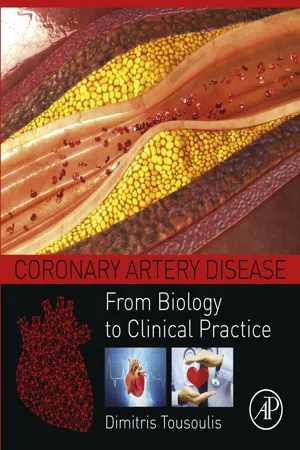
Coronary Artery Disease: From Biology to Clinical Practice links the most important basic concepts of atherosclerosis pathophysiology to treatment management of coronary artery disease. Comprehensive coverage starts with the basic pathophysiologic mechanisms of the disease, including molecular and genetic mechanisms, cells interaction and inflammation. In addition, sections on novel anti-atherosclerotic therapies and a thorough understanding of the recent trends in clinical management round out this comprehensive tome that is ideal for practitioners and researchers.
By summarizing this novel knowledge and changes in diagnostic algorithm and treatment options, this is the perfect reference for cardiology researchers who want a volume with the most up-to-date experimental trends in the field of atherosclerosis, for cardiologists and physicians who manage patients with atherosclerotic risk factors and established coronary artery disease, and medical students who want to learn the basic concepts of atherosclerosis.
- Delivers a comprehensive connection between basic pathophysiologic mechanisms and the clinical context of coronary artery disease
- Provides a focus on the most important novel evidence in the management of atherosclerosis and coronary artery disease
- Includes sum-up tables at the end of each chapter and clinical scenarios that focus on diagnosis and treatment
- Conveys an understanding of upcoming, novel, experimental and clinical treatments
Trusted by 375,005 students
Access to over 1.5 million titles for a fair monthly price.
Study more efficiently using our study tools.
Information
Topic
MedicineSubtopic
CardiologyChapter 1
Pathophysiology of Atherosclerosis
Chapter 1.1
Biology of the Vessel Wall
Evangelos Oikonomou, Sotirios Tsalamandris, Konstantinos Mourouzis, and Dimitris Tousoulis 1st Cardiology Clinic, ‘Hippokration’ General Hospital, National and Kapodistrian University of Athens, School of Medicine, Athens, Greece
Abstract
Atherosclerosis is a pathologic process that develops in the arterial wall. Therefore the biology and imaging of the vessel wall is the cornerstone of research, diagnosis, and treatment in patients with atherosclerosis and coronary artery disease. Three functional layers (intima, media, and adventitia) have been recognized that actively orchestrate blood perfusion in tissue and organs; however, changes in the intima layer and especially endothelial damage predispose to atherosclerosis, thrombus formation, and acute coronary events. Over the years additional characteristics have been recognized (i.e., thin cap fibroatheroma, thermal heterogeneity, infiltration with macrophage and inflammatory cells) predisposing to plaque rapture and erosion and acute coronary syndromes, which should orient future research and treatment strategies.
Keywords
Atherosclerosis; Coronary artery disease; Endothelial cell; Intima; Media layer; Thrombus
In a simplistic view, the role of arteries is to transfer blood from one site to another merely functioning as tubes. However, this concept has long been overcome and since the mid-19th century it has been recognized that the arterial wall serves multiple functions and can actively regulate blood flow and pressure, tissue perfusion or ischemia, and coagulation, while also participating in atherogenesis formation and progression. Therefore the biology of vessel wall and arterial anatomy has gained research interest.
Arterial Anatomy
Three layers can be identified in the arterial wall from inside to outside: the intima, media, and adventitia, and atherosclerosis process involves primarily pathologic changes in the intima with reactive changes in the media and adventitia.
Intima Layer
The intima layer is made up of the endothelial surface, the basement membrane, and the internal elastic lamina. In the absence of atherosclerosis intima is extremely thin and serves several unique roles orchestrating the functional characteristics and properties of the arterial wall.
Endothelium
Normal endothelium is a thin monolayer of endothelial cells. Its surface in the human body is estimated to be 350 m2 with a mass of only 110 g. Many vasoactive substances (i.e., nitric oxide, endothelin 1) are produced by endothelial cells with vasodilating and antithrombogenic actions regulating vascular homeostasis. Importantly, endothelial cells have the unique ability to keep blood liquid and to inhibit activation of the coagulation cascade by the expression of the anticoagulants thrombomodulin, heparin sulfate, and prostacyclin on their surface. On the contrary, in the presence of endothelial damage and dysfunction the balance shifts toward a prethrombotic state and proatherosclerotic changes ensue (Fig. 1.1.1). Interestingly, bone marrow-derived endothelial progenitor cells circulating in the blood stream contribute to neovascularization and re-endothelialization of the injured vessel maintaining vascular function and homeostasis.
Therefore the central role of the endothelium in vascular homeostasis and atherosclerosis progression is discussed in detail in a separate section of this book.

Figure 1.1.1 Endothelial-derived procoagulant and anticoagulant factors. HSPG, heparan sulfate proteoglycan; PAi, plasminogen activator inhibitor; PGI2, prostacyclin; t-PA, tissue plasminogen activator; u-PA, urokinase-type plasminogen activator.
Basement Membrane
Basement membrane supports the endothelial monolayer and contains collagen, laminin, fibronectin, and other extracellular matrix molecules. Aging process changes the composition of basement membrane with presentation of smooth muscle cells and fibrillar forms of collagen (collagen types I and III). The extracellular contents of the basement membrane are produced by smooth muscle cells. Intimal thickening characterizes most adult human arteries and does not necessarily accompany atherosclerosis.
Elastic Membrane
Elastic membrane serves as a connection of the intima with the media layer.
Media Layer
This layer is composed of a series of concentric layers of smooth muscle cells interchangeable with layers of extracellular matrix rich in elastin especially in the great elastic arteries such as aorta. Of note, this structure changes as we progress from great arteries to small muscular arteries where the layers of muscular and extracellular contents cannot be readily recognized. In great arteries, the described structure of media tunica serves to store kinetic energy powered by left ventricular systole in a dynamic form, which is attributed latter during diastole.
Adventitia
The adventitia mainly consists of collagen fibrils and a sparse cellular population consisting of fibroblasts and mast cells. In this layer nerve endings and vasa vasorum are observed.
Coronary Perivascular Adipose Tissue
Adipose tissue plays a specific, well-known role in cardiovascular system physiology through the systemic effects of active adipokines that are released into blood circulation or through paracrine signaling of the fat secretome that surrounds the vascular wall. Our recent studies have underlined the significance of a bidirectional interaction between the arterial wall and perivascular adipose tissue and between the epicardial adipose tissue and the myocardium.
A layer of epicardial fat surrounds the major epicardial arteries, which is critical for their function and coronary atherosclerosis progression. Human epicardial adipose tissue biopsies have shown that its gene expression profile changes to a proinflammatory phenotype in the presence of coronary atherosclerosis. Recently, we have proved that perivascular adipose tissue has defense mechanisms whose activation is induced by “rescue signals” sent by the arterial wall in the presence of cardiovascular disease; for example, the expression of adiponectin, an antiinflammatory adipokine, is upregulated in the human perivascular adipose tissue during high oxi...
Table of contents
- Cover image
- Title page
- Table of Contents
- Copyright
- Contributors
- Preface by Filippo Crea
- Preface by Juan Carlos Kaski
- Preface by Emmanouil S. Brilakis
- Chapter 1. Pathophysiology of Atherosclerosis
- Chapter 2. Coronary Artery Circulation: Basic Principles
- Chapter 3. Novel and Experimental Therapies in Advance Atherosclerosis
- Index
Frequently asked questions
Yes, you can cancel anytime from the Subscription tab in your account settings on the Perlego website. Your subscription will stay active until the end of your current billing period. Learn how to cancel your subscription
No, books cannot be downloaded as external files, such as PDFs, for use outside of Perlego. However, you can download books within the Perlego app for offline reading on mobile or tablet. Learn how to download books offline
Perlego offers two plans: Essential and Complete
- Essential is ideal for learners and professionals who enjoy exploring a wide range of subjects. Access the Essential Library with 800,000+ trusted titles and best-sellers across business, personal growth, and the humanities. Includes unlimited reading time and Standard Read Aloud voice.
- Complete: Perfect for advanced learners and researchers needing full, unrestricted access. Unlock 1.5M+ books across hundreds of subjects, including academic and specialized titles. The Complete Plan also includes advanced features like Premium Read Aloud and Research Assistant.
We are an online textbook subscription service, where you can get access to an entire online library for less than the price of a single book per month. With over 1.5 million books across 990+ topics, we’ve got you covered! Learn about our mission
Look out for the read-aloud symbol on your next book to see if you can listen to it. The read-aloud tool reads text aloud for you, highlighting the text as it is being read. You can pause it, speed it up and slow it down. Learn more about Read Aloud
Yes! You can use the Perlego app on both iOS and Android devices to read anytime, anywhere — even offline. Perfect for commutes or when you’re on the go.
Please note we cannot support devices running on iOS 13 and Android 7 or earlier. Learn more about using the app
Please note we cannot support devices running on iOS 13 and Android 7 or earlier. Learn more about using the app
Yes, you can access Coronary Artery Disease by Dimitris Tousoulis in PDF and/or ePUB format, as well as other popular books in Medicine & Cardiology. We have over 1.5 million books available in our catalogue for you to explore.