eBook - ePub
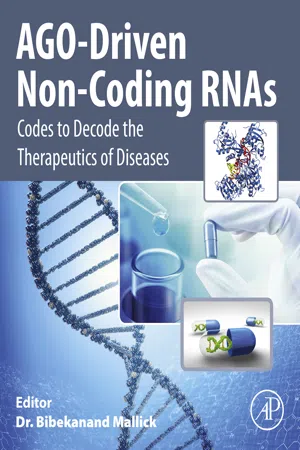
AGO-Driven Non-Coding RNAs
Codes to Decode the Therapeutics of Diseases
- 387 pages
- English
- ePUB (mobile friendly)
- Available on iOS & Android
eBook - ePub
About this book
The 'RNA world' hypothesis that proposed RNA molecules as the first form of genetic material was put forwarded in the late 1980s but got impetus only recently when high-throughput sequencing technologies began unearthing new types of non-coding RNA (ncRNA) transcripts in higher eukaryotes. Till then, research on ncRNAs were primarily confined to transfer RNAs and, ribosomal RNAs, which act as the messengers of the protein synthesis and allow translation of genetic information encoded by DNA into proteins. In recent years, the integration of high-throughput genomic technologies with molecular biology and omics sciences have revolutionized the fields of ncRNA research by identifying the hidden treasures of several new types of ncRNAs encoded in the genomes of several organisms and decrypting their versatile roles in gene expression and epigenetics. Among these, two small endogenous ncRNAs, namely microRNAs (miRNAs) and piwi-interacting RNAs (piRNAs) that drive argonaute (AGO) family of proteins namely Ago and Piwi respectively and silence the expression of genes have geared up molecular and disease biology research in recent years. Both miRNAs and piRNAs are expressed in higher eukaryotes, including human and act as cellular rheostats by regulating the expression of significant fraction of genes encoded in the genomes. The aberrant expressions of these small ncRNAs within the cells cause various abnormalities and diseases including cancer. Manipulating their aberrant expression or function can serve as potential novel diagnostic/prognostic biomarkers and bring in new therapeutic strategies for multiple human diseases. This can be further translated from bench-side to clinic for improving human health.
This book captures the essence of the pioneering work of some of the world's leading researchers showcasing the scientific excitements surrounding the evolving regulatory roles of miRNAs and piRNAs highlighting their potential towards the diagnosis and therapeutics of various diseases. The book is geared towards scientists, students, and will particularly appeal to active investigators in RNA biology, molecular biology, cancer research as well as clinicians and will provide them a comprehensive view of recent discoveries and research progresses to utilize miRNAs, piRNAs and their interacting proteins, Ago and Piwi for diagnosis, prognosis and therapeutics of diseases.
- Provides a unified cutting-edge resource for both miRNAs and piRNAs, two promising AGO-clade small ncRNAs, their functions and potential applications
- Showcase high-throughput technologies and other approaches for discovery of these small ncRNAs and their targets
- Unveils the diverse molecular mechanisms by which miRNAs and piRNAs regulate gene expression in animal cells
- Showcase recent discoveries on involvement of Argonaute and Piwi proteins in different biological processes and diseases as well as their possible use in diagnosis
- Report breakthroughs in the use of small ncRNAs for diagnosis and personalized therapy
Trusted by 375,005 students
Access to over 1.5 million titles for a fair monthly price.
Study more efficiently using our study tools.
Information
Part 1
Small non-coding RNA biology and prediction methods
Chapter 1
Two different mechanisms of two different non-coding RNAs—MicroRNAs and PIWI-interacting RNAs: From origin to cancer
Çağrı Öner Maltepe University, School of Medicine, Department of Medical Biology and Genetics, İstanbul, Turkey
Abstract
“Junk DNA” sequences, which are clusters of small non-coding RNAs, were initially considered regions that do not encode protein, but it has been determined that they play important roles in epigenetic mechanisms in cancerous cells, stem cells, and healthy cells. MicroRNAs (miRNAs) are Dicer-dependent and are associated with Argonaute (AGO) proteins for the transcriptional repression or degradation of target mRNA. Another type of small non-coding RNA is PIWI-interacting RNA (piRNA). piRNAs are incorporated with AGO proteins called PIWI proteins and these piRNAs expressions are not related with Dicer. Although piRNAs and PIWIs were thought to play an important role in embryogenesis (especially spermatogenesis) via transposon silencing, recent studies have shown that they also affect cancer development and biology. In this chapter, the background of miRNAs and piRNAs, the biogenesis and functions of these small non-coding RNAs in cells, and their specific expression patterns in several cancer types are discussed.
Keywords
Argonaute; Cancer; Metastasis; miRNA; PIWI; piRNA
1 History of MicroRNAs
MicroRNAs (miRNAs; miRs) are the small, single-stranded non-coding RNAs that are 18–24 nucleotides (nt) in length and affect the gene expression of their target genes via posttranscriptional regulation [1]. MicroRNAs (miRNAs; miRs) were initially discovered by Victor Ambros and his colleagues who identified a gene 22 nt in length named lin-4 in Caenorhabditis elegans [2]. The second study on miRNAs was published in 2000 by Reinheart et al., who determined another 22-nt small RNA called let-7, which was also involved in C. elegans development [3]. The studies on miRNAs then increased, and more than 100 additional small non-coding RNAs were identified in various organisms such as worms, Drosophila, and humans [4]. Currently, thousands of miRNA loci have been identified, and these small non-coding RNAs have arised as posttranscriptional regulators [5]. With the increased number of studies in humans, some miRNAs have been found to be encoded from the same loci on chromosomes but have different target mRNAs, and others have synergistic effects on the same mRNA. The 50% of transcribed miRNAs are located in polycistronic primary transcripts in humans (Fig. 1.1) [4, 6].

2 Biogenesis of MicroRNAs
miRNAs consist of miRNA loci of genomic DNA by RNA polymerase II. The transcribed region then makes a hairpin structure and is called primer-microRNA (pri-miRNA/pri-miR). A Poly-A tail is found in the 3′ region, although the cap is located in the 5′ region of pri-miRNA. By an endonuclease enzyme called Drosha, the 3′ and 5′ regions of pri-miRNA are abolished, forming precursor-micro RNA (pre-miRNA/pre-miR). Pre-miRNA is transferred from the nucleus to the cytosol of the cell by the exportin V multichannel transport system. The hairpin-structured pre-miRNA undergoes the second cutting stage in the cytosol by Dicer. Dicer, like Drosha, is an endonuclease, and it removes the hairpin structure from pre-miRNA. The two small RNA strands, which only bond to each other with hydrogen bonds, are separated from each other. It remains unknown which chain is the mature miRNA (mat-miRNA/mat-miR) strand, also called the guide strand. It may be either of these two strands, which are complementary to each other. A few viewpoints exist concerning strand selection. First, the guide strand is detected while loading to AGO, based primarily on the relative thermodynamic stability of the two ends of the small RNA duplex. With a relatively unstable terminal on the 5′ side, the strand is typically selected as the guide strand [7–9]. The second viewpoint suggests that the first nucleotide sequence is important for the selection. AGO proteins can select the guide strand according to uracil (U) as the first nucleotide sequence [6, 7, 10–13]. The released passenger strand (the unselected strand) is degraded quickly. Mat-miRNA binds to the RNA-induced-silencing complex (RISC), which can bind to the 3′-untranslated region (3′-UTR) of target messenger RNA (mRNA). This causes failure of RNA polymerase to bind to the target mRNA promoter region, inhibiting transcription (Fig. 1.2).

miRNAs select mRNA targets for downregulation through their association with RISC. Presence of target mRNA sequences which are incompletely complementary to the miRNA indicates selection. Although miRNA-binding sites take place in the 3′-UTR of the mRNA, functional miRNA-binding sites can be located in the 5′-UTR or coding region [5, 14]...
Table of contents
- Cover image
- Title page
- Table of Contents
- Copyright
- Contributors
- About the Editor
- Preface
- About the Book
- Part 1: Small non-coding RNA biology and prediction methods
- Part 2: Small ncRNAs dictating cell fate and immune response
- Part 3: Role of small ncRNAs in diseases and their applications as therapeutic tools
- Index
Frequently asked questions
Yes, you can cancel anytime from the Subscription tab in your account settings on the Perlego website. Your subscription will stay active until the end of your current billing period. Learn how to cancel your subscription
No, books cannot be downloaded as external files, such as PDFs, for use outside of Perlego. However, you can download books within the Perlego app for offline reading on mobile or tablet. Learn how to download books offline
Perlego offers two plans: Essential and Complete
- Essential is ideal for learners and professionals who enjoy exploring a wide range of subjects. Access the Essential Library with 800,000+ trusted titles and best-sellers across business, personal growth, and the humanities. Includes unlimited reading time and Standard Read Aloud voice.
- Complete: Perfect for advanced learners and researchers needing full, unrestricted access. Unlock 1.5M+ books across hundreds of subjects, including academic and specialized titles. The Complete Plan also includes advanced features like Premium Read Aloud and Research Assistant.
We are an online textbook subscription service, where you can get access to an entire online library for less than the price of a single book per month. With over 1.5 million books across 990+ topics, we’ve got you covered! Learn about our mission
Look out for the read-aloud symbol on your next book to see if you can listen to it. The read-aloud tool reads text aloud for you, highlighting the text as it is being read. You can pause it, speed it up and slow it down. Learn more about Read Aloud
Yes! You can use the Perlego app on both iOS and Android devices to read anytime, anywhere — even offline. Perfect for commutes or when you’re on the go.
Please note we cannot support devices running on iOS 13 and Android 7 or earlier. Learn more about using the app
Please note we cannot support devices running on iOS 13 and Android 7 or earlier. Learn more about using the app
Yes, you can access AGO-Driven Non-Coding RNAs by Bibekanand Mallick in PDF and/or ePUB format, as well as other popular books in Biological Sciences & Molecular Biology. We have over 1.5 million books available in our catalogue for you to explore.