- 162 pages
- English
- ePUB (mobile friendly)
- Available on iOS & Android
eBook - ePub
About this book
The containment of pollution by physical defenses is the first step in restoring the ocean to its natural state. The first two chapters of Oil Spill Studies: Healing the Ocean, Biomarking and the Law describes the feedback on seven experiments made on the East Atlantic Ocean. The first chapter concerns semi-open sites while the second focuses on open environment directly linked to the ocean. The third chapter examines pollution from a French harbor marina and its effects on the local biodiversity. The book provides a methodology to quantify biological contamination coming from heavy metal releases into the environment. Chapter four provides the state-of-the-art in the science of a mid-depth-living fish species affected by the treatment of oil pollution by chemical dispersion. In a similar way, the fifth chapter addresses new explored and exploited ocean with extreme environments such as the Arctic and deep sea. The sixth and final chapter provides a lawyer's analysis on the subject.
- Talks about the healing of the ocean through the containment of the population by physical defenses
- Describes the seven experiments conducted on the Atlantic Ocean
- Provides a methodology to quantify biological contamination
- Presents a species of fish affected by the treatment of oil pollution by chemical dispersion
- Address the oceans explored and exploited with extreme environments such as the Arctic and the deep seabed
Trusted by 375,005 students
Access to over 1.5 million titles for a fair monthly price.
Study more efficiently using our study tools.
Information
1
Oil Spill Containment in Semi-open Areas: Experiments in French Atlantic and Alpine Waters
Frédéric Muttin; Rose Campbell
Abstract
In this chapter, experiments conducted on the mechanical containment of oil pollutants in semi-open areas are presented. Located on the French Atlantic coast of the Charente-Maritime district and the Maurienne valley in the Alps, the experiments demonstrate original contingency plans with different geometries and methods to control oil release. These coastal and inland sites are subject to specific environmental constraints and significant damage if oil containment fails.
Keywords
Chef-de-Baie Harbor; Gazole-Peche; Hydraulic plant; Hydrocarbon pollution; Hydroelectric power plant; Isère rivers; Marine environments; Maurienne Hermillon Lake; Rochefort Harbor; Tonnay-Charente
In this chapter, experiments conducted on the mechanical containment of oil pollutants in semi-open areas are presented. Located on the French Atlantic coast of the Charente-Maritime district and the Maurienne valley in the Alps, the experiments demonstrate original contingency plans with different geometries and methods to control oil release. These coastal and inland sites are subject to specific environmental constraints and significant damage if oil containment fails.
1.1 Introduction
Many strategies are available to combat oil spills using floating barriers [FIN 16]. Located in Rochefort, La Rochelle and Hermillon, France, the following three studies used oil spill booms in different hydrographic and marine environments. Table 1.1 presents the details of the strategies used in the experiments. Different shapes of boom deployment are considered as follows: a line with moored end-points, a closed line such as a triangle and a chevron. The head of the chevron can be positioned upstream to deviate oil on each side or downstream to accumulate oil.
Table 1.1
| Experiment location | Boom geometry | Intervention strategy | Environment | Working objectives |
|---|---|---|---|---|
| Rochefort Harbor | Line | Static at quay Dynamic | Estuarine harbor | Sweeping Concentration |
| Chef-de-Baie Harbor | Triangle | Static | Oceanic harbor | Containment Absorption |
| Maurienne Lake | Chevron Double-head | Static | Freshwater lake | Exclusion Diversion |

The position of anchor points can be time dependent due to forcings such as currents and wind or due to an intervention strategy. A static intervention means that a boom part is generally immobile. On the contrary, a dynamic intervention involves displacing a boom end-point generally using a ship.
The objectives of the floating barriers used are to collect, deviate and displace floating pollutants, which vary between the sites. For each site, modeling has been implemented to carry out re-analysis of real scenarios.
1.2 Rochefort Harbor
Different responses to small-scale pollution can be adapted to the requirements of harbors [KRE 07]. This experimental scenario is based on a real accident where a shipwreck was dismantled inside the basin of the river port of Rochefort, leading to a small discharge of oil. At that time, responders used oil-absorbent materials which were directly disposed on the surface of the basin. No efforts were made to contain or concentrate the slick. Responders considered closing the gates between the basin and the river in order to confine the pollution. The drawback of this action is that the commercial shipping activity of the harbor would be interrupted until the pollution was resorbed.
The experimental method used a 50 m curtain boom as a sweeping device on the polluted water surface. A small boat was used to sweep one end-point of the boom in a semicircle, in order to concentrate the hypothetical pollutant near a mooring bollard on the quay. The other end-point of the boom was moored on a quay ladder and equipped with a dynamometer and tension recorder to prevent boom and mooring failure. This scenario considers less than 1 ton of oil pollutants following an accidental release during bunkering from a truck or the breakdown of an old ship.
The towing velocity of the dynamic boom end-point remained in the order of one knot, taking 3 to 4 minutes to complete one arc (Figure 1.1). This method concentrates the pollutant along the quay, where an absorbent material or a skimmer can be used to absorb the oil.
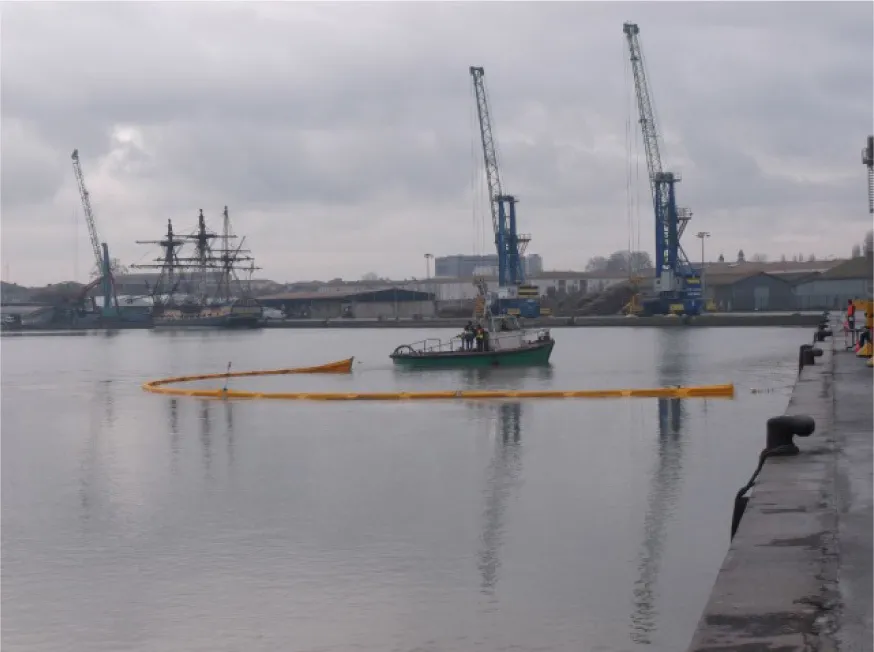
A total of 13 people took part in this experiment: local responders, researchers, students and port authorities. The participant organizations were the Engineering School of La Rochelle, the port of Rochefort and Tonnay-Charente, the Charente-Maritime council and the port of Falmouth.
The boom position was recorded using complementary instruments. A GPS device recorded the position of the end-point located near the boat. Two video cameras filmed the sweeping process from two boundary points on the quay. An overhead view of the boom was obtained using image transformation and georectification. Finally, a flag was mounted on the boom, and three observers tracked the flag throughout the experiment and noted its azimuth relative to the quay using a large protractor for every 20 seconds. The position of the flag was deduced using triangulation, in order to confirm and calibrate the georectified image results. The positions of all of the scientific observers relative to the boat and the boom are shown in Figure 1.2.

The time taken to prepare and deploy the boom and the boat was 30 minutes. A total of 14 sweeps were carrie...
Table of contents
- Cover image
- Title page
- Table of Contents
- Dedication
- Copyright
- Preface
- Acknowledgments
- Author Biographies and Organization Presentations
- 1: Oil Spill Containment in Semi-open Areas: Experiments in French Atlantic and Alpine Waters
- 2: Oil Spill Containment in Open Areas: Four Atlantic and Mediterranean Experiments
- 3: Polymetallic Pollution in Sentinel Bivalves Across a Semi-open Area: La Rochelle Harbor, France
- 4: Oil Spill Dispersant Use: Toxicity on Marine Teleost Fish
- 5: Extreme Environments: The New Exploration/Production Oil Area Problem
- 6: Law Review on Accidental Marine Pollution
- List of Authors
- Index
Frequently asked questions
Yes, you can cancel anytime from the Subscription tab in your account settings on the Perlego website. Your subscription will stay active until the end of your current billing period. Learn how to cancel your subscription
No, books cannot be downloaded as external files, such as PDFs, for use outside of Perlego. However, you can download books within the Perlego app for offline reading on mobile or tablet. Learn how to download books offline
Perlego offers two plans: Essential and Complete
- Essential is ideal for learners and professionals who enjoy exploring a wide range of subjects. Access the Essential Library with 800,000+ trusted titles and best-sellers across business, personal growth, and the humanities. Includes unlimited reading time and Standard Read Aloud voice.
- Complete: Perfect for advanced learners and researchers needing full, unrestricted access. Unlock 1.5M+ books across hundreds of subjects, including academic and specialized titles. The Complete Plan also includes advanced features like Premium Read Aloud and Research Assistant.
We are an online textbook subscription service, where you can get access to an entire online library for less than the price of a single book per month. With over 1.5 million books across 990+ topics, we’ve got you covered! Learn about our mission
Look out for the read-aloud symbol on your next book to see if you can listen to it. The read-aloud tool reads text aloud for you, highlighting the text as it is being read. You can pause it, speed it up and slow it down. Learn more about Read Aloud
Yes! You can use the Perlego app on both iOS and Android devices to read anytime, anywhere — even offline. Perfect for commutes or when you’re on the go.
Please note we cannot support devices running on iOS 13 and Android 7 or earlier. Learn more about using the app
Please note we cannot support devices running on iOS 13 and Android 7 or earlier. Learn more about using the app
Yes, you can access Oil Spill Studies by Frederic Muttin in PDF and/or ePUB format, as well as other popular books in Social Sciences & Oceanography. We have over 1.5 million books available in our catalogue for you to explore.