eBook - ePub
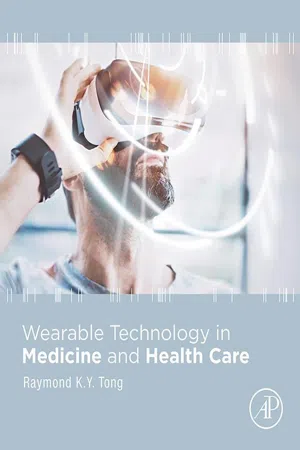
Wearable Technology in Medicine and Health Care
- 340 pages
- English
- ePUB (mobile friendly)
- Available on iOS & Android
eBook - ePub
Wearable Technology in Medicine and Health Care
About this book
Wearable Technology in Medicine and Health Care provides readers with the most current research and information on the clinical and biomedical applications of wearable technology. Wearable devices provide applicability and convenience beyond many other means of technical interface and can include varying applications, such as personal entertainment, social communications and personalized health and fitness. The book covers the rapidly expanding development of wearable systems, thus enabling clinical and medical applications, such as disease management and rehabilitation. Final chapters discuss the challenges inherent to these rapidly evolving technologies.
- Provides state-of-the-art coverage of the latest advances in wearable technology and devices in healthcare and medicine
- Presents the main applications and challenges in the biomedical implementation of wearable devices
- Includes examples of wearable sensor technology used for health monitoring, such as the use of wearables for continuous monitoring of human vital signs, e.g. heart rate, respiratory rate, energy expenditure, blood pressure and blood glucose, etc.
- Covers examples of wearables for early diagnosis of diseases, prevention of chronic conditions, improved clinical management of neurodegenerative conditions, and prompt response to emergency situations
Trusted by 375,005 students
Access to over 1.5 million titles for a fair monthly price.
Study more efficiently using our study tools.
Information
Chapter 1
Wearable Technology in Medicine and Health Care
Introduction
Melisa Junata and Raymond Kai-Yu Tong, Department of Biomedical Engineering, Faculty of Engineering, The Chinese University of Hong Kong, Hong Kong
Abstract
Research teams worldwide have contributed to this book. A wide array of wearable technology is covered in this book literally from head to toe. We have smart glasses for surgeons, smart textiles, upper-limb exoskeleton, and lower-limb exoskeleton. The sensors and technology behind these innovations are discussed deeply in the following chapters. Other topics that act as a result of the inventions of these wearables—big data, patents, regulations, and designs—will help readers to understand the underlying factors that must be considered to deliver these technologies safely and effectively to patients and the general public.
Keywords
Wearable technology; overview; introduction; aging population; personalized medicine; Internet of things; smart eyewear; robotics; sensors; smart textiles; big data
In this era of continuous innovations, the health care world that we are living in will look different in the future. We heard all about new technology innovations in the health-care world. They all promise different outcome and leap from what we have discovered before. A hearing aid is the earliest form of wearable technology that people have ever created [1]. But with the developments in the computing world and the rise in ubiquitous computing technology that gets smaller by size, wearable technology will be a definite part of our future.
It was unimaginable for people in the early forms of computer years that now we can have a smartwatch that will detect our steps and our heartbeat as we walk. It was a significant breakthrough for people to have portable computers wherever and anywhere we go. As time goes on, they are no longer restricted to workplace and home. Wearable technology enables us to wear these devices. We got used to the recent wearable technology that focuses on fitness and health. However, these are not the only ones coming. More advanced devices have a broader use and more sophisticated than before. Rather than consumer-centered, the development of the device is trying to cater health-care professionals as well. This book is comprised of chapters of wearable technology that goes into different facets of technology and impacts health care like never before.
Wearable technology itself is evolving and proliferating in both commercial and research worlds. From Fig. 1.1, we can see how the projected size of the global market for wearable devices in health care grows incrementally from 2015 to 2021. With this trend, we can be confident that the wearable technology will be a big part of health care and medicine sector in the future and there is a significant market for them.

From Fig. 1.2 we can see that the term wearable technology in the medical world arises from 1946 with two studies published that year. Then the studies start to grow steeply from the year 2010 onward. The exponential growth observed from 2010 onward is a sign that more scientists are developing as well as assessing wearable technology that is going to be deployed in the health-care world.

With increasing number of global aging population, paired with home-based health care and rehab, as well as personalized medicine, wearable technology seems like an integral part of the future medicine [4]. The chapters that follow contribute toward the different technological development that has recently turned into media buzzword heard daily: smart eyewear, robotics, Internet of things (IoT), and big data. Some chapters also talk about the intangible parts of technology: patent and regulatory. But they are not only buzzwords, they are also different growing developments in which any technology are going after.
Smart eyewear is a wearable computer glasses that add information alongside or to what the wearer sees [5]. Boillat and Rivas from Stanford University School of Medicine (United States) demonstrate how the use of smart eyewear in the surgery room will enable surgeons and other health professionals to perform things that were impossible or challenging to be done before. This concept is enabled by commercial smart eyewear such as Google Glass and it has benefited time efficiency and live collaboration.
Robotics is defined as a field of engineering that deals with machines that manage a task by mimicking human behavior [6]. Contributions for this book spans widely on wearable robotics. Varghese et al. from Imperial College London (United Kingdom) provide us a review of upper-limb wearable robotics for rehabilitation. The all-in-one review encompasses the design and mechanism of the upper-limb robots, as well as the challenges we may face to put this promising device out there for clinical applications. Shen et al. from the University of California, Los Angeles (United States), discuss the recent progress of upper-limb wearables for rehabilitation and also talk about their research team’s “EXO-UL8” bilateral upper arm rehabilitation wearable. The next robotic wearable review covers the lower-limb wearable for rehabilitation in stroke patients by Yeung and Tong from the Chinese University of Hong Kong (HKSAR, China). They cover the mechanical, electronic, and control design of the lower-limb wearable that is relevant for its clinical application.
The IoT refers to a type of network to connect anything with the Internet through sensors and other monitoring and transmitting equipment to interact and communicate in order to reach common goals such as smart recognition, positioning, tracking, monitoring, and administration [7]. With IoT, health-care devices can be more interconnected than ever and this allows health care to be able to be administered out of conventional point-of-care such as hospitals and clinics to homes and elderly centers.
Sensors is one of the component that enables IoT to happen. Yeo and Lim from the National University of Singapore (Singapore) take us into a greater depth that many upper-limb wearable technologies are faced with, the sensors for upper-limb monitoring and they also discuss on how these technologies meet the requirements of upper-limb monitoring as well as the challenges involved. Victorino et al. from the Simon Fraser University (Canada) expanded the upper-limb sensor discussion by getting into details on the emerging force myography, which has shown capable of doing accurate continuous sensing of finger’s movement.
Smart textile is another technology that we can adopt for use in wearable technology. McKnight et al. from North Carolina State University (United States) talk about the process and the challenges that is involved in creating sensing fabrics and how they can be integrated with the day-to-day textile that we normally wear, but still stay robust to perform its functions. Abtahi et al. from the University of Rhode Island in collaboration with Providence Veteran Affairs Medical Centre and Rhode Island Hospital (United States) describe the future potential of wearable smart textile to change the medical practice; they make their point by demonstrating their application of smart textile on their WearUP smart glove for Parkinson’s disease patients. Xiloyannis et al. from Nanyang Technological University (Singapore) illustrate the possible switch that we may have from hard robots to more user-friendly made-from-fabric exosuit. They demonstrate the exosuit potential with their application for assisting elbow movements.
It is well understood that with more sensing technologies, we also created an even bigger pool of data to be monitored and makes sense of. Big data is a term that describes large volumes of high velocity, complex, and variable data that require advanced techniques and technologies to enable the capture, storage, distribution, management, and analysis of the information [2]. Shi and Wang from Northeastern University (China) and Nagoya Institute of Technology (Japan), respectively, discuss about human body communication-based wearable technology that involves sensing and transmitting vital signs. Vashist and Luong from Immunodiagnostic Systems (Belgium), and University College Cork (Ireland), respectively, illustrate an overview of the wearable technologies that are available commercially for personalized mobile health-care monitoring and management. Slevin and Caulfield from University College Dublin (Ireland) explore how the benefits and uses of data generated by patients will change the future of health care.
With all of the things happening for wearable technology, patent and regulatory is something that we need to consider when we want to bring this technology out to the marketplace. Burmaoglu et al. from Izmir Katip Celebi University (Turkey), University of Novi Sad (Serbia), Ss. Cyril and Methodius University (FYR Macedonia), and University College Dublin (Ireland) talk about how wearable technology in health-care patents evolve over time. Parker et al. from University of Toronto Mississauga (Canada) follows by presenting the chapter on the interconnected truth between design and regulations. This is a very essential chapter noting that regulations are strongly tied with the overall design of the medical device and its delivery to the market.
All in all, we hope that this book and its contents can help widen the horizon of its readers on what we can do to improve medicine and health care with more advanced wearable devices for clinical professionals and patients.
Table of contents
- Cover image
- Title page
- Table of Contents
- Copyright
- List of Contributors
- Preface
- Chapter 1. Wearable Technology in Medicine and Health Care: Introduction
- Chapter 2. Empowering Medical Staff With Smart Glasses in Operating Rooms
- Chapter 3. Wearable Robotics for Upper-Limb Rehabilitation and Assistance: A Review of the State-of-the-Art, Challenges, and Future Research
- Chapter 4. Upper Limb Wearable Exoskeleton Systems for Rehabilitation: State of the Art Review and a Case Study of the EXO-UL8—Dual-Arm Exoskeleton System
- Chapter 5. Lower Limb Exoskeleton Robot to Facilitate the Gait of Stroke Patients
- Chapter 6. Wearable Sensors for Upper Limb Monitoring
- Chapter 7. Wearable Technologies and Force Myography for Healthcare
- Chapter 8. Fiber-Based Sensors: Enabling Next-Generation Ubiquitous Textile Systems
- Chapter 9. WearUp: Wearable Smart Textiles for Telemedicine Intervention of Movement Disorders
- Chapter 10. A Soft Wearable Elbow Exosuit: Design Considerations
- Chapter 11. Human Body Communication–Based Wearable Technology for Vital Signal Sensing
- Chapter 12. Wearable Technologies for Personalized Mobile Healthcare Monitoring and Management
- Chapter 13. Patient-Generated Health Data: Looking Toward Future Health Care
- Chapter 14. Evolution Map of Wearable Technology Patents for Healthcare Field
- Chapter 15. The Interplay Between Regulation and Design in Medical Wearable Technology
- Index
Frequently asked questions
Yes, you can cancel anytime from the Subscription tab in your account settings on the Perlego website. Your subscription will stay active until the end of your current billing period. Learn how to cancel your subscription
No, books cannot be downloaded as external files, such as PDFs, for use outside of Perlego. However, you can download books within the Perlego app for offline reading on mobile or tablet. Learn how to download books offline
Perlego offers two plans: Essential and Complete
- Essential is ideal for learners and professionals who enjoy exploring a wide range of subjects. Access the Essential Library with 800,000+ trusted titles and best-sellers across business, personal growth, and the humanities. Includes unlimited reading time and Standard Read Aloud voice.
- Complete: Perfect for advanced learners and researchers needing full, unrestricted access. Unlock 1.5M+ books across hundreds of subjects, including academic and specialized titles. The Complete Plan also includes advanced features like Premium Read Aloud and Research Assistant.
We are an online textbook subscription service, where you can get access to an entire online library for less than the price of a single book per month. With over 1.5 million books across 990+ topics, we’ve got you covered! Learn about our mission
Look out for the read-aloud symbol on your next book to see if you can listen to it. The read-aloud tool reads text aloud for you, highlighting the text as it is being read. You can pause it, speed it up and slow it down. Learn more about Read Aloud
Yes! You can use the Perlego app on both iOS and Android devices to read anytime, anywhere — even offline. Perfect for commutes or when you’re on the go.
Please note we cannot support devices running on iOS 13 and Android 7 or earlier. Learn more about using the app
Please note we cannot support devices running on iOS 13 and Android 7 or earlier. Learn more about using the app
Yes, you can access Wearable Technology in Medicine and Health Care by Raymond K. Y. Tong, Raymond Tong,Raymond K. Y. Tong in PDF and/or ePUB format, as well as other popular books in Technology & Engineering & Biotechnology. We have over 1.5 million books available in our catalogue for you to explore.