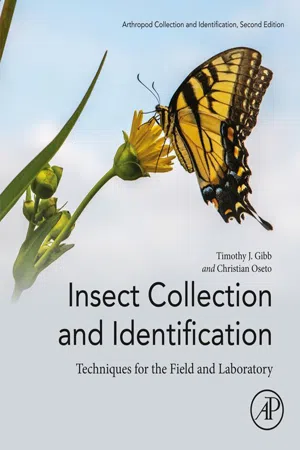
eBook - ePub
Insect Collection and Identification
Techniques for the Field and Laboratory
- 354 pages
- English
- ePUB (mobile friendly)
- Available on iOS & Android
eBook - ePub
Insect Collection and Identification
Techniques for the Field and Laboratory
About this book
Insect Collection and Identification: Techniques for the Field and Laboratory, Second Edition, is the definitive text on all aspects required for collecting and properly preparing specimens for identification. This book provides detailed taxonomic keys to insects and related arthropods, giving recent classification changes to various insect taxa, along with updated preservation materials and techniques for molecular and genomic studies. It includes methods of rearing, storing and shipping specimens, along with a supporting glossary. New sections provide suggestions on how insects and other arthropods can be used within, and outside, the formal classroom and examine currently accepted procedures for collecting insects at crime scenes.
This book is a necessary reference for entomology professionals and researchers who seek the most updated taxonomy and techniques for collection and preservation. It will serve as a valuable resource for entomology students and professionals who need illustrative and detailed information for easy arthropod identification.
- Features updated and concise illustrations for anatomical identification
- Provides an overview of general insect anatomy with dichotomous keys
- Offers sample insect-arthropod based activities for science projects
- Expands the forensic aspect of evidence collection and chain-of-custody requirements
Trusted by 375,005 students
Access to over 1.5 million titles for a fair monthly price.
Study more efficiently using our study tools.
Information
Part 1
Basic tools and general techniques
Outline
Part 1
Basic tools and general techniques

- Introduction 2
- Chapter 1: Equipment and collection methods 5
- Chapter 2: Agents for killing and preserving 71
- Chapter 3: Storage of specimens 73
Introduction
Many reasons exist to collect and preserve insects. Hobbyists, nature enthusiasts, amateur collectors, 4-H or high school students, scientists, and criminal investigators each have different purposes to collect insects. Regardless of the purpose, however, insects collected must be preserved and processed according to established protocols. For example, a box of collected insects without accompanying collection information is of little scientific value. On the other hand, properly collected and preserved insects accompanied by collecting data can be invaluable.
Insects have long been considered indicators of environmental disturbance or pollution. Types and numbers of insects found in various habitats over time provide a measure of change within a system if documented correctly. For example, aquatic insects are sensitive indicators of water pollution. Collecting and preserving aquatic samples requires different collection techniques than other types of insect collecting. Proper equipment and techniques must be understood and used if results are to be of value. Over time, a historical baseline of insects and arthropod species composition and population numbers can be established. Environmentalists look for significant changes from established records as evidence of changes (both positive and negative) to the environment in which they live.
In urban pest management, insect audits have become an extremely important tool in establishing the relative health of buildings. Pharmaceutical and food manufacturing plants and warehouses are some of the places where the presence of insect must be carefully monitored. Insect-infested products, where a single insect or even as much as a part of an insect is detected, can mean the loss of millions of dollars in potential revenues. Collecting and identifying insects in these sensitive situations requires great care and precision and a deep and working understanding of the life history and behavior of the insects in question.
New pests continue to threaten invasion. Counties, states, and countries spend many billions of dollars each year to prevent insects or other potentially harmful pests from invading and establishing themselves. Pests can be unintentionally introduced into new areas via commerce or tourism or by natural dispersion. Most often, when pests arrive in a new habitat, they cause extreme damage because natural controls, which may keep the pests in check in the original areas, do not exist in new habitats, thus allowing the pests to flourish unchecked. Intensive eradication efforts are sometimes implemented in an effort to exterminate the pest once detected. Regulatory officials have been more successful by either thoroughly regulating the movement of infested materials or by monitoring all commodities originating from infested regions. In either case, collecting and preserving insects and related pests at ports of entry can help educate people and provide valuable leads in determining how and where to deny pest entry.
Insects found in food products eaten by unsuspecting people are often the subject of serious litigation, and the outcome of a lawsuit often rests on the collection and preservation of the insect sample as evidence. Likewise, insects that damage structures, agriculture or food, or other commodities can result in the loss of millions of dollars. Those who control these pests often come under considerable pressure when insect inspections show infestations. Proper collection and preservation of such insects is essential.
Insects found in hospitals, where sterile environments are critical or where fully dependent patients are housed, can literally mean the difference between life and death in some instances. Insects that bite or sting cause annoyance, human sickness, and/or death. Insect-transmitted diseases continue to be a leading cause of death in the world. Accurate identification, monitoring, and controlling the spread of these insects are assisted by collecting and maintaining arthropods in a proper manner.
Criminal investigations also can hinge on insects as evidence if they are collected and preserved appropriately. Death scene investigators are very aware that natural succession of insects infesting a corpse can provide extremely valuable information in a death investigation. The species and stages of insects found, together with the temperatures in the surrounding areas, can be used to estimate the location as well as the time of death. Variations from the norm can indicate unusual sequences of postmortem events, but they stand up in a court of law only if the evidence is collected and preserved according to established protocol. Opportunities to collect insects at a death scene occur only once, so entomologists must be trained, prepared, and equipped adequately. In these cases, chain of custody and proper labeling of the evidence are especially critical.
Collecting insects from any habitat or for whatever purpose requires an understanding of the insects’ specific behavior and ecological needs. A collector must understand why and where an insect lives in order to find and collect it. Various traps, flushing agents, and other technical tools may help in this effort. Rearing adult insects from immature life stages is sometimes appropriate, depending on the purpose of the information. Labeling the collected materials with date, precise location, and collector’s name is a minimum. Often, identifying the host or describing the behavior of the insects at the time of collection is also valuable. Sometimes collecting associated materials, such as damaged leaves, wood, cast skins, or fecal material, in addition to the insect is needed. Signs or symptoms of infestations and specific behaviors of the insects just prior to collection are often required. Detailed written accounts or photograp...
Table of contents
- Cover image
- Title page
- Table of Contents
- Copyright
- Dedication
- Preface to the second edition
- Part 1: Basic tools and general techniques
- Part 2: Classification of insects and mites
- Summary
- Appendix I. Liquid preservation formulas
- Appendix II. Guidelines for mounting small and soft-bodied specimens (Systematic Entomology Laboratory)
- Appendix III. Directory state extension service directors and administrators, March 2019
- Appendix IV. Submitting specimens for identification to Systematic Entomology Laboratory Communications & Taxonomic Services Unit
- Glossary
- Bibliography
- Index
Frequently asked questions
Yes, you can cancel anytime from the Subscription tab in your account settings on the Perlego website. Your subscription will stay active until the end of your current billing period. Learn how to cancel your subscription
No, books cannot be downloaded as external files, such as PDFs, for use outside of Perlego. However, you can download books within the Perlego app for offline reading on mobile or tablet. Learn how to download books offline
Perlego offers two plans: Essential and Complete
- Essential is ideal for learners and professionals who enjoy exploring a wide range of subjects. Access the Essential Library with 800,000+ trusted titles and best-sellers across business, personal growth, and the humanities. Includes unlimited reading time and Standard Read Aloud voice.
- Complete: Perfect for advanced learners and researchers needing full, unrestricted access. Unlock 1.5M+ books across hundreds of subjects, including academic and specialized titles. The Complete Plan also includes advanced features like Premium Read Aloud and Research Assistant.
We are an online textbook subscription service, where you can get access to an entire online library for less than the price of a single book per month. With over 1.5 million books across 990+ topics, we’ve got you covered! Learn about our mission
Look out for the read-aloud symbol on your next book to see if you can listen to it. The read-aloud tool reads text aloud for you, highlighting the text as it is being read. You can pause it, speed it up and slow it down. Learn more about Read Aloud
Yes! You can use the Perlego app on both iOS and Android devices to read anytime, anywhere — even offline. Perfect for commutes or when you’re on the go.
Please note we cannot support devices running on iOS 13 and Android 7 or earlier. Learn more about using the app
Please note we cannot support devices running on iOS 13 and Android 7 or earlier. Learn more about using the app
Yes, you can access Insect Collection and Identification by Timothy J. Gibb,Christian Oseto in PDF and/or ePUB format, as well as other popular books in Biological Sciences & Entomology. We have over 1.5 million books available in our catalogue for you to explore.