eBook - ePub
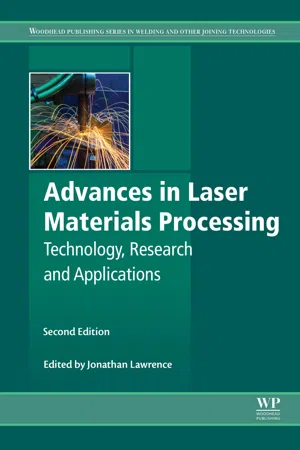
Advances in Laser Materials Processing
Technology, Research and Applications
- 802 pages
- English
- ePUB (mobile friendly)
- Available on iOS & Android
eBook - ePub
About this book
Advances in Laser Materials Processing: Technology, Research and Application, Second Edition, provides a revised, updated and expanded overview of the area, covering fundamental theory, technology and methods, traditional and emerging applications and potential future directions.
The book begins with an overview of the technology and challenges to applying the technology in manufacturing. Parts Two thru Seven focus on essential techniques and process, including cutting, welding, annealing, hardening and peening, surface treatments, coating and materials deposition.
The final part of the book considers the mathematical modeling and control of laser processes. Throughout, chapters review the scientific theory underpinning applications, offer full appraisals of the processes described and review potential future trends.
- A comprehensive practitioner guide and reference work explaining state-of-the-art laser processing technologies in manufacturing and other disciplines
- Explores challenges, potential, and future directions through the continuous development of new, application-specific lasers in materials processing
- Provides revised, expanded and updated coverage
Trusted by 375,005 students
Access to over 1.5 million titles for a fair monthly price.
Study more efficiently using our study tools.
Information
Chapter 1
“Light” Industry: An Overview of the Impact of Lasers on Manufacturing
M. Sparkes; W.M. Steen Cambridge University, Cambridge, United Kingdom
Abstract
Laser materials' processing is now a mature industry encompassing all aspects of modern life: communications, entertainment, security, transportation and medicine are only a few of the applications. Almost every product manufactured is now treated during some part of its lifecycle by laser. This introduction places the developments and challenges for the industry in a historical context; highlighting major advances within the industry, the state of the art and potential future developments.
Keywords
Laser; Processing; Industrial; Review; Historical
This revised edition seeks to communicate a glimpse of how laser materials processing has evolved since the first 2010 publication. Instead of simply summarizing what is to follow, this introduction aims to place the laser and associated technologies in context with other manufacturing methods using electricity as a comparative benchmark before looking at the state of the art and future of industry based on optical energy. Finally predictions from the previous edition will be reviewed, and we will speculate on the future.
By the early 1990s there was enough commercial activity to warrant the first dedicated book on the subject of laser material processing [1], which presented the reader with a basic introduction to the bulk of the industrialized applications while still having space to describe the workings of the laser, basic optics, and process modelling. Now in its fourth edition, the book's basic principles form part of courses taught in schools and colleges. Today the field of laser applications has expanded so far it is hard to see the boundaries of the subject. The application of optical energy goes from atomic fusion through material processing and photochemistry to the remote sensing of planets. The ready availability of high levels of optical energy (with ever increasing efficiency) in a myriad of wavelengths, pulse lengths/shapes, and physical compactness without the need for huge cooling facilities (or patient staff to align the optics) is now a reality, leading to the growing relevance of the subject of lasers in manufacturing.
1.1 The Laser, and the Generation of a Mature Industry
Key technologies fundamentally change manufacturing. Traditionally we start our numbering with the Stone Age, with the last mature development being the Electric Age. With respect to manufacturing, the Optical Age is finally blossoming and has taken its place as an essential tool that is set to dominate developments in this century.
There are many parallels between the dynamo and the laser: one produces large and controllable quantities of electricity, the other the same for electromagnetic radiation. Since the late 19th century, electricity has dominated many developments with astounding results, so much so that it is hard to imagine a world without electricity. We have become dependent upon it. While some might think it strange to write a chapter on the generation of electricity, the electricity produced is being applied in ever more imaginative applications. Optical energy could be considered a progression from electricity as there are many similarities but also additional “knobs to turn,” making it an even more versatile energy source (Table 1.1).
Table 1.1
Properties of a laser beam as an industrial power source compared to electricity and other forms of industrial power
| Power intensity Electricity and laser | A focused laser beam can be one of the most intense power sources available to industry today. A 4 kW laser beam for thick section cutting focused to a 0.2 mm spot size is around 40,000 times more intense than an electric arc [1] |
| Power transmission Electricity and laser | Optical energy is one of the few forms of energy that can be transmitted through a vacuum or air, making it almost uniquely flexible. But it can also be transmitted down optical fibers making it similar to electricity for ease of distribution |
| Automation Electricity and laser | Laser processing can be a non-contact process that creates relatively little noise compared to electric arcs, induction, or flames. Thus laser processes are more open to examination by a variety of in-process sensors offering the possibility of adaptive control and “intelligent” processing |
| Power shaping Ion beam and laser | No other form of energy can be shaped with the precision of optical energy without being in a vacuum. Examples range from photography and holography, to simple point focus or interference fringes |
| Spectral purity Electricity and laser | A laser beam is usually of a single frequency±dispersion effects around a central value. They can only be tuned within small ranges. A range of processes based on resonant absorption are possible. These photolytic processes include cold cutting with ultraviolet light; photodynamic therapy (PDT), which involves breaking of photosensitive molecules; isotope separation (selective ionisation); and fluorescence analysis. Developments in optical computing will soon be using this property |
| Coherence Laser | The stream of electromagnetic waves from a laser is often a single continuous wave stream over measurable distances unlike, for example, radiation from an incandescent bulb. This property has been used for distance measurement and the generation of Bessel beams for low diffraction propagation [2] as well as beam shaping with spatial light modulators (SLM) [3] |
| Polarization Laser | Controlling the direction of the electric field oscillation through polarization effects can influence the absorption of light by materials leading to more efficient processing [4] or fast switching of optical transmission in electro-optic materials [5] |
| Pulse length | Bursts of laser light can provide additional capabilities for controlling laser-matter interactions, such as increased precision when machining or hole drilling by ablation processes, with limited collateral thermal effects. Taken to the extreme, high-intensity short laser pulses (≈<15 ps) are capable of having multi-photon interactions with the photons arriving simultaneously [6,7]. Examples of manufacturing applications are “transparent” material processing, precision ablation [8], and two photon precision additive manufacturing [9,10] |

One common misconception is that the laser is powerful, but truthfully, laser beams are only just moving into the realms of being high powered. A 6 kW laser, which could be considered to be the workhorse for laser cutting job shops over the last 20 years, is about as powerful as two UK domestic electric kettles. The power of the laser comes with its focusability. An industrial 1 kW single mode CW fiber laser can easily be focused to diameters below 7.5 μm, giving a power density of 22.6×10⁹ kW/m2. If this energy density were extended over the entire 1 m2 it would be more than the equivalent of the entire electrical production of the world! The International Energy Outlook [11] estimates 2016 global electricity generation to be around 23×1012 kWh (≈6.3×10⁹ kW).
But first let's consider what a laser can do. It produces a coherent, near parallel beam of electromagnetic radiation. The distribution of power within the beam can be readily manipulated and the range of power can be from μW to PW (Peta 1015) with a range of wavelengths from radio through infrared to ultraviolet or even x-rays (if we include MASERs as a form of laser).
What happens when the radiation strikes the material? For the bulk of laser processes the beam interacts with the electric field within the material causing the structure to vibrate, which is sensed as heating leading to melting and boiling as the structure shakes apart. Looking in more detail, and considering just a single pulse, the interactions are complex. Initially electromagnetic radiation interacts with the electric field of the material's atomic structure (the electron clouds and phonon bonding) and energy is absorbed with characteristic electron-photon interaction timescales of 10−15 s (femtosecond). Plasma is formed after around 10−12 s (picosecond), vaporization and melting being limited by the material's thermal response rate. Shockwave emission of the plasma has been shown to operate in timescales from the picosecond regime to beyond the millisecond [12]. The material interaction then moves to the more understood “classic phenomena” with vapor and plasma ejection and melt propagation within the material followed by melt/particle ejection depending upon the material and energy input (Fig. 1.1).

To add additional complexity, with the exception of single ultrafast pulses, each of these interactions continues under the influence of additional laser energy being absorbed by the ejected material (Fig. 1.2). It is not therefore sufficient to analyze the response of materials to single pulse interactions because industrial processing relies on multiple pulses in order to increase the rate of the particular process.

For practical applications a laser can be considered a chemically pure form of heat energy that can be placed with great accuracy (while not necessarily affecting the surrounding material), which is not dependent on a thermal gradient for energy transfer. But that is not all that a laser beam can do. The radiation has a particular frequency and is therefore able to interact with specific chemical bonds that are of similar quantum energies, resonant absorption leading to flourescence specific bond breaking (photodynamic therapy, polymerization of dental resins, gene surgery). Even further, the laser beam has other properties that are just beginning to be utilized in industry, such as polarization, phase, pulse length, and coherence. Consider as an example the frequency comb (which may be generated by an ultrafast laser), a broad-spectrum source that looks to have a promising future within precision metrology offering what is effectively an absolute optical encoder. Fringe counting may soon be obsolete [15]. There will no doubt be many more applications from these parameters as the years roll by.
The principal early industrial lasers were the CO2 and Nd:YAG ...
Table of contents
- Cover image
- Title page
- Table of Contents
- Copyright
- Dedication
- Contributors
- Preface
- Chapter 1: “Light” Industry: An Overview of the Impact of Lasers on Manufacturing
- Chapter 2: The Challenges Ahead for Laser Macro, Micro and Nano Manufacturing
- Chapter 3: Laser Fusion Cutting of Difficult Materials
- Chapter 4: Laser-Assisted Glass Cleaving
- Chapter 5: Laser Dicing of Silicon and Electronics Substrates
- Chapter 6: Laser Machining of Carbon Fiber-Reinforced Plastic Composites
- Chapter 7: Understanding and Improving Process Control in Pulsed and Continuous Wave Laser Welding
- Chapter 8: Laser Microspot Welding in Electronics Production
- Chapter 9: Laser Arc Hybrid Welding
- Chapter 10: Influencing the Weld Pool During Laser Welding
- Chapter 11: Laser Transformation Hardening of Steel
- Chapter 12: Pulsed Laser Annealing Technology for Nano-Scale Fabrication of Silicon-Based Devices in Semiconductors
- Chapter 13: Laser-Induced Forward Transfer Techniques and Applications
- Chapter 14: Production of Biomaterial Coatings by Laser-Assisted Processes
- Chapter 15: Thick Metallic Coatings Produced by Coaxial and Side Laser Cladding: Processing and Properties
- Chapter 16: Laser Consolidation—A Rapid Manufacturing Process for Making Net-Shape Functional Components
- Chapter 17: Laser-Based Additive Manufacturing Processes
- Chapter 18: Direct Infrared Laser Machining of Semiconductors for Electronics Applications
- Chapter 19: Laser Processing of Direct-Write Nano-Sized Materials
- Chapter 20: Micro- and Nano-Parts Generated by Laser-Based Solid Freeform Fabrication
- Chapter 21: Laser-Assisted Additive Fabrication of Micro-Sized Coatings
- Chapter 22: Multiphysics Modelling of Laser Solid Freeform Fabrication Techniques
- Chapter 23: Process Control of Laser Materials Processing
- Chapter 24: Development of Laser Processing Technologies via Experimental Design
- Chapter 25: Microstructural Characterization and Mechanical Reliability of Laser-Machined Structures
- Index
Frequently asked questions
Yes, you can cancel anytime from the Subscription tab in your account settings on the Perlego website. Your subscription will stay active until the end of your current billing period. Learn how to cancel your subscription
No, books cannot be downloaded as external files, such as PDFs, for use outside of Perlego. However, you can download books within the Perlego app for offline reading on mobile or tablet. Learn how to download books offline
Perlego offers two plans: Essential and Complete
- Essential is ideal for learners and professionals who enjoy exploring a wide range of subjects. Access the Essential Library with 800,000+ trusted titles and best-sellers across business, personal growth, and the humanities. Includes unlimited reading time and Standard Read Aloud voice.
- Complete: Perfect for advanced learners and researchers needing full, unrestricted access. Unlock 1.5M+ books across hundreds of subjects, including academic and specialized titles. The Complete Plan also includes advanced features like Premium Read Aloud and Research Assistant.
We are an online textbook subscription service, where you can get access to an entire online library for less than the price of a single book per month. With over 1.5 million books across 990+ topics, we’ve got you covered! Learn about our mission
Look out for the read-aloud symbol on your next book to see if you can listen to it. The read-aloud tool reads text aloud for you, highlighting the text as it is being read. You can pause it, speed it up and slow it down. Learn more about Read Aloud
Yes! You can use the Perlego app on both iOS and Android devices to read anytime, anywhere — even offline. Perfect for commutes or when you’re on the go.
Please note we cannot support devices running on iOS 13 and Android 7 or earlier. Learn more about using the app
Please note we cannot support devices running on iOS 13 and Android 7 or earlier. Learn more about using the app
Yes, you can access Advances in Laser Materials Processing by Jonathan R. Lawrence in PDF and/or ePUB format, as well as other popular books in Technology & Engineering & Civil Engineering. We have over 1.5 million books available in our catalogue for you to explore.