- 492 pages
- English
- ePUB (mobile friendly)
- Available on iOS & Android
eBook - ePub
Gas Well Deliquification
About this book
Gas Well Deliquification, Third Edition, expands upon previous experiences and applies today's more applicable options and technology. Updated to include more information on automation, nodal analysis, and horizontal gas well operations, this new edition provides engineers with key information in one central location. Multiple contributors from today's operators offer their own learned experiences, critical equipment, and rules of thumb for practicality. Covering the entire lifecycle of the well, this book will be an ideal reference for engineers who need to know the right solutions regarding a well's decline curve in their work to continuously optimize assets.
- Teaches users how to understand the latest methods of deliquifying gas wells, from nodal analysis, to various forms of artificial lift
- Provides an up-to-date reference on automation techniques for today's operations, including horizontal wells
- Presents various perspectives contributed from multiple sources, allowing readers to select the best method for a well's lifecycle
Trusted by 375,005 students
Access to over 1.5 million titles for a fair monthly price.
Study more efficiently using our study tools.
Information
1
Introduction
Abstract
Liquid loading in a gas well is the inability of the produced gas to remove the produced liquids from the wellbore. Under this condition, produced liquids will accumulate in the wellbore leading to reduced production and shortening of the time till the well no longer produces.
Keywords
Liquids; wellbore; gas well; liquid/gas; EIA; Nodal analysis
James F. Lea’s experience includes about 20 years with Amoco Production Research, Tulsa, OK; 7 years as Head PE at Texas Tech; and the last 10 years or so teaching at Petroskills and working for PLTech LLC consulting company. Lea helped to start the ALRDC Gas Dewatering Forum, is the coauthor of two previous editions of this book, author of several technical papers, and recipient of the SPE Production Award, the SWPSC Slonneger Award, and the SPE Legends of Artificial Lift Award.
1.1 Introduction
Liquid loading in a gas well is the inability of the produced gas to lift the produced liquids from the wellbore. Under this condition, produced liquids will accumulate in the wellbore leading to reduced production and shortening of the time till the well no longer produces.
According to EIA, there are about 600,000 gas wells in the United States (see Fig. 1.1).

By some estimates, 70%–80% of gas wells are low rate and below about 300 Mscf/D. Therefore perhaps 400,000–500,000 gas wells are at risk of lower or no production from liquid loading unless artificial lift (AL) is properly applied.
Methods of diagnosing the occurrence of liquid loading will be presented here for both near vertical conventional wells and horizontal rapidly declining unconventional wells. Methods of solution will be presented and discussed in detail to help optimize the solution of liquid loading using various forms of AL including:
- 1. Newer techniques of rod design and rod protection in deviated wells using sucker rod systems
- 2. New methods for SRP (sucker rod pump) systems to allow deeper intake for the systems in horizontal wells
- 3. Design of gas lift systems for conventional and also declining unconventional wells using conventional gas lift with bracketed valves for anticipated changing rates
- 4. Use of high-pressure gas lift to allow more drawdown initially and to eliminate some downhole equipment
- 5. New techniques of tracking plungers, various forms of plunger lift, new plunger optimization techniques, new equipment, and plungers in horizontal wells
- 6. Use of electric submersible pumps (ESPs) to dewater including design for lower rate wells requiring needed cautions
- 7. Optimization of progressing cavity pumpings (PCPs) that usually operate in shallower wells. Rod protection in deviated and horizontal wells
- 8. The latest in application of foamer chemicals and methods of application
- 9. Details and methods of application for gas separation for all the pumping systems
- 10. New advances in automation are presented in a separate chapter. Automation is a necessity if optimum conditions are to be achieved
1.2 Multiphase flow in a gas well
To understand the effects of liquids in a gas well, we must understand how the liquid and gas phases interact under flowing conditions.
Multiphase flow in a vertical conduit can be described by a number of available flow regime maps. These can be used to decide whether or not a well is predicted to be in a loaded condition. However, the well would have to be evaluated at both the surface and depth for a complete analysis. The flow regime of annular mist would be where one would like to flow a gas well and if it drops out of the flow regime, AL (artificial lift) would be required to remove liquid and lighten the gradient in the tubing. In the mist flow the effects of liquid production are felt the least by the well (Fig. 1.2).
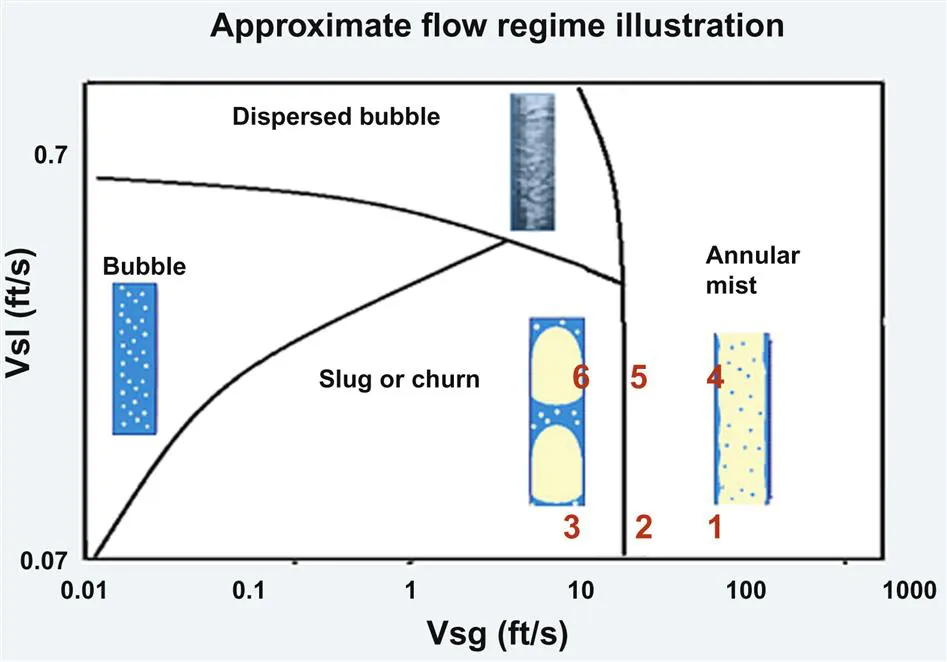
For above what numbers in bold indicate: (all for 2 3/8’s tubing)
1: 88 bbls/Mscf, 50 psi, velocity for 320 Mscf/D, 120°F;
2: 88 bbls/Mscf/100 psi, velocity for 320 Mscf/D, 120°F;
3: 88 bbls/Mscf, 200 psi, velocity for 320 Mscf/D, 120°F;
4: 200 bbls/Mscf, 100 psi, velocity for 320 Mscf/D, 120°F;
5: 200 bbls/Mscf, 50 psi, velocity for 320 Mscf/D, 120°F;
6: 200 bbls/Mscf/50 psi, velocity for 320 Mscf/D, 120°F.
Coincidentally the rate of 320 Mscf/D at 100 psi is the critical for 2 3/8 tubing. When pressure (200 psi), the point drops below critical and the line between annular and slug/churn for both values of bpd/Mscf. When the pressure is less than 100 psi, the velocity is more than critical for both 88 and 200 bbls/Mscf liquid/gas fractions. In Chapter 3 and Appendix B the expression derived and used for critical velocity and rate is independent of the liquid/gas fraction and this shows why the critical, without this dependency, is still shown to work in this example.
This example uses an approximate flow regime map and if one is to use the flow regime chart to suggest if an operational point is above/below critical (in Annular Mist or not), then one should find a flow regime chart that is tested to agree with well data.
More details will be shown on the critical velocity and critical rate. Also it will be shown that Nodal Analysis (Chapter 4) can infer above/below critical or not. However, this example ties the critical to the multiphase aspects of the calculated critical rate. It is shown that the flow regime map, the calculated critical rate/velocity model, and Nodal Analysis will be predictive techniques for critical rate and under what conditions liquid loading can occur.
A well may initially have a high gas rate so that the flow regime is in mist flow in the tubing near the surface, but is more liquid rich flow regimes in the tubing at depth. As time increases and production declines, the flow regimes from perforations to surface will change as the gas velocity decreases. Liquid production may also increase as the gas production declines.
Flow at surface will remain in mist flow until the conditions change sufficiently at the surface so that the flow exhibits a more liquid rich regime such as slug flow. At this point, the well production will be observed to become somewhat erratic, progressing to slug flow as gas rate continues to decline. This will often be accompanied by a marked increase in the decline rate. Note this type of analysis is more complicated than presented here as conditions in a well can be different from the surface to the bottom hole of the well. For instance liquids may be starting to accumulate in a more liquid-rich flow pattern downhole and the conditions uphole can still be in mist flow.
Eventually, the unstable slug flow at surface will transition to a stable, fairly steady production rate again as the gas rate declines further. This occurs when the gas rate is too low to carry liquids to surface and simply bubbles up through a stagnant liquid column at the bottm of the well.
If corrective action is not taken, the well will continue to decline and eventually log off. It is also possible that the well continues to flow for a long period in a loaded condition with gas produces up through liquids with no liquids coming to the surface. Note that the well can continue to flow below critical, sometimes for a long time, but it would flow more if the liquid loading problem could be solved.
1.3 Liquid loading
Nearly all gas wells produce some liquids even if the rate of liquid production is small; if the gas velocity is below the critical (to be defined in more detail in Chapter 3), then the well will experience liquid loading. In other words, liquids will accumulate in the wellbore and reduce production. This is shown by the fact that there are many gas wells on plunger lift that produce 5 or less bpd of liquids. If not on plunger, they will produce less or no gas. Critical velocity correlations (Chapter 3) do not require the liquid rate as an input. If more liquid is being produced then once below the critical the well can load faster. If little liquids are still being produced below critical, the well will eventually liquid load. Liquid loading modeling is sensitive to the liquid rate when using Nodal Analysis (Chapter 4).
1.4 Deliquification techniques
The below list1 (modified) introduces some of the possible methods to deliquefy gas wells that will be discussed in this book. These methods may be used singly or in combination in some cases.
- • Initial high rates (for unconventional well on sharp decline)
Unconventional wells may come in high rates initially which are well above critical rate. For maximum PVP (present value profit) use Nodal to look at flow up casing, flow up casing/tubing annulus and to look at tubing size effect on flow. Some operators are considering annular gas lift and high-pressure gas to boost the high rates. Most of the profits from unconventional ...
Table of contents
- Cover image
- Title page
- Table of Contents
- Copyright
- 1. Introduction
- 2. Recognizing symptoms of liquid loading in gas wells
- 3. Critical velocity
- 4. Nodal Analysis: Analyzing loaded wells
- 5. Compression
- 6. Plunger lift
- 7. Hydraulic pumping
- 8. Liquid unloading using chemicals for wells and pipelines
- 9. Progressing cavity pumps
- 10. Use of beam pumps to deliquefy gas wells
- 11. Gas lift
- 12. Electrical submersible pumps
- 13. Coal bed methane (CBM) and shale
- 14. Production automation
- Appendix A. Development of critical velocity equations
- Appendix B. Nodal concepts and stability concerns
- Appendix C. Plunger troubleshooting procedures
- Appendix D. Gas lift terminology
- Index
Frequently asked questions
Yes, you can cancel anytime from the Subscription tab in your account settings on the Perlego website. Your subscription will stay active until the end of your current billing period. Learn how to cancel your subscription
No, books cannot be downloaded as external files, such as PDFs, for use outside of Perlego. However, you can download books within the Perlego app for offline reading on mobile or tablet. Learn how to download books offline
Perlego offers two plans: Essential and Complete
- Essential is ideal for learners and professionals who enjoy exploring a wide range of subjects. Access the Essential Library with 800,000+ trusted titles and best-sellers across business, personal growth, and the humanities. Includes unlimited reading time and Standard Read Aloud voice.
- Complete: Perfect for advanced learners and researchers needing full, unrestricted access. Unlock 1.5M+ books across hundreds of subjects, including academic and specialized titles. The Complete Plan also includes advanced features like Premium Read Aloud and Research Assistant.
We are an online textbook subscription service, where you can get access to an entire online library for less than the price of a single book per month. With over 1.5 million books across 990+ topics, we’ve got you covered! Learn about our mission
Look out for the read-aloud symbol on your next book to see if you can listen to it. The read-aloud tool reads text aloud for you, highlighting the text as it is being read. You can pause it, speed it up and slow it down. Learn more about Read Aloud
Yes! You can use the Perlego app on both iOS and Android devices to read anytime, anywhere — even offline. Perfect for commutes or when you’re on the go.
Please note we cannot support devices running on iOS 13 and Android 7 or earlier. Learn more about using the app
Please note we cannot support devices running on iOS 13 and Android 7 or earlier. Learn more about using the app
Yes, you can access Gas Well Deliquification by James F. Lea Jr.,Lynn Rowlan,James F. Lea, Jr. in PDF and/or ePUB format, as well as other popular books in Business & Natural Resource Extraction Industry. We have over 1.5 million books available in our catalogue for you to explore.