- 444 pages
- English
- ePUB (mobile friendly)
- Available on iOS & Android
eBook - ePub
Anthropometry, Apparel Sizing and Design
About this book
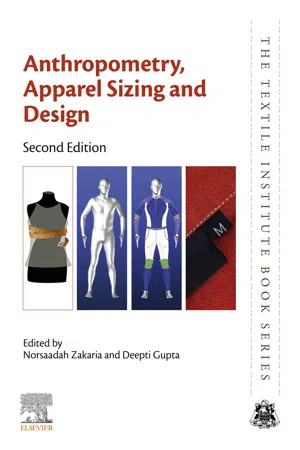
Anthropometry, Apparel Sizing and Design, Second Edition, reviews techniques in anthropometry, sizing system developments, and their applications to clothing design. The book addresses the need for the improved characterization of population size, weights and the shapes of consumers. This new edition presents the very latest advances, and is expanded to include in-depth coverage of sizing and fit for specific groups and applications. Sections cover the development of sizing systems, classification and body types, the use of anthropometric data, body measurement devices and techniques, including 3D scanners for the full body and for particular body parts, 4D scanning technology and motion analysis.
Additional sections cover testing and the evaluation of fit and anthropometric sizing systems for particular functions, thus reflecting the increasing need for apparel to meet specific needs, such as in swimwear, protective clothing, mobility, intimate apparel, footwear and compression garments.
This book will be an essential reference source for apparel designers, manufacturers, retailers and merchandisers. Its detailed information and data will also be of great interest to researchers and postgraduate students across clothing technology, product design, fashion and textiles.
- Reviews methods and techniques in anthropometry, sizing system development, and applications in clothing design
- Enables users to understand and utilize detailed anthropometric data
- Covers sizing and fit for particular uses, including protective clothing, compression garments, intimate apparel and footwear
Information
Part One
Anthropometry and garment sizing systems
1
New directions in the field of anthropometry, sizing and clothing fit
Deepti Gupta Department of Textile Technology, Indian Institute of Technology Delhi, New Delhi, India
Abstract
Rapid technological developments in the field of anthropometry, patternmaking, garment production, and fit evaluation continue to transform the way garments are produced, sold, and purchased across physical and online retail platforms. Increasing digitalization of all operations in the garment supply chain, particularly the process of measuring the body by scanning and development of 3-D avatars of individual customers, has revolutionized the field. These technologies are helping to bridge the communication gap between the producer and customer by providing real-time two-way communication. Control seems to be moving from the manufacturer into the hands of the customer, and there is an increasing trend for mass customization vis-à-vis mass-produced goods. Successful adoption of new technologies in garment production requires collaboration, mastery of new skills, commitment, and intellectual daring. This transformation of the industry will lead to an amalgamation of creative and engineering fields, creating a new breed of designer engineers and others with new skill sets.
Keywords
Anthropometry; Body scanning; Body shape; Garment production; Fit; Sizing
List of Abbreviations
1-D one-dimensional
2-D two-dimensional
3-D three-dimensional
4-D four-dimensional
RTW ready to wear
CAESAR Civilian American and European Surface Anthropometry Resource project
MTM made to measure
CAD computer-aided design
AI artificial intelligence
WEAR World Engineering Anthropometry Resource
SMPL skinned multiperson linear model
XR extended reality
Acknowledgments
The author is highly thankful to Kanika Jolly for preparing the images for the chapter.
1.1 Introduction
The apparel manufacturing industry is concerned with the process of producing garments that fit the customers for whom they are intended. The method comprises several steps such as anthropometry or measuring the body, patternmaking or translating the measures into 2-D patterns, assembling or joining the patterns to make a 3-D shell, and fit testing or draping the shell on the 3-D form to assess how the garment looks and interacts with the body (Efrat, 1982). Rapid technological advances have taken place in each of these fields, and almost all operations have been digitalized.
Manual anthropometric tools yielding linear dimensions have been replaced by noncontact, full-body 3-D scanners that record hundreds of dimensions in a matter of seconds. Body scanners, in turn, are becoming smaller, more mobile, and smarter by the day. Scan data have, for the first time allowed designers and patternmakers to see what real bodies look like in 3-D and how they differ from the idealized models used in the fitting room. In addition to 3-D data, 4-D body movement data are also becoming available. Though studies with 4-D data are still limited, the technology has immense applications in the field of functional clothing.
Powerful software that can analyze and process scan data to offer deep insights regarding the diversity of human body shapes is available. Data repositories have been created to store, segregate, and process 1-D, 3-D, and 4-D anthropometric data. These repositories are, as of now, small, local, or national but will grow to include international data and become more intelligent as they accumulate data. Advanced data mining techniques can process and retract data of specific populations for customized applications.
The process of patternmaking, considered so far to be a mix of art and science, is now wholly digitalized. Complete automation wherein patterns can be generated directly from body scans has not been accomplished yet, but it is possible to sketch garments directly on a 3-D avatar. The virtual garment thus created can be flattened out into 2-D pattern pieces through a series of operations, and the pattern pieces can be draped back on the virtual form to test the fit.
Drawing patterns on real bodies allows the designer to see and understand the peculiarities in body shape of specific population groups such as plus-size individuals or senior women. Accordingly, they can modify the patterns to suit the requirements of each body type. Inclusion of body movement data and availability of animated, real body parametric avatars into the patternmaking process will bring about a paradigm shift in how garments are designed. Designers are using these tools to study the effect of body posture and movement on the shape and body dimensions of swimmers, wheelchair-bound individuals, military personnel, fire fighters, or skiiers. Marginalized population groups who are unable to fit currently into clothes produced for idealized bodies will be able to get clothes specially designed for them. While on one hand their needs would be met, on the other hand, it will open up new market segments for the garment industry.
Traditional flat patterns that are the backbone of RTW industry are produced from linear measures using simple rules that are known to all pattern makers. However, the form and number of patterns created from 3-D avatars are varied and significantly different from the conventional blocks used by patternmakers. The way these pattern pieces are joined to create a complete piece of clothing determines the final look and fit of the garment.
Fit, defined as the relationship between an individual and their clothing, affects the comfort, appearance, performance, and self-esteem of the user. A well-fitted garment is produced from a...
Table of contents
- Cover image
- Title page
- Table of Contents
- Copyright
- Contributors
- Part One: Anthropometry and garment sizing systems
- Part Two: Body measurement devices and techniques
- Part Three: Testing and evaluation of fit
- Part Four: Designing for specific functions
- Index
Trusted by 375,005 students
Access to over 1.5 million titles for a fair monthly price.
Study more efficiently using our study tools.
Frequently asked questions
Yes, you can cancel anytime from the Subscription tab in your account settings on the Perlego website. Your subscription will stay active until the end of your current billing period. Learn how to cancel your subscription
No, books cannot be downloaded as external files, such as PDFs, for use outside of Perlego. However, you can download books within the Perlego app for offline reading on mobile or tablet. Learn how to download books offline
We are an online textbook subscription service, where you can get access to an entire online library for less than the price of a single book per month. With over 1.5 million books across 990+ topics, we’ve got you covered! Learn about our mission
Look out for the read-aloud symbol on your next book to see if you can listen to it. The read-aloud tool reads text aloud for you, highlighting the text as it is being read. You can pause it, speed it up and slow it down. Learn more about Read Aloud
Yes! You can use the Perlego app on both iOS and Android devices to read anytime, anywhere — even offline. Perfect for commutes or when you’re on the go.
Please note we cannot support devices running on iOS 13 and Android 7 or earlier. Learn more about using the app
Please note we cannot support devices running on iOS 13 and Android 7 or earlier. Learn more about using the app
Yes, you can access Anthropometry, Apparel Sizing and Design by Norsaadah Zakaria,Deepti Gupta in PDF and/or ePUB format, as well as other popular books in Technology & Engineering & Materials Science. We have over 1.5 million books available in our catalogue for you to explore.