- 204 pages
- English
- ePUB (mobile friendly)
- Available on iOS & Android
eBook - ePub
About this book
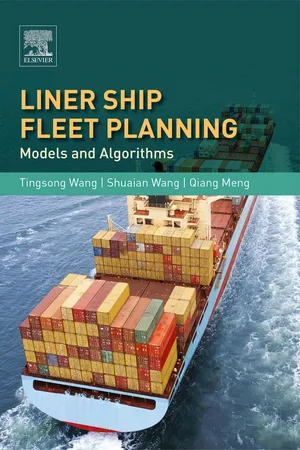
Liner Ship Fleet Planning: Models and Algorithms systematically introduces the latest research on modeling and optimization for liner ship fleet planning with demand uncertainty. Container shipping companies have struggled since the financial crisis of 2007-2008, making it critical for them to make informed decisions about their fleet planning and development.
Current and future shipping professionals require systematic approaches for investigating and solving their fleet planning problems, as well as methodologies for addressing their other shipping responsibilities. Liner Ship Fleet Planning addresses these needs, providing the most recent quantitative research of liner shipping in maritime transportation. The research and methods provided assist those tasked with optimizing shipping efficiency and fleet deployment in the face of uncertain demand. Suitable for those with any level of quantitative background, the book serves as a valuable resource for both maritime academics, and shipping professionals involved in planning and scheduling departments.
- Introduces the latest research on maritime transportation problems
- Analyzes problems of liner ship fleet planning, taking uncertainty into account
- Promotes the use of mathematics to manage uncertainty, using stochastic programming models, and proposing solution algorithms to solve proposed models
- Includes case studies that provide detailed examples of real-world examples of fleet optimization
- Explains how stochastic programming modeling methods and solution algorithms can be applied to other research fields featuring uncertainty, such as container yard planning, berth allocation and vehicle deployment problems
Information
Part One
Introduction
Chapter One
Introduction to Shipping Services
Abstract
This chapter gives a comprehensive introduction to shipping services. The reader will learn about the development of seaborne trade and its structure, the container and container trade, the maritime transportation and its three modes, and the shipping service and design of liner operations.
Keywords
Seaborne trade; Container trade; Maritime transportation; Liner shipping
Seaborne Trade
Development of Seaborne Trade
Seaborne trade refers to goods that are transported by ships. It is the main artery, in a sense, of international trade, standing at the apex of the world's economic activity. The increasing globalization and interdependence of various world economies are leading to tremendous positive growth in the seaborne trade industry. According to the maritime transportation report released in 2015 by the United Nations Conference on Trade and Development (UNCTAD) secretariat, the volume of world seaborne shipments in 2014 increased by 3.4% over 2013. This increase is moderate because of the slow-moving recovery of the world economy, which is due to both an uneven economic recovery rate in developed countries and a slowdown in the economic growth rate in developing countries. The world's economic growth still has significant impact on the seaborne trade volumes; even the responsiveness of merchandise trade to the world's GDP growth is moderate in recent years. According to the review of maritime transport produced by UNCTAD, international seaborne trade increased from 5.983 billion tons in 2000 to 9.842 billion tons in 2014, showing a 3% annual average growth rate during the last 4 years (Review of Maritime Transportation, 2015). The trend in the growth rate of international seaborne trade for selected years is shown in Table 1.1.
Table 1.1
Developments in International Seaborne Trade, Selected Years (millions of tons loaded)
| Year | Oil and Gas | Main Bulksa | Other Dry Cargo | Total |
| 1970 | 1440 | 448 | 717 | 2605 |
| 1980 | 1871 | 608 | 1225 | 3704 |
| 1990 | 1755 | 988 | 1265 | 4008 |
| 2000 | 2163 | 1295 | 2526 | 5984 |
| 2005 | 2422 | 1709 | 2978 | 7109 |
| 2006 | 2698 | 1814 | 3188 | 7700 |
| 2007 | 2747 | 1953 | 33... |
Table of contents
- Cover image
- Title page
- Table of Contents
- Copyright
- About the Authors
- Preface
- Acknowledgments
- Part One: Introduction
- Part Two: Mathematical Modeling
- Part Three: Solution Algorithms
- Part Four: Case Studies
- Part Five: Conclusion
- Index
Trusted by 375,005 students
Access to over 1.5 million titles for a fair monthly price.
Study more efficiently using our study tools.
Frequently asked questions
Yes, you can cancel anytime from the Subscription tab in your account settings on the Perlego website. Your subscription will stay active until the end of your current billing period. Learn how to cancel your subscription
No, books cannot be downloaded as external files, such as PDFs, for use outside of Perlego. However, you can download books within the Perlego app for offline reading on mobile or tablet. Learn how to download books offline
Perlego offers two plans: Essential and Complete
- Essential is ideal for learners and professionals who enjoy exploring a wide range of subjects. Access the Essential Library with 800,000+ trusted titles and best-sellers across business, personal growth, and the humanities. Includes unlimited reading time and Standard Read Aloud voice.
- Complete: Perfect for advanced learners and researchers needing full, unrestricted access. Unlock 1.5M+ books across hundreds of subjects, including academic and specialized titles. The Complete Plan also includes advanced features like Premium Read Aloud and Research Assistant.
We are an online textbook subscription service, where you can get access to an entire online library for less than the price of a single book per month. With over 1.5 million books across 990+ topics, we’ve got you covered! Learn about our mission
Look out for the read-aloud symbol on your next book to see if you can listen to it. The read-aloud tool reads text aloud for you, highlighting the text as it is being read. You can pause it, speed it up and slow it down. Learn more about Read Aloud
Yes! You can use the Perlego app on both iOS and Android devices to read anytime, anywhere — even offline. Perfect for commutes or when you’re on the go.
Please note we cannot support devices running on iOS 13 and Android 7 or earlier. Learn more about using the app
Please note we cannot support devices running on iOS 13 and Android 7 or earlier. Learn more about using the app
Yes, you can access Liner Ship Fleet Planning by Tingsong Wang,Shuaian Wang,Qiang Meng in PDF and/or ePUB format, as well as other popular books in Social Sciences & Sociology. We have over 1.5 million books available in our catalogue for you to explore.