eBook - ePub
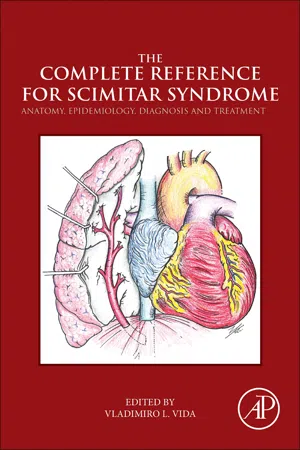
The Complete Reference for Scimitar Syndrome
Anatomy, Epidemiology, Diagnosis and Treatment
- 192 pages
- English
- ePUB (mobile friendly)
- Available on iOS & Android
eBook - ePub
The Complete Reference for Scimitar Syndrome
Anatomy, Epidemiology, Diagnosis and Treatment
About this book
The Complete Reference for Scimitar Syndrome: Anatomy, Epidemiology, Diagnosis and Treatment gives the complete picture of this rare syndrome that is usually treated with tactics such as imaging. The book goes beyond imaging, providing a pathological and clinical description of this rare syndrome. All aspects beginning with development, clinical presentation, current surgical options (including recent techniques) and indications to treat patients based on current results coming from multicenter study experiences are included. This book is a must-have reference for all cardiologists, cardiac surgeons, thoracic surgeons, pathologists, physicians, residents and students involved in Scimitar Syndrome cases.
- Includes diagnostic features and surgical techniques based on the international scimitar registry
- Gives a complete picture of the various aspects of this rare congenital heart malformation that focuses on recent therapeutic results
- Provides insights into current medical and surgical outcomes
Part A
Scimitar Syndrome
Chapter 1
Introduction and Definition
Vladimiro L. Vida University of Padua, Padua, Italy
Abstract
Scimitar syndrome (SS) is a rare congenital heart defect (CHD) characterized by anomalous venous drainage of part or all of the right lung to the inferior vena cava, variable right lung hypoplasia, and variable systemic blood supply to part of the right lung.
Keywords
Congenital heart disease; Pulmonary hypoplasia; Scimitar syndrome
1.1. Introduction
In 2006–07, I spent a period of time at the Children’s Hospital, Harvard Medical School, Boston, as “senior fellow” and “chief resident” in cardiac surgery. At that time, Dr. PJ Del Nido, chief of the pediatric cardiac surgery unit called me to his office because he needed some language translation with an Italian lady, Rita Martini, who came into touch with him because of her rare congenital heart disease, the scimitar syndrome (SS).
After that, Rita told me that she was confused because in Italy she was not able to find someone who could help her in the management and treatment of her heart malformation; furthermore, she was not able to find a consistent scientific document treating the various aspects of her rare cardiac malformation. For this reason, she decided to get in touch with the chief of one of the leading pediatric and congenital heart centers in North America and she ended up coming over to Boston for her treatment. In those days I had the privilege to assist Dr. Del Nido during the operation and to take part in Rita’s postoperative care till discharge.
Rita is an active and brilliant lady, and after coming back from the United States she decided to found a nonprofit association in Italy called “Amici della Scimitarra, ONLUS” (translated: friends of scimitar association) to create a network among patients with this rare disease and their families in order to share information, experiences, and knowledge.
Once I finished my training period in the United States, I decided to get more information on SS and I embarked on a couple of multiinstitutional studies, at a national and international basis, to evaluate surgical results and follow-up outcomes of these patients, and eventually in a multicenter study evaluating the clinical outcome of patients with SS who didn’t undergo surgical correction of their anomalous pulmonary venous connection. Eventually I decided to coordinate a group of international experts about the anatomy, embryology, diagnosis, and treatment of this rare syndrome, putting together their knowledge to build up a consistent document on this topic, treating also other rare pulmonary vascular malformations such as pulmonary sequestration, horseshoe lung, anomalous arterious supply to the normal lung, and the persistent primitive hepatic venous plexus.
1.2. Definition
A scimitar is a curved oriental sword with an edge on the convex side (from French “cimaterre,” from Italian “scimitarra,” from Spanish “cimitarra,” and from Persian “simsir”) [1] (Fig. 1.1).
SS is a rare association of congenital cardiopulmonary anomalies consisting of a partial or total anomalous pulmonary venous connection of the right lung to the inferior vena cava, right lung hypoplasia and a systemic arterial supply of variable hemodynamic importance to the right lung [2–5].

Figure 1.1 The curved oriental sword with an edge on the convex side, named scimitar.
The origin of the name “scimitar” comes from the curvilinear shadow along the posterior-anterior chest X-ray, representing the anomalous pulmonary venous connection of the hypoplastic right lung [6,7] (Fig. 1.2).

Figure 1.2 Plain chest X-ray showing the curvilinear shadow along the posterior-anterior on the right hemithorax, representing the anomalous pulmonary venous connection of the hypoplastic right lung.
In fact, the intrathoracic course of the right anomalous pulmonary venous connection, descending toward the inferior vena cava appears as a radio-opaque waning moon gradually widening from the pulmonary hilum toward the cardiophrenic angle.
This syndrome is also known as Halasz syndrome, mirror-image lung syndrome, hypogenetic lung syndrome, epi-bronchial right pulmonary artery syndrome, vena cava bronchovascular syndrome, or congenital pulmonary veno-lobar syndrome [3,8,9].
Chapter 2
Historical Notes
Gaetano Thiene University of Padua, Padua, Italy
Abstract
From the first observation in 1836 to nowadays, the scimitar syndrome has been described by many eminent authors throughout different countries. Its name was eventually christened in the 1960 and has remained unchanged to underline its specific conformation among pulmonary vascular abnormalities.
Keywords
History; Scimitar syndrome
The first anatomical observation of this peculiar anomalous venous connection was described by George Cooper [1] in the United Kingdom and by Raoul Chassinat in France [2], both in 1836.
George Cooper was an English pathologist who reported the autopsy findings of an “imperfect development of the right lung with malposition of the heart’’ in a 10-month-old girl with right pulmonar...
Table of contents
- Cover image
- Title page
- Table of Contents
- Copyright
- List of Contributors
- Foreword
- Part A. Scimitar Syndrome
- Part B. Pulmonary Vascular Anomalies
- Index
Trusted by 375,005 students
Access to over 1.5 million titles for a fair monthly price.
Study more efficiently using our study tools.
Information
Publisher
Academic PressYear
2017Topic
MedicinePrint ISBN
9780128104064
Subtopic
CardiologyeBook ISBN
9780128104071
Frequently asked questions
Yes, you can cancel anytime from the Subscription tab in your account settings on the Perlego website. Your subscription will stay active until the end of your current billing period. Learn how to cancel your subscription
No, books cannot be downloaded as external files, such as PDFs, for use outside of Perlego. However, you can download books within the Perlego app for offline reading on mobile or tablet. Learn how to download books offline
Perlego offers two plans: Essential and Complete
- Essential is ideal for learners and professionals who enjoy exploring a wide range of subjects. Access the Essential Library with 800,000+ trusted titles and best-sellers across business, personal growth, and the humanities. Includes unlimited reading time and Standard Read Aloud voice.
- Complete: Perfect for advanced learners and researchers needing full, unrestricted access. Unlock 1.5M+ books across hundreds of subjects, including academic and specialized titles. The Complete Plan also includes advanced features like Premium Read Aloud and Research Assistant.
We are an online textbook subscription service, where you can get access to an entire online library for less than the price of a single book per month. With over 1.5 million books across 990+ topics, we’ve got you covered! Learn about our mission
Look out for the read-aloud symbol on your next book to see if you can listen to it. The read-aloud tool reads text aloud for you, highlighting the text as it is being read. You can pause it, speed it up and slow it down. Learn more about Read Aloud
Yes! You can use the Perlego app on both iOS and Android devices to read anytime, anywhere — even offline. Perfect for commutes or when you’re on the go.
Please note we cannot support devices running on iOS 13 and Android 7 or earlier. Learn more about using the app
Please note we cannot support devices running on iOS 13 and Android 7 or earlier. Learn more about using the app
Yes, you can access The Complete Reference for Scimitar Syndrome by Vladimiro Vida in PDF and/or ePUB format, as well as other popular books in Medicine & Cardiology. We have over 1.5 million books available in our catalogue for you to explore.