- 100 pages
- English
- ePUB (mobile friendly)
- Available on iOS & Android
eBook - ePub
Western Blotting Guru
About this book
Western Blotting Guru provides researchers in molecular biology with a handy reference for approaching and solving challenging problems associated with immunoblotting setup and optimization. As a laboratory guide, it emphasizes the technical aspects of efficiently employing immunoblotting as a tool in molecular biology laboratories. The book covers the basic science underlying immunoblotting and detailed description of the method parameters, followed by good benchtop practices, tips and tricks for obtaining high-quality data and a detailed troubleshooting guide addressing a variety of problem types.
- Provides a benchtop reference that every molecular biologists will use to design, optimize, troubleshoot and analyze their immunoblotting experiments
- Contains unique good practices and tips that are indispensable for the beginner and expert alike
- Features special cases with applications of immunoblotting optimization
- Includes detailed appendices with tables, figures and key protocols
- Provides troubleshooting tips for various types of modifications of standard protocols
- Organized as a systematic, concentrated resource to save time when addressing an immunoblotting problem
Trusted by 375,005 students
Access to over 1.5 million titles for a fair monthly price.
Study more efficiently using our study tools.
Information
Topic
MedicineSubtopic
Biochemistry in MedicineChapter 1
Introduction
Abstract
This chapter introduces the reader to the origins of Western blotting, also known as immunoblotting. Western blotting is a popular technique among many disciplines of science. It allows the researcher to detect and quantify specific proteins using antibodies as probes. General information about this widely used technique and its applications are illustrated.
Keywords
Western blotting; immunoblotting; Harry Towbin; W. Neal Burnette; George Stark
Only those who dare, drive the world forward.
—Cadillac, Dare Greatly
The superior man is satisfied and composed; the mean man is always full of distress.
—Confucius
1.1 What is Western Blotting?
Western blotting (or immunoblotting) is a widely used method for protein detection, using antibody-based probes to obtain specific information about target proteins from complex samples. It is a routine method in molecular biology, biochemistry, and cell biology fields with a multitude of applications. This method can be used to obtain information about quantity, molecular weight, and post-translational modifications of proteins. Due to high affinities of antibody toward their epitopes and amplificatory nature of Western blotting, it is a very sensitive method and even picogram quantities of target proteins can be detected. Depending on the type of reagents used, Western blotting can be quantitative or semiquantitative (see Chapter 6: Special Cases for quantitative Western blotting).
1.2 A Bit of History
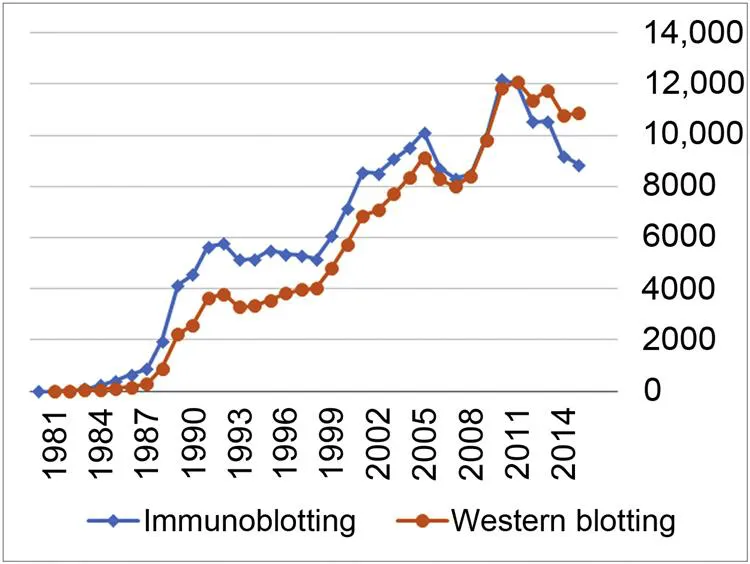
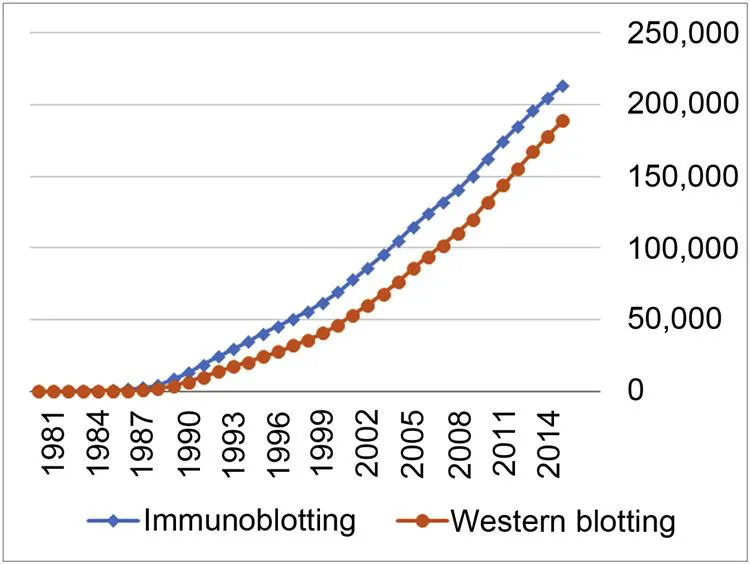
The ancestral versions of the modern Western blotting were first described by two laboratories in 1979:Harry Towbin and colleagues at the Friedrich Miescher Institute, Basel/Switzerland and George Stark and colleagues at Stanford University, California/USA. A more improved version of the method was developed and the name “Western blotting” was given in 1981 by W. Neal Burnette at the Fred Hutchinson Cancer Research Center Washington/USA, simply because of the location of the laboratory on the west coast of the USA, as a word play to the previously invented Southern blotting method for DNA detection, in 1975, and Northern blotting method, for RNA detection, in 1977. According to Google Scholar, Towbin’s landmark paper has been cited more than 54,000 times in the last 38 years (Figures 1.1–1.3).

Chapter 2
Procedure
Abstract
This chapter focuses on introducing the reader to the Western blotting procedure and gives the basic principles and information behind every step in the procedure. Sodium dodecyl sulfate–polyacrylamide gel electrophoresis, gel preparation, sample preparation, resolution of proteins using gel electrophoresis, protein electrotransfer, and antibody selection and validations are described in detail.
Keywords
SDS–PAGE; gel electrophoresis; polyacrylamide gels; gel running; transfer; PVDF; nitrocellulose; primary antibody; secondary antibody; ECL; quantitative Western blotting
The young do not know enough to be prudent, and therefore they attempt the impossible—and achieve it, generation after generation.
—Pearl S. Buck
In a moment of decision, the best thing you can do is the right thing to do. The worst thing you can do is nothing.
—Theodore Roosevelt
Inspiration usually comes during work, rather than before it.
—Madeleine L’Engle
There are five major steps in the Western blotting procedure (Fig. 2.1), and every step is critical for obtaining high-quality, reliable, and analyzable data.

2.1 Sample Preparation
Cell or tissue lysates can be prepared in several different ways (see Appendices H and I), using either denaturing or native lysis buffers. Protein samples are best prepared using fresh lysis buffers in the presence of protease and phosphatase inhibitors to avoid the degradation of target proteins by proteases or dephosphorylation, if one is interested in probing for phosphorylated proteins. Protein samples should always be kept on ice to minimize degradation and dephosphorylation. For native lysate storage (e.g. to preserve protein activity or protein complex assembly), 0.27 M sucrose- or 10% glycerol-containing samples can be snap-frozen in liquid nitrogen and stored at −80°C. After clearing the lysates by centrifugation at 16,000×g, 15 minutes, 4°C, protein concentration can be determined via Bradford protein assay or Bicinchoninic acid assay (BCA). BCA is less variable and less susceptible to detergents than Bradford, while Bradford assay has a simpler and faster procedure. After the protein concentrations are quantified, the samples can be prepared for loading into the gels by supplementing the lysates with 5× sodium dodecyl sulfate–polyacrylamide gel electrophoresis (SDS–PAGE) sample buffer to achieve a final concentration of 1× (see Appendix A). 1× SDS–PAGE sample buffer can be used to equalize all the protein and sample buffer concentrations across samples.
One important aspect of sample preparation is the final protein concentration of the samples. Typically, 10–50 µg of total lysate protein per well should be loaded. Thus, the sample concentration should be between 1 and 2.5 mg/mL, in order to be able to load 10–20 µL per well. Samples should be normalized to have the same concentration, so that the loading volume is consistent across the samples in a gel. If the loading volume changes between samples, it will affect the running of each sample. For example, a higher volume sample can interfere with the running of a sample that has low volume. After the samples are prepared, they should be denatured and spun down (see Appendix C). Proteins in sample buffer can be stored at −20°C.
2.2 Gel Electrophoresis
SDS–PAGE is a method that allows resolution of denatured proteins by their molecular weight (MW), using an electric field and a porous acrylamide-based matrix. To prepare the proteins for gel electrophoresis, the protein extracts are mixed with SDS, an anionic detergent that binds uniformly to proteins—approximately one SDS molecule for every two amino acid residues. Addition of SDS results in disruption of the tertiary structure of proteins into linear molecules and proteins become coated with a negative charge. To further unfold proteins, thiol (–SH) group containing compounds such as β-mercaptoethanol or dithiothreitol are also employed in order to reduce the disulfide bonds present in many proteins. Finally, sam...
Table of contents
- Cover image
- Title page
- Table of Contents
- Copyright
- Preface
- Note to the Reader
- Chapter 1. Introduction
- Chapter 2. Procedure
- Chapter 3. Good Practices
- Chapter 4. Optimization and Troubleshooting
- Chapter 5. Tips and Tricks
- Chapter 6. Special Cases
- Chapter 7. Data Analysis, Storage, Retrieval
- Appendix A. Buffers and Solutions
- Appendix B. SDS–PAGE Gel Tables
- Appendix C. SDS–PAGE Protocol
- Appendix D. Wet Transfer and Immunoblotting Protocol
- Appendix E. Home-Made Enhanced ChemiLuminescence (ECL) Detection
- Appendix F. Stripping Protocols
- Appendix G. Coomassie Staining Protocol
- Appendix H. Lysis of Cells Using Native Conditions
- Appendix I. Quick Denaturing Lysis Protocol
- Appendix J. Protein Tags
- Appendix K. Covalent Crosslinking of Antibodies to Beads
- References
Frequently asked questions
Yes, you can cancel anytime from the Subscription tab in your account settings on the Perlego website. Your subscription will stay active until the end of your current billing period. Learn how to cancel your subscription
No, books cannot be downloaded as external files, such as PDFs, for use outside of Perlego. However, you can download books within the Perlego app for offline reading on mobile or tablet. Learn how to download books offline
Perlego offers two plans: Essential and Complete
- Essential is ideal for learners and professionals who enjoy exploring a wide range of subjects. Access the Essential Library with 800,000+ trusted titles and best-sellers across business, personal growth, and the humanities. Includes unlimited reading time and Standard Read Aloud voice.
- Complete: Perfect for advanced learners and researchers needing full, unrestricted access. Unlock 1.5M+ books across hundreds of subjects, including academic and specialized titles. The Complete Plan also includes advanced features like Premium Read Aloud and Research Assistant.
We are an online textbook subscription service, where you can get access to an entire online library for less than the price of a single book per month. With over 1.5 million books across 990+ topics, we’ve got you covered! Learn about our mission
Look out for the read-aloud symbol on your next book to see if you can listen to it. The read-aloud tool reads text aloud for you, highlighting the text as it is being read. You can pause it, speed it up and slow it down. Learn more about Read Aloud
Yes! You can use the Perlego app on both iOS and Android devices to read anytime, anywhere — even offline. Perfect for commutes or when you’re on the go.
Please note we cannot support devices running on iOS 13 and Android 7 or earlier. Learn more about using the app
Please note we cannot support devices running on iOS 13 and Android 7 or earlier. Learn more about using the app
Yes, you can access Western Blotting Guru by Ayaz Najafov,Gerta Hoxhaj in PDF and/or ePUB format, as well as other popular books in Medicine & Biochemistry in Medicine. We have over 1.5 million books available in our catalogue for you to explore.