eBook - ePub
Single-Cell Omics
Volume 1: Technological Advances and Applications
- 490 pages
- English
- ePUB (mobile friendly)
- Available on iOS & Android
eBook - ePub
Single-Cell Omics
Volume 1: Technological Advances and Applications
About this book
Single-Cell Omics: Volume 1: Technological Advances and Applications provides the latest technological developments and applications of single-cell technologies in the field of biomedicine. In the current era of precision medicine, the single-cell omics technology is highly promising due to its potential in diagnosis, prognosis and therapeutics. Sections in the book cover single-cell omics research and applications, diverse technologies applied in the topic, such as pangenomics, metabolomics, and multi-omics of single cells, data analysis, and several applications of single-cell omics within the biomedical field, for example in cancer, metabolic and neuro diseases, immunology, pharmacogenomics, personalized medicine and reproductive health.
This book is a valuable source for bioinformaticians, molecular diagnostic researchers, clinicians and members of the biomedical field who are interested in understanding more about single-cell omics and its potential for research and diagnosis.
- Covers not only the technological aspects, but also the diverse applications of single cell omics in the biomedical field
- Summarizes the latest progress in single cell omics and discusses potential future developments for research and diagnosis
- Written by experts across the world, bringing different points-of-view and case studies to give a comprehensive overview on the topic
Trusted by 375,005 students
Access to over 1.5 million titles for a fair monthly price.
Study more efficiently using our study tools.
Information
Section II
Omics Technologies in Single-Cell
Chapter 6
An Overview of Single-Cell Isolation Techniques
Qudsia Zeb*; Ce Wang*; Sarfraz Shafiq†,‡; Liangyu Liu* * College of Life Sciences, Capital Normal University, and Beijing Key Laboratory of Plant Gene Resources and Biotechnology for Carbon Reduction and Environmental Improvement, Beijing, China
† Department of Paediatrics, Schulich School of Medicine and Dentistry, Western University, London, ON, Canada
‡ School of Life Sciences, Tsinghua University, Beijing, China
† Department of Paediatrics, Schulich School of Medicine and Dentistry, Western University, London, ON, Canada
‡ School of Life Sciences, Tsinghua University, Beijing, China
Abstract
Multicellular organisms are composed of different types of tissues and cells, and the conventional cell-based assays mainly represent the average response from a mixed population of cells. In this scenario, isolation of single-cell types from the whole organism is essential to better understand the phenomenon of cellular diversity and cell reprogramming. Therefore, a lot of effort have been made over the past few years to develop the methods of single-cell isolation, which now have become powerful tools for unraveling the mystery regulations of cell-specific genomics, transcriptomics, and proteomics. Current single-cell isolation techniques have their merits and demerits based on their yield, purity, cost, and application, and the technical problems for single-cell isolation vary between organisms and tissues. This chapter will summarize and evaluate the key features of available techniques for the isolation of single-cell types.
Keywords
Single-cell isolation; FACS; MACS; Laser-capture microdissection LMD/LCM; Microfluidics; INTACT; BITS-ChIP; Nu-TRAP; Targeted DamID (TaDa); Poly(A) mRNA tagging; TU tagging; Ribo-Tag/TRAP; miRAP
Acknowledgments
The writing of this chapter was supported by grants to Liangyu Liu from the National Natural Science Foundation of China (No. 31571258), the Sea Poly Project of Beijing Overseas Talents, and the Youth Innovative Research Team of Capital Normal University; and by grants to Sarfraz Shafiq from School of Life Sciences, Tsinghua University, Beijing 100084, China. Qudsia Zeb is supported by China Scholarship Council (CSC).
6.1 Introduction
Higher organisms are composed of multiple types of cells and tissues that have different gene expression profiles. Obtaining the precise genetic and biochemical information from the part of interest requires the isolation of a single type of cell or even a single-cell from the whole organism (Macaulay and Voet, 2014). For genetic and epigenetic analysis, it is essential to isolate the heterogeneous cancer cells from the tumor as well as to capture the shoot apical meristem (SAM) cells or stomata from the whole plants (Adrian et al., 2015; Cho et al., 2018; Torti et al., 2012). Especially for genome-wide analysis, the traditional transcriptome, epigenome, or proteome represents the average levels of all cell signals, which ignore cell-to-cell variation. Therefore, methods of single-cell-isolation play an important role in dissecting the unique cellular mechanisms in animals, plants, or microbe populations (Macaulay and Voet, 2014). Most plant genes express in a tissue/cell-specific manner. The flowering stimulus, Flowering Locus T (Piatkevich et al., 2018) protein as part of florigen, is synthesized in phloem cells of leaf vasculatures and moves up to plant SAM cells to induce flowering (Liu et al., 2014; Turck et al., 2008). It is also worth noting that animal cell lines that are extensively investigated for cis elements and epigenetic features lose the important developmental signals in the ENCODE (Encyclopedia of DNA Elements) project (Qu, 2013; Yavartanoo and Kyoon Choi, 2013). Even though the specific tissues are included as targets in this big project, we believe that in the near future more and more single types of cells from whole organisms will also be studied.
To follow up, one might ask how to isolate the single-cell. The sorting methods developed over the past few decades are mainly based on cell properties like cell size, surface antigen, and labeling tag. These target cells can be isolated with methods such as fluorescence-activated cell sorting (FACS), magnetic-activated cell sorting (MACS), microfluidics, and laser capture microdissection (LCM) (Sanz et al., 2009). Different isolation methods are adapted and varied depending on the organism, tissue, or cell being studied. This chapter summarizes and compares several popular methods of single-cell isolation.
6.2 Methods of Single-Cell Isolation
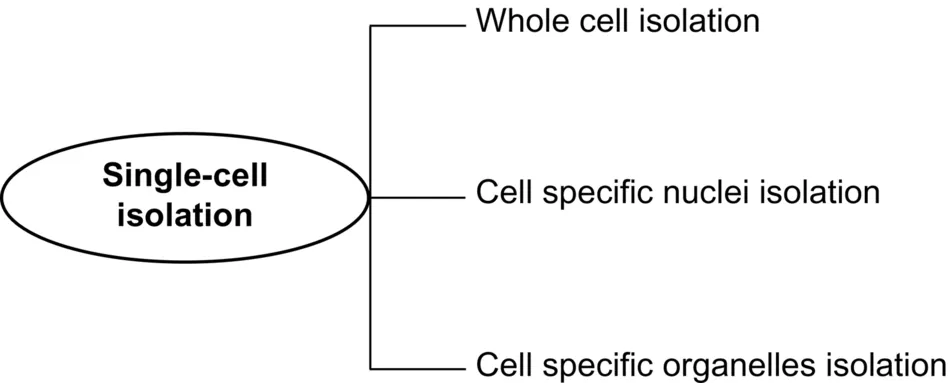
Single-cell sorting can be performed by the isolation of whole cells or cell-specific nuclei or cell-specific organelles (Fig. 6.1), and a number of approaches have been introduced for sorting the desired cells. However, their selection depends on cell type, acquisition cost, and single-cell yield. This section summarizes the most popular methods of cell sorting from living organisms and highlights the merits and demerits of each (Fig. 6.2).

6.2.1 Manual Micromanipulation
Manual isolation is a simple and robust single-cell isolation method. In motorized mechanical stages, micromanipulators use micropipettes and an inverted microscope to pick cells manually. The micropipettes are ultrathin glass capillaries that have an aspiration and dispensation unit. A micropipette is placed in close proximity to the cell, and the cell can be picked by sucking through the micropipette (Fig. 6.3A). The aspirated liquid that contains the cell is transferred to the collection vessel via dispensation. To ensure unbiased single-cell isolation, the isolated single-cell can be detected and snapped through the microscope. Micromanipulators are used to isolate embryo cells or live culture cells; this is different from LCM (a detailed introduction is given below), which is used to isolate cells from fixed tissue (Hu et al., 2016). To clone animals like the sheep Dolly and the monkeys Zhong-zhong and Hua-hua, the somatic cell nuclear transfer technique (SCNT) is adapted, and one of its critical steps is to capture the donated egg cell by micromanipulation (Kishigami and Wakayama, 2009). Additionally, in the electrophysiology lab, micromanipulation is feasible for use with the patch-clamp system (Citri et al., 2011; Eberwine et al., 1992). Micromanipulation is a fast and robust method, though its throughput is not very high. In addition, this method requires highly skilled professional training. Cells with complex structures, like neuronal cells, cannot be fully excised by micromanipulation, and sometimes the isolated cells can be impaired.

Table of contents
- Cover image
- Title page
- Table of Contents
- Copyright
- Contributors
- About the Editors
- Preface
- Section I: Overview of Single-Cell Omics
- Section II: Omics Technologies in Single-Cell
- Section III: Data Analysis in Single-Cell Omics
- Index
Frequently asked questions
Yes, you can cancel anytime from the Subscription tab in your account settings on the Perlego website. Your subscription will stay active until the end of your current billing period. Learn how to cancel your subscription
No, books cannot be downloaded as external files, such as PDFs, for use outside of Perlego. However, you can download books within the Perlego app for offline reading on mobile or tablet. Learn how to download books offline
Perlego offers two plans: Essential and Complete
- Essential is ideal for learners and professionals who enjoy exploring a wide range of subjects. Access the Essential Library with 800,000+ trusted titles and best-sellers across business, personal growth, and the humanities. Includes unlimited reading time and Standard Read Aloud voice.
- Complete: Perfect for advanced learners and researchers needing full, unrestricted access. Unlock 1.5M+ books across hundreds of subjects, including academic and specialized titles. The Complete Plan also includes advanced features like Premium Read Aloud and Research Assistant.
We are an online textbook subscription service, where you can get access to an entire online library for less than the price of a single book per month. With over 1.5 million books across 990+ topics, we’ve got you covered! Learn about our mission
Look out for the read-aloud symbol on your next book to see if you can listen to it. The read-aloud tool reads text aloud for you, highlighting the text as it is being read. You can pause it, speed it up and slow it down. Learn more about Read Aloud
Yes! You can use the Perlego app on both iOS and Android devices to read anytime, anywhere — even offline. Perfect for commutes or when you’re on the go.
Please note we cannot support devices running on iOS 13 and Android 7 or earlier. Learn more about using the app
Please note we cannot support devices running on iOS 13 and Android 7 or earlier. Learn more about using the app
Yes, you can access Single-Cell Omics by Debmalya Barh,Vasco Ariston De Car Azevedo,Vasco Azevedo in PDF and/or ePUB format, as well as other popular books in Medicine & Pharmaceutical, Biotechnology & Healthcare Industry. We have over 1.5 million books available in our catalogue for you to explore.